How do wedges split or separate materials?
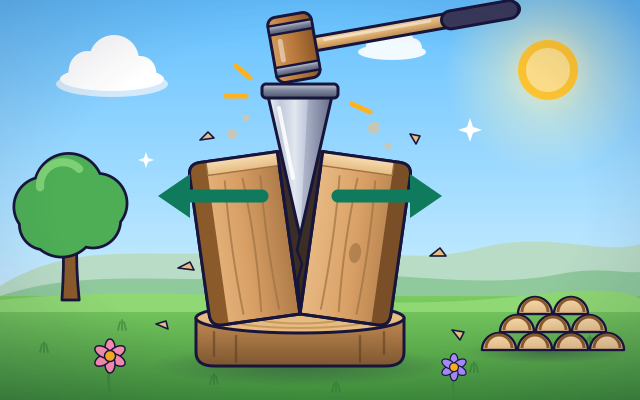
A wedge turns one push forward into two strong pushes sideways. That is how axes split logs and knives slice bread.
The big idea: A wedge is two ramps back to back. When you push it forward, its sloping sides push the material sideways, harder than you pushed.
It's like sliding your flat hand, fingertips first, between two couch cushions: as the thicker part of your hand goes in, the cushions are pushed apart sideways.
The interactive parts didn't load. The explanations below still work; try reloading the page.
How a wedge splits a log
- Maya wants firewood, but hitting the log with a flat mallet does nothing. The push is spread over the whole top. She needs a way to push the wood apart.
- This is a wedge: thin at one end, thick at the other. It is really two ramps stuck back to back. The thin edge slips into a tiny crack.
- When the mallet pushes the wedge down, the sloping sides push the wood sideways. One push down becomes two pushes out, and each is stronger than the push you gave.
- With every tap the wedge goes deeper and the gap gets wider. The crack runs ahead along the grain until the log falls into two pieces.
- A thin wedge is easy to push in, but it must go deep to open a wide gap. A fat wedge opens the gap quickly, but it needs a much harder push.
- Look around: an axe, a knife, a nail, a zipper slider and your front teeth are all wedges. A doorstop is a wedge too. It squeezes in and holds the door still.
Look inside a splitting log
The log is cut open so you can see the wedge inside. Tap each part to see it work.
- Sharp edge. The thin edge touches the wood on a tiny strip, so all the push is squeezed onto that strip. That is how it gets in to start the split.
- Sloping faces. The two sloping faces are like two ramps back to back. As the wedge moves down, they slide along the wood and push it out sideways.
- Flat head. The thick end is flat and wide, so it is easy to hit, and the mallet's push goes straight down the middle of the wedge.
- Mallet. The mallet gives the push. Its heavy head builds up speed in the swing, then passes its motion to the wedge in one sharp tap.
- The two sides. The wedge needs room, so the two sides of the log are pushed apart. The deeper the wedge goes, the wider the gap.
- Crack. The wood tears open in front of the edge. The crack races ahead, so the wedge does not have to cut all the way down.
- Wood grain. Wood is made of long fibers that run along the trunk, like a bundle of straws. It is much easier to push the fibers apart than to break them.
Thin wedge or fat wedge?
Pick a wedge and a block, then tap the mallet. Watch the green arrows: they show how hard the wedge pushes sideways.
Experiment: You push just as hard every time. Which wedge can split the toughest block?
- Choose the pine block and the fat wedge. Tap the mallet.
- Now choose the thin wedge and tap again. Count the taps.
- Try all three wedges on the oak block.
What we found: The thin wedge wins. It turns your push into the biggest sideways push, so it can split even oak. But it opens the gap only a little with each tap, so it needs more taps. The fat wedge opens a wide gap in one tap, but only if you can push hard enough.
Turn on JavaScript to try it yourself.
Fewest taps
Split all three blocks: foam, pine and oak. Use as few taps as you can. A tap that gets stuck still counts!
How a wedge multiplies your push
A wedge is one of the oldest tools people have. It is simply a block that is thin at one end and thick at the other. You can think of it as two ramps stuck back to back. A ramp helps you lift something by moving it along a slope. A wedge does the same job the other way around: the wedge moves, and its slopes push the material out of the way.
When you push a wedge forward, each sloping face pushes on the material sideways. Because the faces slope gently, the wedge has to move a long way to push the sides apart just a little. That trade is where the extra force comes from: a long move with a small push becomes a short move with a big push.
That is also why shape matters. A long, thin wedge multiplies your push a lot, so it can split tough things, but it opens the gap slowly. A short, fat wedge opens the gap quickly, but you must push much harder. Knives and axes are thin so they are easy to push in. A doorstop is a wedge too, used the other way: it squeezes into the gap under a door, and rubbing, called friction, holds it there.
Our comparison with couch cushions is not perfect. Cushions squash and spring back, but a log does not. Once the wood fibers are pushed far enough apart, a crack runs ahead of the wedge and the log stays split.
Key words
- Wedge
- A simple machine that is thin at one end and thick at the other. It pushes things apart or holds them in place.
- Mechanical advantage
- How many times a machine multiplies your push.
- Inclined plane
- A ramp: a sloping surface that trades a longer distance for a smaller force.
- Friction
- The rubbing force between two surfaces that slows sliding and helps things stay put.
- Pressure
- Force divided by the area it presses on. A sharp edge has a tiny area, so its pressure is very high.
- Grain
- The direction the long fibers run in a piece of wood. Wood splits most easily along the grain.
Check your thinking
-
What does a wedge do with your push?
Show the answer
Turns it into sideways pushes that move things apart. The sloping faces turn one push forward into two pushes sideways.
-
Why can a thin wedge split a tough block when a fat wedge gets stuck?
Show the answer
It turns the same push into a bigger sideways push. The gentler the slope, the more the wedge multiplies your push.
-
What is the cost of using a very thin wedge?
Show the answer
It must go in much farther to open the same gap. A thin wedge gives more force, but you pay with distance: it opens the gap only a little for each push.
-
A thin wedge and a fat wedge split the same block. Ignoring friction, how does the work compare?
Show the answer
They use the same work. Work is force times distance. The thin wedge uses less force over a longer distance, the fat wedge more force over a shorter distance. The product is the same.
-
Why does a doorstop stay put when the door pushes on it?
Show the answer
Friction holds it against the floor and the door. The door squeezes the wedge against the floor, and friction stops it from sliding away.
-
Why is it easier to split a log from its end than from its side?
Show the answer
The wedge pushes the long wood fibers apart instead of breaking them. Wood fibers run along the trunk. Pushing them apart is far easier than snapping them.
You're a Forces & mechanisms expert!
You watched, looked inside, tried it, solved the challenge and went deeper. Pick another question below, or switch the age at the top to see this topic another way.
More about forces & mechanisms
 #107
Forces & mechanisms
How do screw threads hold things together?
Turn screws with different thread spacing and compare forward movement and fastening action.
#107
Forces & mechanisms
How do screw threads hold things together?
Turn screws with different thread spacing and compare forward movement and fastening action.
 #108
Forces & mechanisms
How do gears change speed and direction?
Connect different-sized gears and observe rotation speed, direction, and turning force.
#108
Forces & mechanisms
How do gears change speed and direction?
Connect different-sized gears and observe rotation speed, direction, and turning force.
 #109
Forces & mechanisms
How do cams create repeating movements?
Rotate differently shaped cams and watch connected parts rise, pause, and fall.
#109
Forces & mechanisms
How do cams create repeating movements?
Rotate differently shaped cams and watch connected parts rise, pause, and fall.
 #110
Forces & mechanisms
How do ratchets allow movement in only one direction?
Explore a toothed wheel and pawl, then build a mechanism that prevents backward movement.
#110
Forces & mechanisms
How do ratchets allow movement in only one direction?
Explore a toothed wheel and pawl, then build a mechanism that prevents backward movement.
Keep exploring
Games to play next
- Machine RepairFix levers, pulleys, gears and ramps so every contraption works.
- Marble MountainLay straights, curves, drops and splitters to roll marbles down the mountain.
- Bridge LabBuild a bridge from beams, brace it with triangles, and stay on budget.
Guide for grown-ups
- How to start homeschooling: a step-by-step guide for familiesA guide for parents · 7 min read
Science games by grade
Science worksheets by grade
- Preschool Science Worksheets
- Pre-K Science Worksheets
- Kindergarten Science Worksheets
- 1st Grade Science Worksheets
- 2nd Grade Science Worksheets
- 3rd Grade Science Worksheets
- 4th Grade Science Worksheets
- 5th Grade Science Worksheets
- 6th Grade Science Worksheets
- 7th Grade Science Worksheets
- 8th Grade Science Worksheets