How is chewing gum made?
Chewing gum is a stretchy base that never dissolves, mixed with sweetness and flavor that do. See it mixed, rolled, cut and wrapped.
The big idea: Gum is made of two kinds of things. The gum base is stretchy and does not dissolve, so you can chew it for ages. The sugar and flavor mixed into it do dissolve, so the taste slowly fades.
It's like cookie dough: you mix it, roll it out flat and cut it into shapes. But this dough is a stretchy rubber that never melts in your mouth.
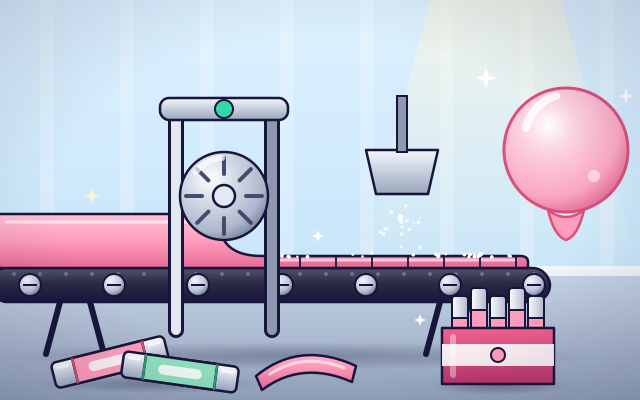
The interactive parts didn't load. The explanations below still work; try reloading the page.
From gum base to wrapped stick
- A hard candy dissolves in your mouth until it is gone. Gum is different. You can chew it for an hour and it is still there. What is it made of?
- For thousands of years people chewed chicle, the rubbery sap of a tree. Today most gum base is made in factories. Either way, it is soft, stretchy and does not dissolve in water.
- The gum base is warmed until it is soft, and big blades knead it like bread dough. Sweetener, softeners that keep it squishy, flavor and color are folded in.
- The warm gum is pushed out as a thick ribbon. Then pairs of rollers, each a little closer together than the last, squeeze it thinner and longer. Sweet powder stops it from sticking.
- Cutting wheels press lines into the thin sheet, marking out the sticks. The sheets rest in a cool room for a day or two until the gum is firm, and then they break apart along the lines.
- Machines wrap every stick to keep it soft and fresh, and slide the sticks into packs. Because gum base never dissolves, old gum belongs in a bin, wrapped in paper.
Look inside a gum factory
Follow the gum along the belt from left to right. Tap each machine to see it work.
- Mixer. Two big blades knead the warm gum base and fold in the sweetener, softener, flavor and color until the lump is the same all the way through.
- Extruder. A screw inside pushes the gum through a wide slot, and it comes out as one long, thick ribbon, like toothpaste from a tube.
- Rollers. Each pair of rollers is a little closer together than the one before, so the ribbon gets thinner and longer step by step, until it is as thin as a stick of gum.
- Powder duster. A fine sweet powder is sprinkled on the sheet so that it does not stick to the rollers, the knives or the wrapper. It is the white dust you see on a fresh stick.
- Scoring wheels. A row of thin wheels presses lines along and across the sheet. They do not cut all the way through, so the sticks stay together for now.
- Cooling room. The scored sheets rest in a cool room for a day or two. The gum firms up, so the sticks keep their shape and break apart cleanly.
- Wrapping machine. The wrapping machine breaks the sheet into sticks, folds a wrapper around each one and pushes them into packs, hundreds every minute.
Mix, roll, cut and wrap
Choose a flavor and mix a batch. Roll it thin, cut it and wrap it. Then press Chew test and watch the close-up to see what stays and what goes.
Experiment: What happens to a piece of gum when it is chewed for a long time?
- Tap the jars to add gum base, sweetener and flavor, then tap the mixer.
- Tap the rollers until the sheet is about 2 millimeters thick. Then tap the cutter and the wrapper.
- Press Chew test and watch the close-up.
- Look at the two bars. Which one goes down?
What we found: The sweetener and flavor dissolved into the water and were carried away, so the taste faded in a few minutes. The stretchy threads of gum base did not change at all. That is why gum loses its flavor but never disappears.
Turn on JavaScript to try it yourself.
A strawberry order
Fill a pack with strawberry gum that is soft but not sticky, in sticks 2 millimeters thick.
Why gum never dissolves
People have chewed gum for a very long time. Thousands of years ago, people in different parts of the world chewed lumps of tree sap. In Central America, the Maya chewed chicle, a milky sap that turns rubbery when it is boiled. The first modern chewing gums were made from chicle too.
Today the chewy part, called the gum base, is usually made in a factory instead of collected from trees. It is a soft, stretchy material, a little like rubber, that is safe to chew. The important thing about gum base is that water cannot dissolve it. Your spit is mostly water, so the base stays in one piece however long you chew.
The base has no taste, so sweetener and flavor are kneaded into it, along with softeners that keep it squishy. These do dissolve in water. As you chew, they wash out of the gum bit by bit and you swallow them. That is why gum tastes strong at first and like nothing at the end.
In the factory the warm gum is rolled thinner and thinner, dusted with sweet powder, marked into sticks, rested in a cool room and wrapped. Rolling gum is a lot like rolling cookie dough, with one difference: cookie dough is baked and eaten, while gum base is only chewed. It is not food, so it should not be swallowed, and it is not for very young children. Because it never dissolves, used gum should go in a bin, wrapped in a bit of paper.
Key words
- Gum base
- The stretchy, chewy part of gum that does not dissolve.
- Chicle
- The rubbery sap of the sapodilla tree, used to make the first modern chewing gums.
- Dissolve
- To mix into a liquid so finely that the pieces are too small to see. Sugar dissolves in water. Gum base does not.
- Polymer
- A material made of very long, chain-like molecules. Rubber and plastics are polymers.
- Softener
- An ingredient that keeps gum soft and squishy.
Check your thinking
-
Why does gum lose its flavor after a while?
Show the answer
The sweetener and flavor dissolve and are swallowed. The tasty parts dissolve in your spit. The stretchy base cannot dissolve, so it stays.
-
Why does the gum go through several pairs of rollers instead of just one?
Show the answer
Squeezing it thin a little at a time stops it from tearing. Each pair of rollers is a bit closer together, so the gum thins step by step without ripping.
-
What is the white powder on a fresh stick of gum for?
Show the answer
It stops the gum from sticking to the machines and the wrapper. Soft gum is sticky. A dusting of sweet powder keeps it from sticking to rollers, knives and paper.
-
Why should used gum be put in a bin and not dropped on the ground?
Show the answer
Gum base does not dissolve, so rain cannot wash it away. The same thing that makes gum last in your mouth makes it last on the street.
-
What makes bubble gum good for blowing bubbles?
Show the answer
Its base is extra stretchy, so it can hold air without tearing. A bubble is a thin skin of gum around air. Only a very stretchy base can be pulled that thin.
You're a Food & farming expert!
You watched, looked inside, tried it, solved the challenge and went deeper. Pick another question below, or switch the age at the top to see this topic another way.
More about food & farming
 #286
Food & farming
How is breakfast cereal made?
Choose a cereal style and follow cooking, shaping, drying, toasting, and packaging.
#286
Food & farming
How is breakfast cereal made?
Choose a cereal style and follow cooking, shaping, drying, toasting, and packaging.
 #287
Food & farming
How does pasteurization work?
Follow controlled factory heating and cooling and visualize changes in microbial numbers.
#287
Food & farming
How does pasteurization work?
Follow controlled factory heating and cooling and visualize changes in microbial numbers.
 #288
Food & farming
How does fruit ripen?
Explore changes in color, firmness, aroma, and stored carbohydrates over time.
#288
Food & farming
How does fruit ripen?
Explore changes in color, firmness, aroma, and stored carbohydrates over time.
 #289
Food & farming
How does drying preserve food?
Remove water from virtual fruit and compare moisture, texture, and microbial growth conditions.
#289
Food & farming
How does drying preserve food?
Remove water from virtual fruit and compare moisture, texture, and microbial growth conditions.
Keep exploring
Games to play next
- Ratio KitchenScale recipes, fill ratio tables and find the better buy.
- Garden AutomationProgram a garden robot with sensor rules — then watch a whole day play out.
- Label LabPut the right labels on beautiful science diagrams, from bean plants to heart chambers.
Guide for grown-ups
- How to start homeschooling: a step-by-step guide for familiesA guide for parents · 7 min read
Science games by grade
Science worksheets by grade
- Preschool Science Worksheets
- Pre-K Science Worksheets
- Kindergarten Science Worksheets
- 1st Grade Science Worksheets
- 2nd Grade Science Worksheets
- 3rd Grade Science Worksheets
- 4th Grade Science Worksheets
- 5th Grade Science Worksheets
- 6th Grade Science Worksheets
- 7th Grade Science Worksheets
- 8th Grade Science Worksheets