How does a click pen extend and retract?
Every click turns a hidden part called a cam one step. One step holds the tip out. The next lets a spring pull it back in.
The big idea: A spring is always trying to push the ink tube back inside. A turning cam decides whether it can: on a ledge the tip stays out, and in a deep slot it slides back in.
It's like a push-button lamp switch: one push and the light stays on, the next push and it goes off. Inside the pen, a turning part remembers which comes next.
The interactive parts didn't load. The explanations below still work; try reloading the page.
What happens when you click a pen?
- Click the button and the tip pops out, ready to write. Click it again and the tip hides. The same push does two different things. How?
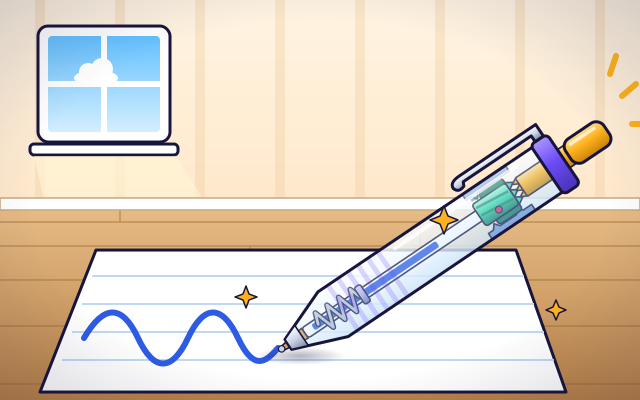
- Let us look through the barrel. Inside are a button, a turning part called a cam, a long tube of ink and a spring near the tip.
- When you push the button, it pushes the cam, and the cam pushes the ink tube toward the tip. That squashes the spring, and the spring pushes back.
- Imagine unrolling that part of the pen flat. The button has slanted teeth. When the cam is pushed past the stops in the barrel, it slides along the slant and twists a little.
- Let go, and the spring pushes the cam back. It slides along another slant and lands on a ledge. It cannot go all the way back, so the tip stays out.
- Click again. The cam twists one more step, and this time it meets a deep slot. The spring pushes it all the way up, and the tip slides back in. Ledge, slot, ledge, slot!
Look inside a click pen
Tap each part. The card above the pen shows the clicking parts unrolled flat.
- Button. The part you press. Its other end has slanted teeth that push on the cam.
- Cam. The cam turns one step with every click. Its ribs decide where it stops: on a ledge or up a deep slot.
- Stops in the barrel. Bumps molded inside the barrel. They take turns: a ledge, then a deep slot, then a ledge again.
- Spring. The spring is always pushing the ink tube back toward the button. It is what makes the tip hide again.
- Ink tube. A thin tube full of thick ink, with the writing tip on the end. The whole tube slides forward and back.
- Ball tip. At the very tip is a tiny metal ball. As you write it rolls, picking up ink on one side and rolling it onto the paper on the other.
- Barrel. The body of the pen. It holds every part in line and gives you somewhere to grip.
- Clip. The springy clip grips a pocket or a notebook so the pen does not get lost.
Click it and watch the cam
Tap the button to click the pen. Watch the green cam on the card. Then turn on slow motion, or push the button slowly yourself.
Experiment: The tip is in. You click three times. Where is the tip now?
- Click once and look at where the green cam stops.
- Click a second time. Where does the cam go now?
- Click a third time and check the tip.
What we found: Every click turns the cam one step, and the steps take turns: ledge (tip out), slot (tip in), ledge, slot. After one click or three clicks the tip is out. After two or four it is in.
Turn on JavaScript to try it yourself.
Put the pen together
This pen is in pieces. Tap the parts in the order they go into the barrel, then click the pen to test it.
How a click pen remembers
A click pen has a clever problem to solve. You push the button the same way every time, but the pen has to do two different things: put the tip out, or pull it back in. So the pen needs a way to remember what it did last time.
The part that remembers is called the cam. It is a small ring that can turn, and it sits between the button and the ink tube. A spring near the tip is always pushing the ink tube and the cam back toward the button.
The button has slanted teeth, like tiny slides. When you push, the teeth push the cam forward until it is clear of the bumps inside the barrel. Then the spring makes the cam slip down the slant, and it twists a little. When you let go, the cam slides along one more slant and stops.
The bumps in the barrel take turns. One is a ledge: the cam stops early, so the tip stays out and you can write. The next is a deep slot: the cam slides all the way back, and the spring pulls the tip inside. Ledge, slot, ledge, slot, all the way around. That is how one button can do two jobs.
Key words
- Cam
- A turning part whose shape controls how another part moves.
- Plunger
- The sliding part joined to the button. It pushes the cam.
- Retract
- To pull back inside.
- Bistable
- Able to rest in two different positions.
- Preload
- How much a spring is already squashed before you push.
Check your thinking
-
What pushes the ink tube back inside when the tip retracts?
Show the answer
The spring. The spring is squashed when the tip is out, so it is always pushing the ink tube back.
-
You click the pen two times. Where is the tip?
Show the answer
Hiding inside again. Click one: out. Click two: back in.
-
The tip is in. You click the pen five times. Where is the tip?
Show the answer
Out. Count it: out, in, out, in, out. Five is an odd number, so the tip is out.
-
Imagine a pen where every bump in the barrel is a ledge and there are no deep slots. What happens?
Show the answer
The tip would come out and never go back in. A ledge stops the cam early, which holds the tip out. With only ledges, the spring could never push the tip all the way back.
-
Why does the cam twist when you push the button?
Show the answer
It slides along slanted teeth. The teeth are slanted like little slides, so the cam slips sideways along them, and sideways on a round part means it turns.
-
A spring of stiffness 0.2 N/mm is fitted with 5 mm of preload, and a click compresses it 5 mm more. What force is needed at the bottom of the click?
Show the answer
2 N. Force is stiffness times total compression: 0.2 N/mm × 10 mm = 2 N. At rest it is 0.2 × 5 = 1 N.
You're a Everyday objects expert!
You watched, looked inside, tried it, solved the challenge and went deeper. Pick another question below, or switch the age at the top to see this topic another way.
More about everyday objects
 #153
Everyday objects
How does a mechanical pencil advance its graphite?
Press the button and watch tiny gripping parts move and hold the graphite.
#153
Everyday objects
How does a mechanical pencil advance its graphite?
Press the button and watch tiny gripping parts move and hold the graphite.
 #154
Everyday objects
How does a stapler join sheets of paper?
Follow a staple as it pierces paper and bends against the stapler's base.
#154
Everyday objects
How does a stapler join sheets of paper?
Follow a staple as it pierces paper and bends against the stapler's base.
 #155
Everyday objects
How does a can opener cut around a lid?
Trace the gripping and cutting wheels as they travel around a virtual can.
#155
Everyday objects
How does a can opener cut around a lid?
Trace the gripping and cutting wheels as they travel around a virtual can.
 #156
Everyday objects
How does an umbrella open and fold?
Move the runner and watch linked supports spread or collapse the canopy.
#156
Everyday objects
How does an umbrella open and fold?
Move the runner and watch linked supports spread or collapse the canopy.
Keep exploring
Games to play next
- Machine RepairFix levers, pulleys, gears and ramps so every contraption works.
- Science QuizzesOlly's Science Quiz Show: plants, animals, the body, weather, space and more, for every grade.
Guide for grown-ups
- How to start homeschooling: a step-by-step guide for familiesA guide for parents · 7 min read
Science games by grade
Science worksheets by grade
- Preschool Science Worksheets
- Pre-K Science Worksheets
- Kindergarten Science Worksheets
- 1st Grade Science Worksheets
- 2nd Grade Science Worksheets
- 3rd Grade Science Worksheets
- 4th Grade Science Worksheets
- 5th Grade Science Worksheets
- 6th Grade Science Worksheets
- 7th Grade Science Worksheets
- 8th Grade Science Worksheets