How does a stapler join sheets of paper?
One push drives a staple through the paper. A metal plate underneath bends its legs flat, so the pages cannot slip apart.
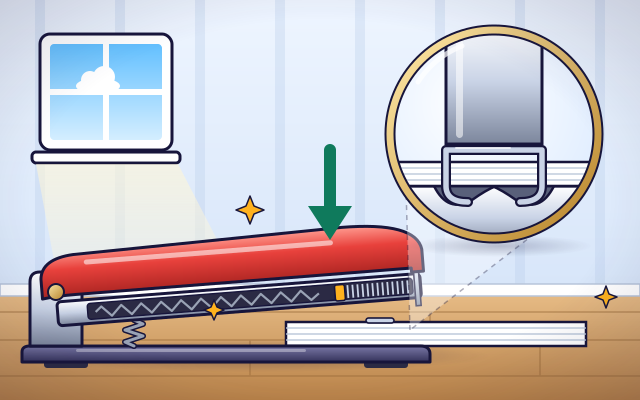
The big idea: A blade pushes one staple down. Its sharp legs go through the paper and hit curved grooves in a metal plate called the anvil, which bend the legs under the stack.
It's like pushing a pipe cleaner through a hole in cardboard and bending both ends flat, so it cannot slip back out. A stapler does all of that in one push.
The interactive parts didn't load. The explanations below still work; try reloading the page.
How a staple holds paper together
- Slide loose pages into the stapler and press down. Ka-chunk! Now the pages are joined. What happened in that one quick push?
- Inside the stapler is a row of staples, lightly glued together. A spring pushes the row forward, so there is always one staple waiting under the blade.
- When you press the handle, a thin metal blade comes down on the front staple. It snaps that one staple off the row and pushes it down.
- The staple's two legs have sharp tips. All of your push is squeezed onto those tiny tips, so they poke straight through the paper.
- Under the paper is a metal plate called the anvil. It has two curved grooves. When the legs hit the grooves, they have to turn, and they curl in toward each other.
- The legs end up folded flat under the stack. They cannot pull back through the holes, so the pages are held. The blade lifts, and the spring pushes the next staple into place.
Look inside a stapler
Tap each part. The circle shows the staple from the front, close up.
- Handle. The top part that you press. It is a lever: it swings down around the hinge and pushes the blade.
- Driver blade. A thin, flat piece of metal as wide as a staple. It pushes the front staple down and out.
- Magazine. The long metal channel that holds the row of staples and keeps them lined up.
- Staples. Each staple is a piece of wire bent like a tiny bridge, with two sharp legs. They are lightly glued side by side in a row.
- Pusher and spring. A little block with a spring behind it. It keeps pushing the row of staples forward, so the next one is always ready.
- Return spring. This spring is squashed when you press down. When you let go, it lifts the top of the stapler back up.
- Hinge. The pin at the back that the top swings around, like the hinge of a door.
- Anvil. A small metal plate under the paper with two curved grooves. The grooves bend the staple's legs so they fold under the pages.
- Base. The heavy bottom part. It holds the anvil steady and keeps the stapler from sliding.
Follow the staple
Press the stapler and follow the staple in the close-up. Then press slowly, add more sheets and turn the anvil around.
Experiment: What happens if you staple a very thick stack with ordinary staples?
- Staple 5 sheets and look at the folded legs in the close-up.
- Slide the sheets up to 40 and staple again.
- Go back to a few sheets and try the Fold out setting.
What we found: A staple's legs have to go all the way through the stack with some left over to fold. In a thick stack almost nothing is left, so the legs cannot fold and nothing holds the pages. Thick stacks need staples with longer legs.
Turn on JavaScript to try it yourself.
Three stapling jobs
Do three stapling jobs. For each one, pick the right staples and the right anvil setting, then staple.
One push, three jobs
A stapler does three jobs in one quick push. First it picks just one staple from a whole row. Then it pushes that staple through the paper. Last, it bends the staple's legs so they cannot come back out.
The staples sit side by side in a long metal channel, lightly glued together. A spring pushes the row forward so one staple is always waiting at the front. When you press the handle, a thin metal blade comes down on that front staple, snaps it off the row and pushes it down.
The legs of a staple have sharp tips. A sharp tip is very small, so all of your push is squeezed onto a tiny spot. That is why the legs can poke through many sheets of paper, when your finger pushing just as hard would do nothing at all.
Under the paper is a metal plate called the anvil, with two curved grooves. When the legs come out of the bottom of the stack, they slide into the grooves and are turned sideways, in toward each other. They end up folded flat. Now the pages are squeezed between the top of the staple and its folded legs, and they cannot slip apart.
Key words
- Staple
- A small piece of bent wire with two sharp legs.
- Anvil
- The metal plate with grooves that bends the staple's legs.
- Lever
- A bar that turns around a fixed point and makes pushing easier.
- Pressure
- How strongly a push is squeezed onto a spot. A small spot means a big pressure.
- Clinch
- To fold the legs of a staple flat against the back of the paper.
Check your thinking
-
What bends the staple's legs under the paper?
Show the answer
The curved grooves in the anvil. The legs slide into the anvil's curved grooves, and the curve turns them in toward each other.
-
Why can a staple's legs go through paper when your fingertip cannot?
Show the answer
The sharp tips squeeze the push onto a tiny spot. A tiny tip puts the whole push on a very small spot, and that is enough to break through the paper.
-
You try to staple 50 sheets with ordinary staples, and the pages fall apart. Why?
Show the answer
The legs are not long enough to fold under the stack. The legs get used up going through the thick stack. With nothing left to fold, nothing stops the pages from sliding off.
-
After each staple, how does the next one get to the front?
Show the answer
A spring pushes the whole row forward. A block with a spring behind it keeps pushing the row, so a new staple is always waiting under the blade.
-
The blade needs 60 N and sits 150 mm from the hinge. Your hand presses 300 mm from the hinge. About what force must your hand supply?
Show the answer
30 N. Force times distance balances: 60 N × 150 mm = F × 300 mm, so F = 30 N. Twice the distance, half the force.
You're a Everyday objects expert!
You watched, looked inside, tried it, solved the challenge and went deeper. Pick another question below, or switch the age at the top to see this topic another way.
More about everyday objects
 #155
Everyday objects
How does a can opener cut around a lid?
Trace the gripping and cutting wheels as they travel around a virtual can.
#155
Everyday objects
How does a can opener cut around a lid?
Trace the gripping and cutting wheels as they travel around a virtual can.
 #156
Everyday objects
How does an umbrella open and fold?
Move the runner and watch linked supports spread or collapse the canopy.
#156
Everyday objects
How does an umbrella open and fold?
Move the runner and watch linked supports spread or collapse the canopy.
 #157
Everyday objects
How do window blinds raise, lower, and tilt?
Operate controls and trace how their mechanisms move the slats together.
#157
Everyday objects
How do window blinds raise, lower, and tilt?
Operate controls and trace how their mechanisms move the slats together.
 #159
Everyday objects
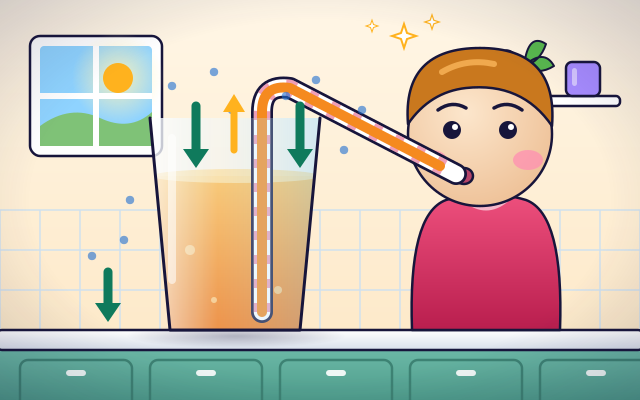
How does a drinking straw lift liquid?
Change pressure inside a straw and observe surrounding air pressure pushing liquid upward.
#159
Everyday objects
How does a drinking straw lift liquid?
Change pressure inside a straw and observe surrounding air pressure pushing liquid upward.
Keep exploring
Games to play next
- Machine RepairFix levers, pulleys, gears and ramps so every contraption works.
- Science QuizzesOlly's Science Quiz Show: plants, animals, the body, weather, space and more, for every grade.
Guide for grown-ups
- How to start homeschooling: a step-by-step guide for familiesA guide for parents · 7 min read
Science games by grade
Science worksheets by grade
- Preschool Science Worksheets
- Pre-K Science Worksheets
- Kindergarten Science Worksheets
- 1st Grade Science Worksheets
- 2nd Grade Science Worksheets
- 3rd Grade Science Worksheets
- 4th Grade Science Worksheets
- 5th Grade Science Worksheets
- 6th Grade Science Worksheets
- 7th Grade Science Worksheets
- 8th Grade Science Worksheets