How does a mechanical pencil advance its graphite?
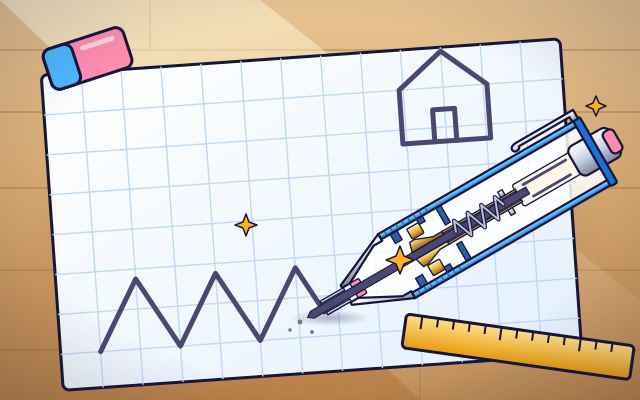
Inside the pencil, tiny jaws grip the lead, carry it forward, let go, slide back and grip again. Every click is one small step.
The big idea: The jaws only move the lead while they are squeezed shut. They carry it forward closed, then slide back open, so the lead goes out but never comes back.
It's like pulling a rope hand over hand: grab, pull, let go, reach back and grab again. The pencil's jaws do this to the lead, one tiny step for each click.
The interactive parts didn't load. The explanations below still work; try reloading the page.
How the lead comes out
- Click the button and a little more lead comes out of the tip. Click again, a little more. It never needs sharpening. What is going on in there?
- Inside is a long, thin stick of lead. Near the tip, two little jaws hold it. A ring squeezes the jaws shut, and a spring pulls everything back.
- When you push the button, the jaws, the ring and the lead all move forward together. The jaws are still squeezed shut, so the lead comes along.
- Then the ring bumps into a stop and cannot go any farther. The jaws keep moving, slip out of the ring and spring open. A little rubber grip in the tip keeps the lead from falling out.
- Let go of the button and the spring pulls the jaws back. They are still open, so they slide along the lead without moving it, and they push the loose ring back too.
- The ring reaches its back stop, and the spring pulls the jaws into it. Squeeze! They grip the lead again, a little farther back. So each click leaves a bit more lead sticking out.
Look inside a mechanical pencil
Tap each part. Watch what the jaws and the ring do during a click.
- Lead. A thin stick that leaves a dark mark on paper. It is called lead, but it is really made of graphite.
- Lead sleeve. A thin metal pipe at the tip. It supports the lead right up to the end so it is less likely to snap.
- Rubber grip. A little piece of rubber in the tip that hugs the lead lightly. It holds the lead still while the jaws are open.
- Jaws. The jaws grip the lead. They are springy and want to spread apart, so they only grip while the ring squeezes them.
- Ring. The ring slides over the jaws and squeezes them shut. It can only move a tiny way before it bumps into a stop.
- Spring. The spring pulls the jaws back when you let go of the button, and it pulls them into the ring so they grip.
- Lead tube. A tube that joins the button to the jaws. Spare leads wait inside it. When one lead is used up, the next one drops into the jaws.
- Button. The part you press. On many pencils it is a cap with a small eraser under it, and you take it off to put in new leads.
Watch the jaws feed the lead
Tap the button to click. Then push the button slowly yourself and hold it down. What can the lead do while the jaws are open?
Experiment: You hold the button all the way down. What can the lead do now?
- Click two or three times to feed some lead out.
- Slide Push the button yourself all the way and leave it there.
- Now tap the lead to push it back in.
What we found: While the button is held down, the jaws are out of the ring and open, so nothing grips the lead and it can slide back in. Let go, and the ring squeezes the jaws shut again.
Turn on JavaScript to try it yourself.
Five mountain peaks
Draw all five peaks. Drawing wears the lead down, so click for more when you need it. Too much lead at once will snap.
Grip, carry, let go, slide back
A wooden pencil gets shorter every time you sharpen it. A mechanical pencil never needs sharpening, because its lead is already thin, and a clever mechanism pushes out a little more whenever you click.
Near the tip are tiny jaws that hold the lead. The jaws are springy and want to spread open. A ring slides over them and squeezes them shut. A spring pulls the jaws back into the ring, so most of the time the lead is held tight. That is why it does not slide back in when you press down to write.
When you push the button, the jaws carry the lead forward. After a tiny distance the ring bumps into a stop, but the jaws keep going. They slip out of the ring and spring open, letting go of the lead. When you release the button, the open jaws slide back along the lead without moving it. Then the ring squeezes them shut again, a little farther back.
It is just like pulling a rope hand over hand, except that the jaws push instead of pull. The lead only moves while the jaws are gripping, and they only grip on the way forward. If you hold the button down, the jaws stay open, and you can push the lead back inside.
Key words
- Graphite
- The soft, dark material that pencil lead is made of.
- Chuck
- The set of little jaws that grip the lead.
- Wedge
- A sloping shape that turns a push along it into a bigger squeeze sideways.
- Friction
- The grip between two things that are pressed together.
- Bending stress
- How hard a push is trying to snap something by bending it.
Check your thinking
-
What squeezes the jaws shut on the lead?
Show the answer
The ring. The jaws want to spring open. The ring slides over them and squeezes them shut.
-
During a click, when does the lead actually move?
Show the answer
While the closed jaws carry it forward. The lead only moves while the jaws grip it, and they only grip on the way forward. On the way back they are open.
-
A pencil has lost its little rubber grip in the tip. You hold the pencil point down and press the button. What probably happens?
Show the answer
The lead slides out when the jaws open. When the jaws open, nothing else is holding the lead. The rubber grip is what keeps it from sliding out.
-
Why is it a bad idea to click out a lot of lead before you write?
Show the answer
A long, thin lead bends and snaps easily. The metal sleeve only supports the lead up to the tip. The longer the part sticking out, the more easily it bends and breaks.
-
A designer wants each click to feed 0.8 mm of lead instead of 0.5 mm. What should change?
Show the answer
A wider gap between the ring's front and rear stops. The lead is carried only while the ring travels across its gap, so the gap sets the feed. The spring changes the grip, not the distance.
You're a Everyday objects expert!
You watched, looked inside, tried it, solved the challenge and went deeper. Pick another question below, or switch the age at the top to see this topic another way.
More about everyday objects
 #154
Everyday objects
How does a stapler join sheets of paper?
Follow a staple as it pierces paper and bends against the stapler's base.
#154
Everyday objects
How does a stapler join sheets of paper?
Follow a staple as it pierces paper and bends against the stapler's base.
 #155
Everyday objects
How does a can opener cut around a lid?
Trace the gripping and cutting wheels as they travel around a virtual can.
#155
Everyday objects
How does a can opener cut around a lid?
Trace the gripping and cutting wheels as they travel around a virtual can.
 #156
Everyday objects
How does an umbrella open and fold?
Move the runner and watch linked supports spread or collapse the canopy.
#156
Everyday objects
How does an umbrella open and fold?
Move the runner and watch linked supports spread or collapse the canopy.
 #157
Everyday objects
How do window blinds raise, lower, and tilt?
Operate controls and trace how their mechanisms move the slats together.
#157
Everyday objects
How do window blinds raise, lower, and tilt?
Operate controls and trace how their mechanisms move the slats together.
Keep exploring
Games to play next
- Machine RepairFix levers, pulleys, gears and ramps so every contraption works.
- Science QuizzesOlly's Science Quiz Show: plants, animals, the body, weather, space and more, for every grade.
Guide for grown-ups
- How to start homeschooling: a step-by-step guide for familiesA guide for parents · 7 min read
Science games by grade
Science worksheets by grade
- Preschool Science Worksheets
- Pre-K Science Worksheets
- Kindergarten Science Worksheets
- 1st Grade Science Worksheets
- 2nd Grade Science Worksheets
- 3rd Grade Science Worksheets
- 4th Grade Science Worksheets
- 5th Grade Science Worksheets
- 6th Grade Science Worksheets
- 7th Grade Science Worksheets
- 8th Grade Science Worksheets