How does the cold chain keep food chilled during delivery?
Fresh food travels in a chain of cold places. If one link gets warm, the food spoils sooner, so every step is chilled and checked.
The big idea: Cold makes the tiny germs in food grow very slowly. So fresh food is kept cold in every place it passes through, like links in a chain, and nobody lets the chain break.
It's like a relay race with an ice cream instead of a baton: every runner has to keep it cold, and one slow handover in the sun spoils it.
The interactive parts didn't load. The explanations below still work; try reloading the page.
From the dairy to your fridge
- Fresh milk is warm, as warm as the cow. At the dairy it is chilled within minutes in a big cold tank, and packed into cartons. But why the hurry?
- Tiny living things called germs are in all fresh food. In the warm they multiply fast and make food go off. In the cold they multiply very slowly, so the food stays fresh for days.
- The cartons wait in a cold store, a room built like a giant fridge. Thick padded walls keep heat out, and a cooler on the wall pumps out any heat that sneaks in.
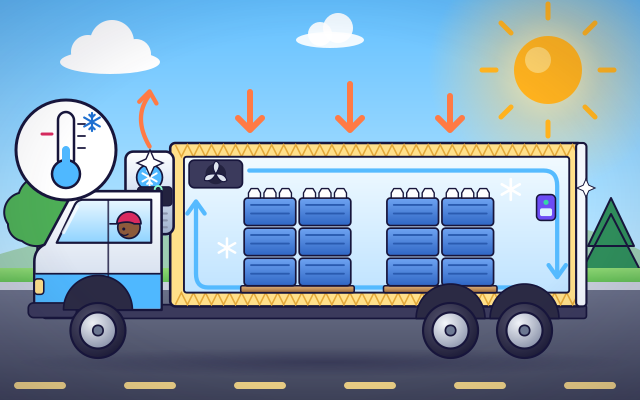
- A refrigerated truck is a fridge on wheels. Its box has thick walls, and a cooling unit at the front blows cold air all around the crates, even on the hottest day.
- At the shop, someone checks the temperature before the milk comes in. A small recorder in the truck has written down the temperature for the whole trip. The line stayed in the cold zone.
- From the shop's cold shelf the milk goes into a bag and quickly home to your fridge. Dairy, cold store, truck, shop, home: every link stayed cold. That is the cold chain.
Inside a refrigerated truck
Tap each part of the truck. Watch what it does to the heat and the cold air.
- Padded walls. The walls, floor and roof are filled with thick foam. Heat from the hot day can only creep through very slowly, like through a thick winter coat.
- Cooling unit. The cooling unit works like the back of your fridge. It collects heat from inside the box and dumps it into the air outside.
- Fan and cold air. A fan blows cold air along the ceiling to the back of the box. The air sinks, flows forward under the crates and returns to be cooled again.
- Crates with gaps. The crates are stacked on pallets with gaps between them. If they were packed tight against the walls, the cold air could not get around them.
- Doors and seals. Rubber seals around the doors keep warm air out. Every time the doors open, cold air spills out and warm air rushes in, so drivers keep them open as briefly as they can.
- Temperature recorder. A small recorder measures the temperature every few minutes and saves it. At the shop, the record shows whether the food stayed cold the whole way.
- Display and alarm. A display shows the driver the temperature in the box. If it climbs too high, an alarm warns the driver to stop and fix the problem.
Test the cold truck on a hot day
Tap the cooling unit to switch it off and on, and tap the doors to open and close them. Watch the thermometer and the freshness.
Experiment: The milk got too warm for a while. Then the cooling is switched back on. What happens?
- Switch the cooling unit off and watch the thermometer climb past the red line.
- Look at the freshness. Then switch the cooling on again.
- Wait until the milk is cold. Did the freshness come back?
What we found: The milk does get cold again. But while it was warm, germs multiplied, and cooling does not undo that. Lost freshness stays lost. That is why the cold chain must never break, not even for a short time.
Turn on JavaScript to try it yourself.
Deliver the milk cold
Take the milk from the dairy to the shop. At each of the five stops, choose what keeps it at 5 °C or colder.
A chain of cold places
Fresh food is never completely clean. Tiny living things called germs, far too small to see, sit on it and in it. Most are harmless in small numbers. But when food is warm, germs multiply quickly, and in the end the food smells bad or can make you ill.
Cold slows germs down. At fridge temperature they multiply so slowly that milk stays good for many days. Cold does not get rid of them, though. As soon as the food warms up, they get busy again. And any freshness that was lost while the food was warm does not come back when it is cooled again.
So chilled food is kept cold at every single step. The dairy cools the milk at once. It waits in a cold store, rides in a refrigerated truck, sits in the shop's chilled cabinet and ends up in your fridge. Each place is one link, and together they are called the cold chain.
Two things keep each link cold. Thick padded walls, called insulation, slow down the heat that tries to get in. A cooling unit pumps out the heat that gets in anyway. Small recorders write down the temperature all the way, so shops can check that the chain never broke. You can help with the last link: take cold food home quickly and put it in the fridge.
Key words
- Cold chain
- All the cold places and cold vehicles that chilled food passes through, from where it is made to your fridge.
- Germs
- Tiny living things, too small to see, that can make food go off.
- Insulation
- Thick padding that slows heat down, like a winter coat.
- Refrigeration
- Using a machine to move heat out of a closed space.
- Data logger
- A small recorder that saves the temperature every few minutes during a journey.
- Shelf life
- How long a food stays good to eat.
Check your thinking
-
Why is fresh food kept cold on its whole journey?
Show the answer
Cold makes germs multiply very slowly, so the food stays fresh longer. Germs grow fast in the warm and slowly in the cold.
-
A truck's doors are left open on a hot day. What happens inside the box?
Show the answer
Cold air spills out and warm air rushes in. An open door swaps the cold air for warm air within seconds. The unit cannot keep up.
-
Milk was left in a warm place for a while and then cooled again. Is it as fresh as before?
Show the answer
No. It is cold again, but the freshness it lost stays lost. Germs multiplied while it was warm. Cooling slows them again but does not remove them.
-
What do the thick walls of a cold truck do?
Show the answer
They slow down the heat that tries to get in. Insulation does not make cold. It only slows heat down, like a thick coat.
-
Why not simply set every cold store and truck to minus 10 °C to be extra safe?
Show the answer
Chilled foods like milk are damaged by freezing, and extra cold wastes energy. Each food has a band. Below it the food is damaged, above it microbes grow, and colder than needed costs fuel.
You're a Money, shops & services expert!
You watched, looked inside, tried it, solved the challenge and went deeper. Pick another question below, or switch the age at the top to see this topic another way.
More about money, shops & services
 #481
Money, shops & services
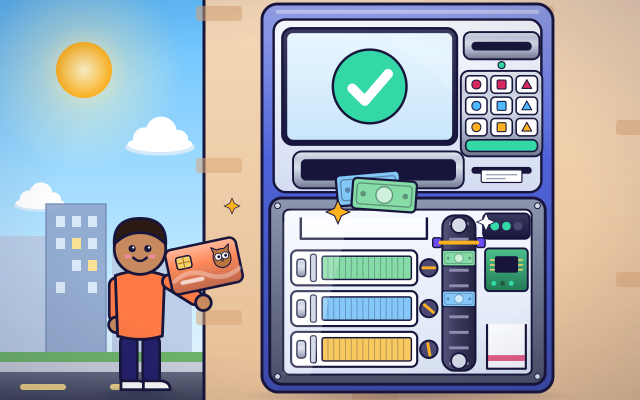
How does an ATM dispense money?
Follow card verification, account checks, note counting, and dispensing inside a transparent machine.
#481
Money, shops & services
How does an ATM dispense money?
Follow card verification, account checks, note counting, and dispensing inside a transparent machine.
 #482
Money, shops & services
How does a debit-card payment work?
Trace a purchase through merchant, payment network, and bank using pretend account balances.
#482
Money, shops & services
How does a debit-card payment work?
Trace a purchase through merchant, payment network, and bank using pretend account balances.
 #483
Money, shops & services
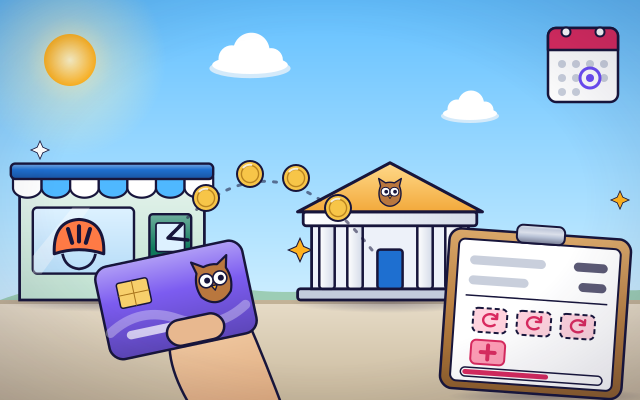
How does a credit-card payment work?
Follow a purchase, statement, and repayment using a fictional account and simple balances.
#483
Money, shops & services
How does a credit-card payment work?
Follow a purchase, statement, and repayment using a fictional account and simple balances.
 #484
Money, shops & services
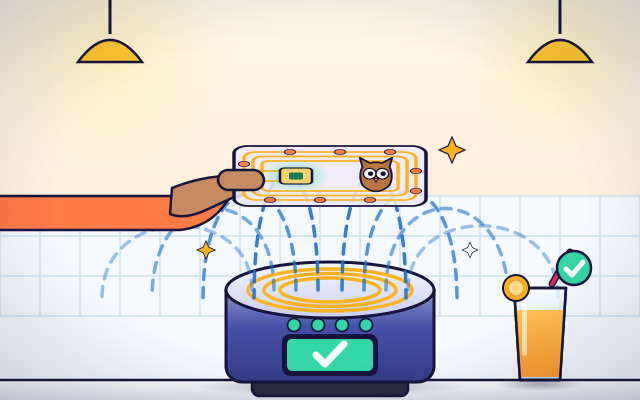
How do contactless payments work?
Bring a virtual card near a reader and follow the short-range exchange and authorization.
#484
Money, shops & services
How do contactless payments work?
Bring a virtual card near a reader and follow the short-range exchange and authorization.
Keep exploring
Games to play next
- Supermarket StockerRoll out your cart and make every shelf ready for the day.
- Coin MarketRun a pretend market stall: pay exactly, use the fewest coins, and give the right change.
- Festival PlannerPlace the stalls, book the acts and keep the budget — make every rule true.
Guide for grown-ups
- How to start homeschooling: a step-by-step guide for familiesA guide for parents · 7 min read