How do reusable rockets land upright?
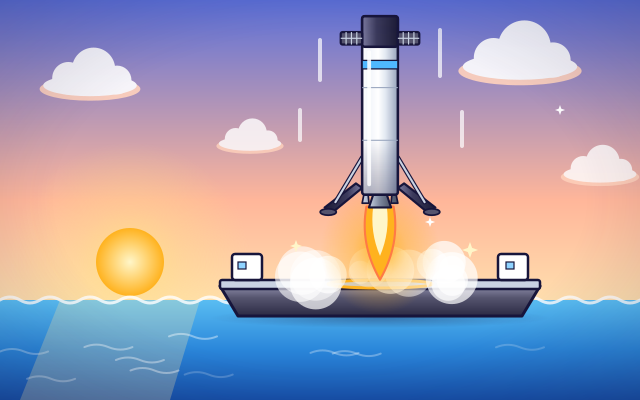
After launch, a rocket booster turns around, steers itself down and lands upright on its own fire, so it can be used again.
The big idea: A falling rocket fires its engine downward. When the push is bigger than the rocket's weight, the rocket slows. Small tilts of the engine keep it upright and steer it to the landing pad.
It's like balancing a broom upright on your palm: when it starts to tip, you slide your hand under it. The rocket slides its push under itself the same way.
The interactive parts didn't load. The explanations below still work; try reloading the page.
How a booster comes home
- Liftoff! The tall bottom part of the rocket is called the booster. Its engines do the hard work of lifting the whole rocket off the ground and through the thick air.
- When its work is done, the booster lets go and the top part flies on to space. Old boosters just fell into the sea. This one turns itself around with small puffs of gas, engines first.
- The booster falls bottom first. Four grid fins unfold near the top. They look like waffles, and they tilt to push against the air and steer the booster toward the landing pad.
- Near the ground one engine lights again. Its push, called thrust, is bigger than the booster's weight, so the booster slows down. The burn must start at just the right moment.
- A tall booster is like a broom balanced on your hand. If it starts to lean, the engine swivels a little and pushes its bottom back underneath. A computer does this many times every second.
- Four legs unfold just before landing. The booster touches down at about walking speed and the engine switches off. After a check and new fuel, it can fly again, which saves building a new one.
Look inside a reusable booster
The booster rides lying down to the launch pad. Tap each part to see what it does during the landing.
- Engines. The engines burn fuel and blast hot gas out of their bells. That pushes the rocket the other way. The middle engine can swivel to steer, and its power can be turned up and down.
- Landing legs. Four legs lie flat against the booster during flight. Just before landing they swing out wide. A wide stance keeps the tall booster from tipping over.
- Grid fins. These waffle-shaped fins fold out near the top after the booster turns around. They tilt to push on the air and steer the booster toward the pad.
- Gas thrusters. Small jets near the top puff out cold nitrogen gas. Above the air, where fins cannot work, these puffs flip the booster around and keep it pointed the right way.
- Fuel tanks. Most of the booster is two huge tanks: one for fuel and one for very cold liquid oxygen, which the fuel needs to burn. A small part is saved for coming home.
- Flight computer. No pilot flies the booster. Its computer reads sensors that feel every tilt and wobble, checks its position, and moves the fins, the thrusters and the engine many times every second.
Thrust against weight
Move the power lever and watch the two arrows. Then tilt the rocket and see where it goes.
Experiment: The rocket is falling. What happens when the engine's push is exactly as big as the rocket's weight?
- Let the rocket fall with the engine off. Watch its speed grow.
- Push the lever up until the green arrow is longer than the red one. What does the speed do?
- Tilt the rocket a little and watch it slide sideways.
What we found: When the push is smaller than the weight, the rocket speeds up as it falls. When the push is bigger, it slows down. When they are equal, the speed stays just as it is. To stop a falling rocket you need more push than its weight, for a while.
Turn on JavaScript to try it yourself.
Land on the pad
Steer the booster over the landing pad and touch down gently, standing straight. Save fuel for more stars.
How a booster lands itself
For most of the history of spaceflight, rockets were thrown away after one flight. The booster, the biggest and most expensive part, fell into the sea. That is like building a new airplane for every trip. A reusable booster flies back and lands so it can be used again.
Landing is all about two forces. The booster's weight pulls it down. The engine's push, called thrust, points up. If thrust is smaller than weight, the booster falls faster and faster. If thrust is bigger than weight, it slows down. The landing burn uses thrust bigger than weight for just long enough to bring the speed close to zero at the pad.
A booster is as tall as a building and has to stay upright. It does this the way you balance a broom on your hand: when it leans, the engine swivels and pushes the bottom back under the top. Higher up, grid fins steer through the air, and above the air, puffs of gas do the turning. A computer controls everything, because it all happens far too fast for a person.
The broom idea breaks down in one place: your hand can stay still under the broom, but this engine is too strong to let the booster hover. So the booster cannot wait above the pad. It has to arrive at the ground at the very moment it stops.
Key words
- Booster
- The big first stage of a rocket, which lifts everything off the ground.
- Thrust
- The push of a rocket engine.
- Weight
- The pull of gravity on something. It points down and depends on mass.
- Throttle
- The control that turns an engine's power up or down.
- Gimbal
- A swivel that lets the engine point a little to one side to steer.
- Grid fin
- A waffle-shaped fin that steers the booster as it falls through the air.
Check your thinking
-
What slows a booster down just before it lands?
Show the answer
Engine thrust that is bigger than its weight. Only a push bigger than the weight can slow a falling booster.
-
How does a tall booster keep from tipping over while it lands?
Show the answer
The engine swivels to push its bottom back under its top. It balances like a broom on your hand, with the engine doing the job of the hand.
-
A falling rocket's thrust is exactly equal to its weight. What happens?
Show the answer
It keeps falling at the same speed. Equal pushes cancel, so the speed does not change. It needs extra push to slow down.
-
A booster falling at 100 meters per second can slow at 20 meters per second squared. How high must the burn start?
Show the answer
250 meters. Stopping distance is v squared over twice the deceleration: 10,000 divided by 40 is 250 meters.
-
Why do engineers go to so much trouble to land the booster?
Show the answer
It is the most expensive part, and it can fly again. Using the same booster many times costs far less than building a new one each time.
You're a Space & astronomy expert!
You watched, looked inside, tried it, solved the challenge and went deeper. Pick another question below, or switch the age at the top to see this topic another way.
More about space & astronomy
 #78
Space & astronomy
Why do we have day and night?
Spin a globe beside the Sun and place characters around Earth. Watch sunrise, midday, sunset, and night from different locations.
#78
Space & astronomy
Why do we have day and night?
Spin a globe beside the Sun and place characters around Earth. Watch sunrise, midday, sunset, and night from different locations.
 #79
Space & astronomy
Why do the seasons change?
Move a tilted Earth around the Sun. Compare sunlight angle and day length in both hemispheres and follow a location through the year.
#79
Space & astronomy
Why do the seasons change?
Move a tilted Earth around the Sun. Compare sunlight angle and day length in both hemispheres and follow a location through the year.
 #80
Space & astronomy
Why does the Moon seem to change shape?
Move the Moon around Earth and compare its sunlit half with the portion visible from the ground. Match positions to lunar phases.
#80
Space & astronomy
Why does the Moon seem to change shape?
Move the Moon around Earth and compare its sunlit half with the portion visible from the ground. Match positions to lunar phases.
 #81
Space & astronomy
How do satellites stay in orbit?
Explore gravity and sideways motion in a simplified orbital simulation. Adjust a satellite's starting speed and height to compare its path.
#81
Space & astronomy
How do satellites stay in orbit?
Explore gravity and sideways motion in a simplified orbital simulation. Adjust a satellite's starting speed and height to compare its path.
Keep exploring
Games to play next
- Seasons and SkiesFrom days of the week to Earth's tilt: dress for the weather, read the sky and discover why seasons happen.
- Globe ExplorerSpin a real 3D globe, flip to the flat map, and find continents, oceans and countries.
- Science QuizzesOlly's Science Quiz Show: plants, animals, the body, weather, space and more, for every grade.
Draw it or make it
- How to draw a rocketDrawing lesson
- Paper-Roll RocketPaper craft
Guide for grown-ups
- How to start homeschooling: a step-by-step guide for familiesA guide for parents · 7 min read
Science games by grade
Science worksheets by grade
- Preschool Science Worksheets
- Pre-K Science Worksheets
- Kindergarten Science Worksheets
- 1st Grade Science Worksheets
- 2nd Grade Science Worksheets
- 3rd Grade Science Worksheets
- 4th Grade Science Worksheets
- 5th Grade Science Worksheets
- 6th Grade Science Worksheets
- 7th Grade Science Worksheets
- 8th Grade Science Worksheets