Why do the seasons change?
Earth is tilted as it travels around the Sun. Find out why that tilt gives us hot summers, cold winters and long and short days.
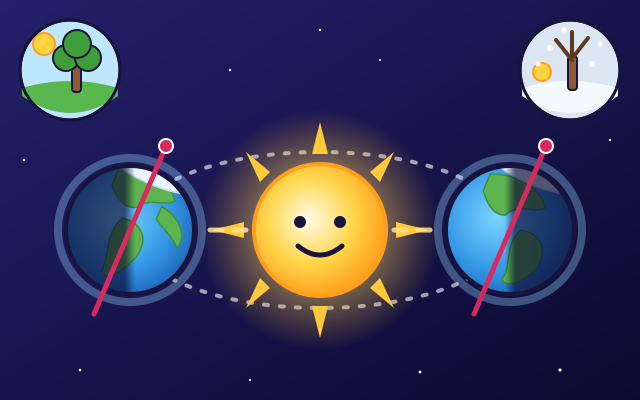
The big idea: Earth's axis is tilted, and it keeps pointing the same way all year. As Earth goes around the Sun, first one half and then the other leans toward the Sun. The half leaning toward the Sun gets high, strong sunlight and long days: summer.
It's like
The interactive parts didn't load. The explanations below still work; try reloading the page.
Why do the seasons change?
- In many places the weather changes through the year. Summer is warm with long days. Winter is cold with short days. What makes the seasons happen?
- Earth travels around the Sun in a path called an orbit. One trip around takes a year, about 365 days.
- Earth's axis is tilted. As Earth goes around the Sun, the axis keeps pointing the same way, toward the North Star.
- In June the northern half leans toward the Sun. The Sun climbs high, its light shines straight down and the days are long. It is summer in the north and winter in the south.
- In December it is the other way around. The southern half leans toward the Sun and has summer. Kids in Australia can go to the beach at Christmas!
- Many people think summer happens when Earth is closer to the Sun. But Earth is actually closest to the Sun in January, during winter in the north!
A year in four pictures
Tap each part to see how Earth leans at different times of the year.
- The Sun. The Sun sits near the middle of Earth's orbit. It gives out about the same amount of light all year.
- Orbit. Earth's orbit is its path around the Sun. It is almost a perfect circle, so Earth's distance from the Sun hardly changes.
- Tilted axis. Earth's axis is tilted by about 23 degrees. It always points the same way in space, toward the North Star.
- June solstice. Around June 21 the north leans most toward the Sun. It is the longest day of the year in the north and the start of summer there.
- September equinox. Around September 22 neither half leans toward the Sun. Day and night are about 12 hours each everywhere. Fall starts in the north and spring in the south.
- December solstice. Around December 21 the south leans most toward the Sun. It is summer in the south and the shortest day of the year in the north.
- March equinox. Around March 20 day and night are equal again. Spring begins in the north, and fall begins in the south.
- Sunlight angle. When the Sun is high, its light hits the ground straight on and makes a small, strong spot. When it is low, the same light spreads over more ground, so each spot gets less warmth.
Follow a year: north and south
Move the tilted Earth around the Sun. Compare the Sun's height, the sunlight spot and the day length in the north and the south.
Experiment: Why is it warmer in summer?
- Move Earth to June. Look at the north card and the south card.
- Move Earth to December. What changed in each half?
- Watch the sunlight spot and the day bar.
What we found: Summer happens on the half of Earth that leans toward the Sun. The Sun climbs higher, its light hits the ground more directly and the days are longer. When it is summer in the north, it is winter in the south!
Turn on JavaScript to try it yourself.
Season match
Move Earth to the right place in its orbit for each season card, then press Here!
It's all about the tilt
Earth spins around an axis, an imaginary line through the North and South Poles. That axis is not straight up and down compared with Earth's path around the Sun. It is tilted by about 23 degrees, and it keeps pointing the same way, toward the North Star, all year long.
As Earth travels around the Sun, the tilt means that in June the northern half leans toward the Sun, and in December the southern half does. The half that leans toward the Sun has summer. The other half has winter. That is why Australia has summer when Canada has winter.
Leaning toward the Sun helps in two ways. First, the Sun climbs higher in the sky, so its light hits the ground more directly. Shine a flashlight straight down and you get a small, bright spot. Tilt it and the same light spreads out and looks dimmer. Second, the days are longer, so the ground has more hours to warm up.
Here is a surprise: Earth is closest to the Sun in early January, in the middle of northern winter! The distance changes very little during the year, so it is not what causes the seasons.
Key words
- Axial tilt
- How much Earth's axis leans: about 23 degrees.
- Hemisphere
- Half of Earth. The equator divides it into the Northern and Southern Hemispheres.
- Solstice
- The day with the most or least daylight of the year, around June 21 and December 21.
- Equinox
- A day around March 20 or September 22 when day and night are about equal everywhere.
- Orbit
- The path Earth follows around the Sun, taking about 365.25 days.
Check your thinking
-
What causes the seasons?
Show the answer
The tilt of Earth's axis. The tilt makes each half lean toward the Sun for part of the year, giving it high Sun and long days.
-
When it is summer in the north, what season is it in the south?
Show the answer
Summer. The seasons are opposite: when one half leans toward the Sun, the other leans away.
-
When is Earth closest to the Sun?
Show the answer
In January, during winter in the north. Surprise! Earth is closest in January, when it is winter in the north. So distance can't be the reason for summer.
-
Why does high summer sunlight warm the ground more than low winter sunlight?
Show the answer
Its light is packed into a smaller area. Direct light is concentrated. Slanted light spreads the same energy over more ground.
-
At latitude 40°N, what is the noon Sun's altitude at the December solstice (declination −23.4°)?
Show the answer
About 27°. 90° − |40° − (−23.4°)| = 90° − 63.4° ≈ 26.6°.
-
What would happen if Earth's axis were not tilted at all?
Show the answer
There would be almost no seasons. Without a tilt, no half would ever lean toward the Sun, so the sunlight would stay the same all year.
You're a Space & astronomy expert!
You watched, looked inside, tried it, solved the challenge and went deeper. Pick another question below, or switch the age at the top to see this topic another way.
More about space & astronomy
 #80
Space & astronomy
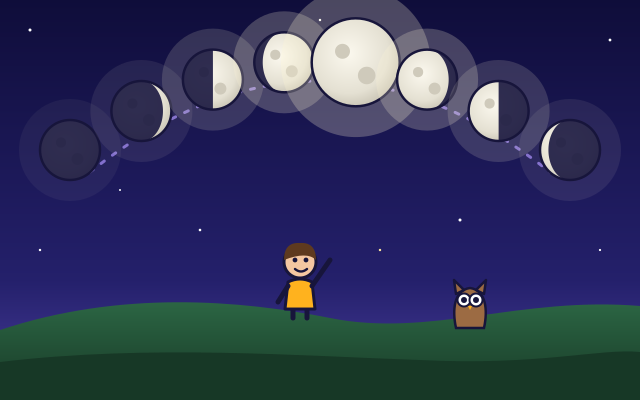
Why does the Moon seem to change shape?
Move the Moon around Earth and compare its sunlit half with the portion visible from the ground. Match positions to lunar phases.
#80
Space & astronomy
Why does the Moon seem to change shape?
Move the Moon around Earth and compare its sunlit half with the portion visible from the ground. Match positions to lunar phases.
 #81
Space & astronomy
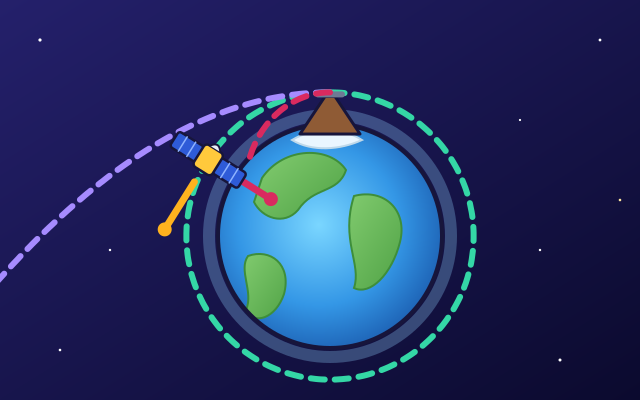
How do satellites stay in orbit?
Explore gravity and sideways motion in a simplified orbital simulation. Adjust a satellite's starting speed and height to compare its path.
#81
Space & astronomy
How do satellites stay in orbit?
Explore gravity and sideways motion in a simplified orbital simulation. Adjust a satellite's starting speed and height to compare its path.
 #82
Space & astronomy
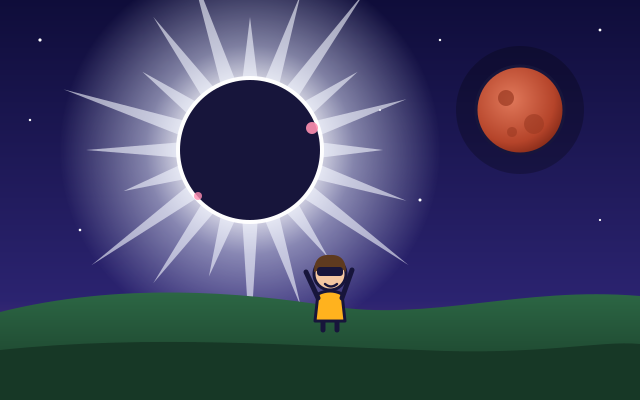
How do solar and lunar eclipses happen?
Align the Sun, Earth, and Moon. Compare the shadows in solar and lunar eclipses and investigate why an eclipse does not happen every month.
#82
Space & astronomy
How do solar and lunar eclipses happen?
Align the Sun, Earth, and Moon. Compare the shadows in solar and lunar eclipses and investigate why an eclipse does not happen every month.
 #83
Space & astronomy
How does a space station support astronauts?
Explore air, water, food, power, exercise, and waste systems. Manage a small station and discover how astronauts live and work in orbit.
#83
Space & astronomy
How does a space station support astronauts?
Explore air, water, food, power, exercise, and waste systems. Manage a small station and discover how astronauts live and work in orbit.
Keep exploring
Games to play next
- Seasons and SkiesFrom days of the week to Earth's tilt: dress for the weather, read the sky and discover why seasons happen.
- Globe ExplorerSpin a real 3D globe, flip to the flat map, and find continents, oceans and countries.
- Science QuizzesOlly's Science Quiz Show: plants, animals, the body, weather, space and more, for every grade.
Guide for grown-ups
- How to start homeschooling: a step-by-step guide for familiesA guide for parents · 7 min read
Science games by grade
Science worksheets by grade
- Preschool Science Worksheets
- Pre-K Science Worksheets
- Kindergarten Science Worksheets
- 1st Grade Science Worksheets
- 2nd Grade Science Worksheets
- 3rd Grade Science Worksheets
- 4th Grade Science Worksheets
- 5th Grade Science Worksheets
- 6th Grade Science Worksheets
- 7th Grade Science Worksheets
- 8th Grade Science Worksheets