How are plastic toys made?
Plastic beads are melted, squirted into a steel mold, cooled and popped out. Then the pieces are put together and decorated.
The big idea: Some plastics go soft and runny when heated and hard again when cooled. Injection molding squirts hot, runny plastic into a toy-shaped mold, lets it cool and harden, and pops it out.
It's like
The interactive parts didn't load. The explanations below still work; try reloading the page.
How a toy is molded
- Toys start as tiny plastic pellets. Plastic is made of very long, chain-like molecules. Colored pellets can be mixed in to give the toy its color.
- The pellets fall into a heated tube. A big turning screw pushes them along. Heaters and rubbing melt them into thick, runny plastic, at about 200 to 250 degrees Celsius.
- The two halves of a steel mold clamp shut. The screw pushes forward like a syringe and squirts the hot plastic into the toy-shaped hole inside. It fills in about a second.
- Cool water flows through little tunnels in the mold and carries the heat away. The plastic hardens. It shrinks a tiny bit, so the machine keeps pushing in a little more plastic.
- The mold opens and little pins push the part out. The extra plastic from the channels is snipped off and can be melted again. Then the mold closes for the next toy.
- Finally the pieces are put together. Wheels snap on, and printing or stickers add faces, stripes and numbers. Then the toy is checked and packed.
Inside an injection molding machine
Tap each part of the machine to see what it does. Many of them move!
- Hopper. The hopper is a big funnel that holds the plastic pellets. They trickle down into the barrel below.
- Screw. The screw turns to push the pellets forward and mix the melted plastic. Then it slides forward like a syringe to squirt the plastic out.
- Heater bands. Heater bands wrap around the barrel to warm it. The plastic melts at about 200 to 250 degrees Celsius.
- Nozzle. The nozzle presses tightly against the mold, so the hot plastic shoots into the mold without leaking.
- Steel mold. The mold is made of two halves of very hard steel. It is carefully cut so that every toy comes out exactly the same.
- Cavity. The cavity is the toy-shaped space inside the mold. Plastic flows in through a small opening called a gate and fills it.
- Cooling channels. Water flows through tunnels drilled in the mold. It carries the heat away so the plastic hardens quickly.
- Ejector pins. When the mold opens, these pins push the hard plastic part out. Look for tiny round marks on toys: they show where the pins pushed.
- Clamp. The clamp squeezes the two mold halves together very hard, so the hot plastic can't leak out between them.
Run the molding machine
Pick a toy design. Change the heat and the push. The machine makes a toy every cycle. When does the plastic fill the whole mold?
Experiment: What happens if the plastic isn't hot enough?
- Set the push to Medium.
- Turn the heat down to Cool and watch the next toy.
- Then turn the heat up to Hot. Compare the toys in the bin.
What we found: Cool plastic is thick and sticky, so it flows slowly and starts to harden against the cold mold before it reaches the far corners. The toy comes out with missing pieces. That's called a short shot. Hot plastic flows easily and fills the whole shape.
Turn on JavaScript to try it yourself.
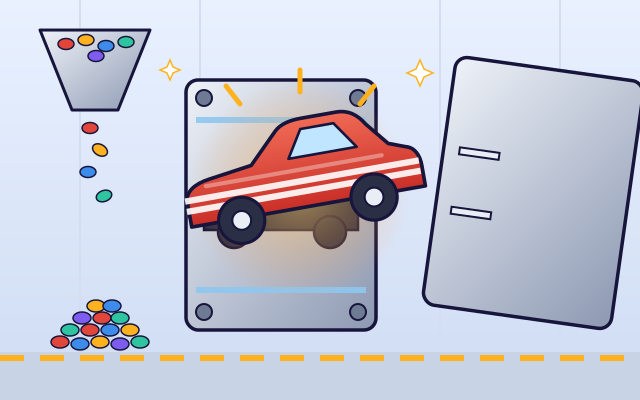
The toy car factory
Design a toy car, mold its parts with no defects, cool them, snap on the wheels and decorate it.
Molding plastic toys
Plastics are made of very long molecules, like tangled strands of spaghetti. Many toy plastics are thermoplastics: when they are heated, the strands can slide past each other, so the plastic flows. When it cools, the strands lock in place again, and the plastic is hard.
In injection molding, plastic pellets are melted in a heated tube by a turning screw. Then the screw pushes the hot plastic into a steel mold, a bit like squeezing a syringe. The plastic fills the toy-shaped hole, cools against the cold steel, and hardens.
Getting the settings right matters. If the plastic is too cool or pushed too gently, it hardens before filling the mold, and the toy has missing bits. If it is pushed too hard, plastic squeezes out between the mold halves and makes thin, sharp edges called flash. Take the toy out too soon and it bends.
Molds are expensive, but one mold can make hundreds of thousands of identical toys, each in less than a minute. After molding, pieces are snapped together, printed or painted, checked and packed. Leftover bits of plastic can often be ground up and melted again.
Key words
- Polymer
- A material made of very long chain molecules built from repeating units.
- Thermoplastic
- A plastic that softens when heated and hardens when cooled, again and again.
- Mold
- A hollow block, usually steel, shaped like the part you want to make.
- Short shot
- A part with missing pieces because the plastic hardened before filling the mold.
- Flash
- Thin extra plastic squeezed out between the mold halves.
- Ejector pin
- A pin that pushes the finished part out of the mold.
- Cycle time
- How long the machine takes to make one shot, from closing the mold to closing it again.
Check your thinking
-
Why can thermoplastics be molded?
Show the answer
They soften and flow when heated, then harden when cooled. Heat lets the long molecules slide, so the plastic flows. Cooling locks them in place again.
-
What is a short shot?
Show the answer
A part with missing bits because the plastic hardened before filling the mold. If the plastic cools and stiffens too soon, it can't reach the far corners of the mold.
-
Why does cold water flow through the mold?
Show the answer
To carry heat away so the plastic hardens quickly. The water takes heat from the steel, so the toy cools and hardens fast.
-
Why do toys often have tiny round marks on their undersides?
Show the answer
Ejector pins pushed there to pop the part out. Ejector pins press on the part to push it out of the mold, leaving small round marks.
-
Why is a toy's mold made slightly bigger than the finished part?
Show the answer
Plastic shrinks a little as it cools. Plastics shrink as they cool, often around 0.5 to 2 percent, so the cavity is made slightly oversize.
You're a Making everyday things expert!
You watched, looked inside, tried it, solved the challenge and went deeper. Pick another question below, or switch the age at the top to see this topic another way.
More about making everyday things
 #18
Making everyday things
How are bricks made?
Prepare virtual clay, shape bricks, dry them, and fire them in a kiln. Compare brick shapes and arrange them into different wall patterns.
#18
Making everyday things
How are bricks made?
Prepare virtual clay, shape bricks, dry them, and fire them in a kiln. Compare brick shapes and arrange them into different wall patterns.
 #19
Making everyday things
How is pottery made?
Shape clay on a virtual pottery wheel. Explore drying, kiln firing, and glazing, and see how each stage changes the object.
#19
Making everyday things
How is pottery made?
Shape clay on a virtual pottery wheel. Explore drying, kiln firing, and glazing, and see how each stage changes the object.
 #20
Making everyday things
How does a 3D printer make an object?
Turn a simple digital design into layers. Watch a filament printer build it layer by layer and explore why some shapes need temporary supports.
#20
Making everyday things
How does a 3D printer make an object?
Turn a simple digital design into layers. Watch a filament printer build it layer by layer and explore why some shapes need temporary supports.
 #301
Making everyday things
How is steel made?
Follow iron through a simplified steelworks and shape finished steel into useful products.
#301
Making everyday things
How is steel made?
Follow iron through a simplified steelworks and shape finished steel into useful products.
Keep exploring
Games to play next
- Sorting FactoryTurn a work order into if/else rules and watch the conveyor sort every item.
- Machine RepairFix levers, pulleys, gears and ramps so every contraption works.
- Geometry Architect 3DCount, build and fold solids like a real architect.
Guide for grown-ups
- How to start homeschooling: a step-by-step guide for familiesA guide for parents · 7 min read
Science games by grade
Science worksheets by grade
- Preschool Science Worksheets
- Pre-K Science Worksheets
- Kindergarten Science Worksheets
- 1st Grade Science Worksheets
- 2nd Grade Science Worksheets
- 3rd Grade Science Worksheets
- 4th Grade Science Worksheets
- 5th Grade Science Worksheets
- 6th Grade Science Worksheets
- 7th Grade Science Worksheets
- 8th Grade Science Worksheets