How does crop rotation help farms?
Farmers grow a different crop in each field every year. It keeps the soil rich and the pests away.
The big idea: Every crop takes different things from the soil and has its own pests. Changing the crop each year gives the soil time to refill and leaves the pests with nothing to eat.
It's like a team that takes turns: one player runs hard and gets tired, another rests and brings the snacks, so the team stays strong all season.
The interactive parts didn't load. The explanations below still work; try reloading the page.
Why farmers swap their crops
- This field grew a great crop of corn: three full baskets. So the farmer plans to plant corn again next year, and the year after. What could go wrong?
- Corn is a hungry crop. Its roots take lots of nitrogen, a food that plants need to grow. Year after year the nitrogen runs low, and the corn grows small and pale.
- There is another problem. Bugs that eat corn lay their eggs in the soil. If corn grows there again next year, the baby bugs hatch right next to their favorite food.
- So the farmer plants beans instead. Tiny helpers in bumps on bean roots catch nitrogen from the air and put it into the soil. And the corn bugs hatch, find no corn and starve.
- After the harvest, bare soil can wash away in the rain. A cover crop such as clover acts like a blanket. Its leaves break the fall of the raindrops and its roots hold the soil together.
- So farmers follow a plan: corn, then beans, then carrots, then clover, and round again. This is crop rotation. The soil refills, the pests starve and the harvest stays big.
Look inside a crop rotation
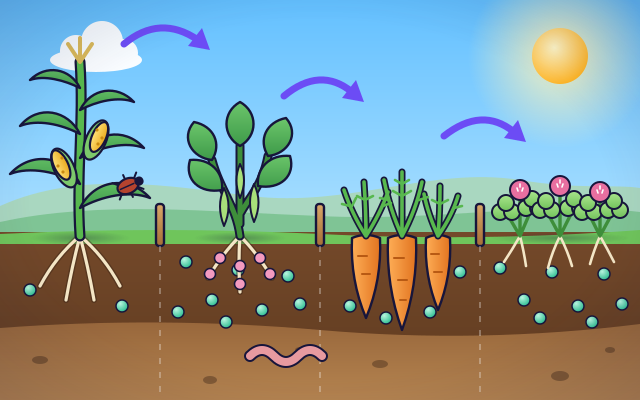
Four fields, four crops. Tap each part to see what it does to the soil.
- Hungry crop: corn. Corn is a heavy feeder. It grows fast and tall, and to do that it takes a lot of nitrogen out of the soil.
- Root nodules. Bean roots have small bumps called nodules. Friendly bacteria live inside and turn nitrogen from the air into plant food.
- Root crop: carrots. Carrots are light feeders: they need only a little nitrogen. Their long roots push deep and loosen the soil.
- Cover crop: clover. Clover is a cover crop. It is not grown to eat. It covers the soil so rain and wind cannot carry it away.
- Nitrogen. The green dots show nitrogen, a food plants need to make green leaves. There is lots under the clover and little under the corn.
- Pests and their eggs. Many bugs eat only one kind of crop. They lay eggs in the soil, and the babies hatch the next spring, looking for the same crop.
- Earthworms. Earthworms eat old roots and leaves and turn them into rich soil. Their tunnels let air and water in.
- Rotation plan. The plan is a circle. Each year every crop moves to the next field, so no field grows the same crop twice in a row.
Year after year in one field
Tap a seed packet to grow one year. Watch the nitrogen dots, the bugs and the baskets. What happens if you plant the same crop again and again?
Experiment: You grow corn in the same field three years in a row. What happens to the harvest?
- Press Start over, then plant corn three times.
- Watch the green dots, the bugs and the baskets each year.
- Now plant beans, then corn again. What changed?
What we found: Corn takes a lot of nitrogen, and its pests wait in the soil for the next corn crop. So corn after corn gives smaller and smaller harvests. A year of beans puts nitrogen back and starves the corn pests.
Turn on JavaScript to try it yourself.
The six-year plan
Plan 6 years. The village needs corn in at least 3 of them. Harvest 11 baskets or more.
Why crop rotation works
Plants do not only need sunlight and water. They also need food from the soil. One of the most important soil foods is nitrogen, which plants use to make their green leaves. Some crops, such as corn, are heavy feeders: they take a lot of nitrogen. If a farmer plants corn in the same field every year, the nitrogen runs low and the corn grows small and pale.
Beans, peas and clover are special. They belong to a family called legumes. On their roots are little bumps called nodules, and inside the bumps live friendly bacteria. The bacteria catch nitrogen from the air and turn it into plant food. So when a legume grows in a field, the soil ends up richer than before.
Pests are the second reason to rotate. Many bugs and plant diseases attack only one kind of crop. They spend the winter in the soil as eggs. If the same crop comes back next spring, they hatch beside their favorite food, and each year there are more of them. If a different crop grows there, most of them starve.
The third reason is the soil itself. Bare soil can be washed away by rain or blown away by wind. A cover crop, such as clover, covers it like a blanket and holds it with its roots. When farmers put these ideas together into a plan, changing the crop in each field every year, it is called crop rotation.
Key words
- Crop rotation
- Growing a different crop in the same field each year, following a plan.
- Nitrogen
- A soil food that plants need to grow green leaves.
- Legume
- A plant such as a bean, pea or clover whose root bacteria take nitrogen from the air.
- Nodule
- A small bump on a legume root where nitrogen-fixing bacteria live.
- Cover crop
- A crop grown to protect and feed the soil, not to be harvested.
- Monoculture
- Growing the same single crop on the same land year after year.
Check your thinking
-
Which crop adds nitrogen to the soil?
Show the answer
Beans. Bacteria in the bumps on bean roots take nitrogen from the air.
-
A farmer grows corn in one field for four years in a row. What is likely to happen?
Show the answer
The harvest shrinks as nitrogen runs low and corn pests build up. Corn keeps taking nitrogen, and its pests keep finding their favorite food.
-
Corn bugs laid eggs in a field. Next spring the field is planted with beans. What happens to most of the baby bugs?
Show the answer
They hatch, find no corn and starve. These bugs can only eat corn roots. With no corn, there is nothing for them to eat.
-
Why do farmers grow a cover crop that they will not harvest?
Show the answer
It keeps rain and wind from carrying the soil away. Leaves break the fall of raindrops and roots hold the soil together.
-
A farmer keeps growing corn every year but adds enough nitrogen fertilizer. Which problem remains?
Show the answer
Corn pests still build up, and the soil is still left bare in winter. Fertilizer replaces the nutrient, but it does not break pest cycles or protect and feed the soil.
-
Which plan is a crop rotation?
Show the answer
Corn, then beans, then carrots, then clover. In a rotation a different crop grows in the field each year.
You're a Food & farming expert!
You watched, looked inside, tried it, solved the challenge and went deeper. Pick another question below, or switch the age at the top to see this topic another way.
More about food & farming
 #298
Food & farming
How do farmers use natural pest control?
Introduce beneficial organisms and observe effects on pests and crop damage.
#298
Food & farming
How do farmers use natural pest control?
Introduce beneficial organisms and observe effects on pests and crop damage.
 #299
Food & farming
How does a hen make an egg?
Assemble yolk, albumen, membranes, and shell along a simplified internal timeline.
#299
Food & farming
How does a hen make an egg?
Assemble yolk, albumen, membranes, and shell along a simplified internal timeline.
 #300
Food & farming
How is sea salt produced?
Guide seawater through evaporation, crystallization, harvesting, cleaning, and packaging.
#300
Food & farming
How is sea salt produced?
Guide seawater through evaporation, crystallization, harvesting, cleaning, and packaging.
 #21
Food & farming
How is bread made, and why does dough rise?
Mix ingredients, zoom into dough as gas bubbles develop, and watch a loaf change during baking. Compare different rising times in a simulation.
#21
Food & farming
How is bread made, and why does dough rise?
Mix ingredients, zoom into dough as gas bubbles develop, and watch a loaf change during baking. Compare different rising times in a simulation.
Keep exploring
Games to play next
- Garden AutomationProgram a garden robot with sensor rules — then watch a whole day play out.
- Ratio KitchenScale recipes, fill ratio tables and find the better buy.
- Label LabPut the right labels on beautiful science diagrams, from bean plants to heart chambers.
Guide for grown-ups
- How to start homeschooling: a step-by-step guide for familiesA guide for parents · 7 min read
Science games by grade
Science worksheets by grade
- Preschool Science Worksheets
- Pre-K Science Worksheets
- Kindergarten Science Worksheets
- 1st Grade Science Worksheets
- 2nd Grade Science Worksheets
- 3rd Grade Science Worksheets
- 4th Grade Science Worksheets
- 5th Grade Science Worksheets
- 6th Grade Science Worksheets
- 7th Grade Science Worksheets
- 8th Grade Science Worksheets