How does a hen make an egg?
It takes a hen about a day to build one egg, layer by layer, from the yolk out to the shell.
The big idea: An egg is built from the inside out. The yolk travels down a long tube, and each part of the tube adds one layer: egg white, two thin skins, then the shell.
It's like a sandwich line: the plate moves along the counter and each cook adds one layer, always in the same order.
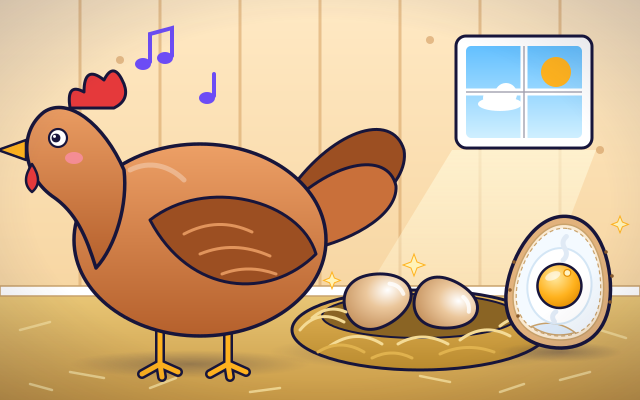
The interactive parts didn't load. The explanations below still work; try reloading the page.
One egg, one day
- Almost every day a hen lays one egg. Yesterday the nest was empty, and today there is a perfect egg with a hard shell. How does she build it in a single day?
- This is a simple picture of the inside of a hen. Yolks of different sizes are growing. When the biggest one is ready, it lets go and a soft funnel catches it.
- The yolk moves slowly along the tube. For the next three hours the walls add layer after layer of egg white. The white cushions the yolk and holds lots of water.
- In the next part, two thin skins wrap around the white. They are like a soft bag that gives the egg its shape. This takes a little over an hour.
- The last stop is the longest: about 20 hours. Here a hard shell slowly builds up from calcium, the same material as chalk. Near the end, the shell gets its color.
- After about 25 hours of work the egg is finished, and the hen lays it in her nest. About half an hour later the next yolk sets off, and the whole journey begins again.
Look inside an egg
Here is an egg cut in half. Tap each part to find out what it is for.
- Shell. The shell is the egg's hard armor. It is made of calcium, like chalk, and it is thin but surprisingly strong.
- Pores. The shell is dotted with thousands of holes too small to see, called pores. They let air in and out.
- Two skins. Just inside the shell are two thin skins. You can see them when you peel a boiled egg. They help keep germs out.
- Air cell. At the blunt end is a pocket of air between the two skins. It forms when the warm egg cools down after it is laid.
- Egg white. The egg white is mostly water with some protein. It cushions the yolk like a pillow and helps protect it from germs.
- Twisted cords. Two twisted white cords hold the yolk in the middle of the egg, like ropes on a hammock.
- Yolk. The yolk is the first part to be made. It is packed with food: fat, protein and vitamins.
- Germ spot. This small pale spot sits on the yolk. Eggs from the shop come from hens that live without a rooster, so no chick can grow in them.
Ride the egg road
Move the egg from stop to stop. Each stop adds a layer and needs time. Make one perfect egg, then find out what happens if you hurry.
Experiment: What happens if an egg leaves the shell stop after only a short time?
- Move the egg to each stop and wait for the ring to fill. Lay a perfect egg.
- Begin a new egg. This time leave the shell stop early.
- Compare the two eggs. What was missing?
What we found: The shell is added last and takes the longest: about 20 hours. An egg that leaves too soon has only a thin, soft shell. Every layer needs its time, and the order never changes.
Turn on JavaScript to try it yourself.
Put the steps in order
Fill the four stops in the right order. What is made first, and what is added last? Then send the egg.
A day in the making
An egg is built from the inside out, and it starts with the yolk. Yolks grow inside the hen for about ten days, filling up with food. When one is big enough, it is let go and caught by a soft funnel. The funnel is the start of a long tube, and the yolk now travels down it, slowly, in one direction only.
Each part of the tube has one job. The first long part adds the egg white, layer after layer, for about three hours. The next part wraps the white in two thin skins, which takes a little over an hour. Now the egg has its shape, but it is still soft, like a water balloon.
The last stop is the longest. For about 20 hours, mostly through the night, a hard shell builds up on the skins. The shell is made of calcium, the same material as chalk and seashells. To make it, the hen needs plenty of calcium in her food, so farmers often give hens crushed shells to peck at. In the last hours the shell gets its color.
Then the hen lays the egg, and about half an hour later the next yolk sets off. That is why a hen can lay about one egg a day. The eggs we eat could never become chicks: a chick can only start to grow if a rooster lives with the hens, and even then the egg must be kept warm for three weeks.
Key words
- Yolk
- The yellow center of an egg, full of stored food. It is the first part to be made.
- Albumen
- The proper name for egg white.
- Membrane
- A thin skin. An egg has two of them just under the shell.
- Oviduct
- The long tube inside a hen where the egg is built.
- Calcium carbonate
- The hard, chalky material that eggshells, seashells and limestone are made of.
- Pore
- A tiny hole. Eggshell pores let air and water vapor pass through.
Check your thinking
-
Which part of an egg is made first?
Show the answer
The yolk. An egg is built from the inside out, starting with the yolk.
-
Which step takes the most time?
Show the answer
Building the shell: about 20 hours. The shell grows slowly, crystal by crystal, for about 20 hours.
-
Why could the shell not be put on before the egg white?
Show the answer
Once the hard shell is on, nothing more can get inside. Each layer wraps around the one before, so the hard outside layer has to come last.
-
A hen is not getting enough calcium in her food. What will her eggs be like?
Show the answer
They will have thin shells that crack easily. The shell is made of calcium, so with too little calcium the shell is thin.
-
The shell gland needs about 20 hours and the earlier steps about 5. What does this tell you about how many eggs a hen can lay?
Show the answer
About one a day, because the slowest step sets the pace. The steps add up to about 25 hours, and the oviduct normally holds one egg at a time.
-
What are the tiny pores in an eggshell for?
Show the answer
To let air pass in and out. Pores let air through the shell, which a growing chick would need.
You're a Food & farming expert!
You watched, looked inside, tried it, solved the challenge and went deeper. Pick another question below, or switch the age at the top to see this topic another way.
More about food & farming
 #300
Food & farming
How is sea salt produced?
Guide seawater through evaporation, crystallization, harvesting, cleaning, and packaging.
#300
Food & farming
How is sea salt produced?
Guide seawater through evaporation, crystallization, harvesting, cleaning, and packaging.
 #21
Food & farming
How is bread made, and why does dough rise?
Mix ingredients, zoom into dough as gas bubbles develop, and watch a loaf change during baking. Compare different rising times in a simulation.
#21
Food & farming
How is bread made, and why does dough rise?
Mix ingredients, zoom into dough as gas bubbles develop, and watch a loaf change during baking. Compare different rising times in a simulation.
 #22
Food & farming
How is ice cream made?
Follow mixing, chilling, and churning inside a transparent machine. Experiment with simulated churning conditions and explore how air and ice crystals affect texture.
#22
Food & farming
How is ice cream made?
Follow mixing, chilling, and churning inside a transparent machine. Experiment with simulated churning conditions and explore how air and ice crystals affect texture.
 #23
Food & farming
How is chocolate made?
Follow cacao from pods through fermentation, drying, roasting, grinding, mixing, and molding. Run a miniature chocolate factory and design a finished shape.
#23
Food & farming
How is chocolate made?
Follow cacao from pods through fermentation, drying, roasting, grinding, mixing, and molding. Run a miniature chocolate factory and design a finished shape.
Keep exploring
Games to play next
- Ratio KitchenScale recipes, fill ratio tables and find the better buy.
- Garden AutomationProgram a garden robot with sensor rules — then watch a whole day play out.
- Label LabPut the right labels on beautiful science diagrams, from bean plants to heart chambers.
Draw it or make it
- How to draw a chickDrawing lesson
Guide for grown-ups
- How to start homeschooling: a step-by-step guide for familiesA guide for parents · 7 min read
Science games by grade
Science worksheets by grade
- Preschool Science Worksheets
- Pre-K Science Worksheets
- Kindergarten Science Worksheets
- 1st Grade Science Worksheets
- 2nd Grade Science Worksheets
- 3rd Grade Science Worksheets
- 4th Grade Science Worksheets
- 5th Grade Science Worksheets
- 6th Grade Science Worksheets
- 7th Grade Science Worksheets
- 8th Grade Science Worksheets