How do knots hold ropes and shoelaces together?
Loops, pulling and rubbing work together so a knot grips harder the harder you pull.
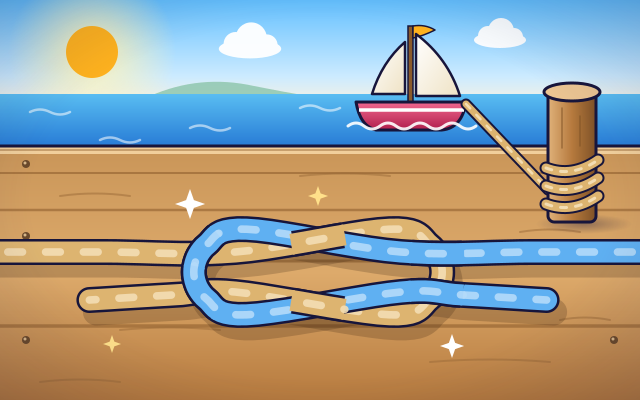
The big idea: A knot bends rope into loops that press on each other. Pulling tightens the loops, the squeeze makes more friction, and the friction stops the rope from sliding.
It's like holding hands in a tug game: the harder your friend pulls, the tighter you both squeeze, so your hands do not slip apart.
The interactive parts didn't load. The explanations below still work; try reloading the page.
Why knots hold
- With loose laces, nothing holds this shoe on. A knot would fix it. But how can a bit of bent lace hold so well?
- Rope is made of tiny rough fibers. Lightly touching ropes slide past each other. Press them together and the fibers catch. That catching is called friction.
- Wind a rope round a post and every loop rubs on the wood. Each extra loop takes away a big share of the pull, so a small hand can hold a boat.
- In a knot the rope loops around itself. Pull the ends and the loops shrink and squeeze the rope inside. The harder you pull, the harder it grips.
- A shoelace bow is two tucks. The second tuck is made with loops, so one pull on a lace end slides it out and unties the bow.
- Loops make squeeze, squeeze makes friction, and friction holds. That is how a little knot keeps your shoes on all day.
Look inside a reef knot
Two ropes are joined by a reef knot. Tap each part to see how it helps the knot hold.
- Standing part. The standing part is the long piece that carries the pull into the knot. When it pulls, the whole knot tightens.
- Loop. Each rope bends into a U-shaped loop that hooks through the other rope's loop. Sailors call this bend a bight.
- Crossings. Wherever rope crosses rope, the two rub together. A reef knot has six crossings, so there are six places making friction.
- The nip. The nip is where a loop squeezes the ropes inside it hardest. Pull the knot and the nip pinches tighter.
- Tail. The tail is the short end left over. As the knot tightens it pulls in a little of the tail, so a tail that is too short can slip right through.
- Fibers. Look closely: rope is thousands of thin fibers twisted into strands. Their bumpy surface is what makes rope grip rope.
Loops round a post
Wind the rope round the post, change the rope and change the wind. When does a small hand hold the boat, and when does the rope slip?
Experiment: What happens to the pull your hand must hold when you add more loops round the post?
- Start with no loops and watch the boat.
- Add one loop at a time. Watch the green arrow at the hand.
- Try the slippery rope. How many loops does it need?
What we found: Every loop rubs on the post and takes away a big share of the pull. With enough loops a small hand can hold a whole boat. Slippery rope has less friction, so it needs more loops.
Turn on JavaScript to try it yourself.
Tie a knot that holds
Join the two ropes with two tucks, then press Pull test. The knot must hold.
How knots hold
Rope looks smooth, but up close it is made of thousands of thin fibers twisted together, and its surface is bumpy. When two pieces of rope are pressed together and try to slide, the bumps catch on each other. That catching is called friction, and friction is the reason a knot can hold.
A knot is a clever way of making a rope press on itself. The rope bends into loops and crosses over itself, and at every crossing rope rubs on rope. When you pull on the knot, the loops get smaller and squeeze the rope inside them. The harder you pull, the harder the squeeze and the more friction there is. So the pull that tries to undo the knot is the same pull that locks it.
More loops mean more rubbing. That is why a sailor winds a rope round a post a few times before tying it. Each turn takes away a big share of the pull, so a small hand can hold a big boat. Slippery rope needs more turns than rough rope.
The shape of the knot matters too. In a reef knot the second tuck goes the opposite way to the first, so the two ropes lock together neatly. If both tucks go the same way you get a granny knot, which twists and slips. A shoelace bow is a reef knot with loops in it, which is why one pull on an end unties it. Holding hands is only a rough comparison: your hands choose to squeeze, but a knot squeezes all by itself.
Key words
- Friction
- The grip between two surfaces that stops them sliding past each other.
- Tension
- The pulling force carried along a rope.
- Bight
- A U-shaped bend in a rope; the loop that knots are built from.
- Nip
- The place in a knot where the rope is squeezed hardest.
- Reef knot
- A flat knot made of two opposite tucks: left over right, then right over left.
- Granny knot
- A knot made of two tucks the same way round. It twists and slips.
- Capstan equation
- A rule that tells sailors how much each turn of rope round a post helps.
Check your thinking
-
Why does a knot hold?
Show the answer
Its loops squeeze the rope, and friction stops it sliding. Pulling shrinks the loops. They squeeze the rope inside, and friction between the rough fibers stops it sliding.
-
You wind a rope round a post one more time. What happens to the pull your hand must hold?
Show the answer
It gets much smaller. Each loop rubs on the post and takes a big share of the pull, so less is left for your hand.
-
With μ = 0.2, one full turn round a post divides the holding force by about 3.5. What do two full turns divide it by?
Show the answer
About 12. The factors multiply: 3.5 × 3.5 is about 12. That is what exponential growth with wrap angle means.
-
Your knot twists and slips, and its tails stick out sideways. What should you change?
Show the answer
Make the second tuck go the opposite way. Two tucks the same way make a granny knot. Opposite tucks make a reef knot, which locks flat.
-
Why does a shiny ribbon come untied more easily than a rough shoelace?
Show the answer
There is less friction between its smooth surfaces. Smooth surfaces catch on each other less, so the same squeeze makes less friction.
-
A knotted rope breaks at a lower load than the same rope with no knot. Why?
Show the answer
Tight bends put extra stress on some of the fibers. Fibers on the outside of a tight bend stretch more than the rest and fail first, so the whole rope gives way sooner.
You're a Everyday objects expert!
You watched, looked inside, tried it, solved the challenge and went deeper. Pick another question below, or switch the age at the top to see this topic another way.
More about everyday objects
 #150
Everyday objects
How does a trigger spray bottle work?
Pull the trigger and follow liquid through a pump, valves, and nozzle.
#150
Everyday objects
How does a trigger spray bottle work?
Pull the trigger and follow liquid through a pump, valves, and nozzle.
 #151
Everyday objects
How do foaming soap dispensers make foam?
Watch liquid soap and air combine and pass through a fine mesh.
#151
Everyday objects
How do foaming soap dispensers make foam?
Watch liquid soap and air combine and pass through a fine mesh.
 #152
Everyday objects
How does a click pen extend and retract?
Inspect the spring and rotating mechanism inside a transparent retractable pen.
#152
Everyday objects
How does a click pen extend and retract?
Inspect the spring and rotating mechanism inside a transparent retractable pen.
 #153
Everyday objects
How does a mechanical pencil advance its graphite?
Press the button and watch tiny gripping parts move and hold the graphite.
#153
Everyday objects
How does a mechanical pencil advance its graphite?
Press the button and watch tiny gripping parts move and hold the graphite.
Keep exploring
Games to play next
- Machine RepairFix levers, pulleys, gears and ramps so every contraption works.
- Science QuizzesOlly's Science Quiz Show: plants, animals, the body, weather, space and more, for every grade.
Guide for grown-ups
- How to start homeschooling: a step-by-step guide for familiesA guide for parents · 7 min read
Science games by grade
Science worksheets by grade
- Preschool Science Worksheets
- Pre-K Science Worksheets
- Kindergarten Science Worksheets
- 1st Grade Science Worksheets
- 2nd Grade Science Worksheets
- 3rd Grade Science Worksheets
- 4th Grade Science Worksheets
- 5th Grade Science Worksheets
- 6th Grade Science Worksheets
- 7th Grade Science Worksheets
- 8th Grade Science Worksheets