How do hydraulic systems multiply force?
Liquid trapped between a small piston and a big one turns a small push into a big lift.
The big idea: Liquid cannot be squashed, so a push on a small piston travels through it. A bigger piston at the other end gets a bigger push, but moves a shorter way.
It's like a seesaw made of liquid: a small push that goes a long way on one side becomes a big push that goes a short way on the other.
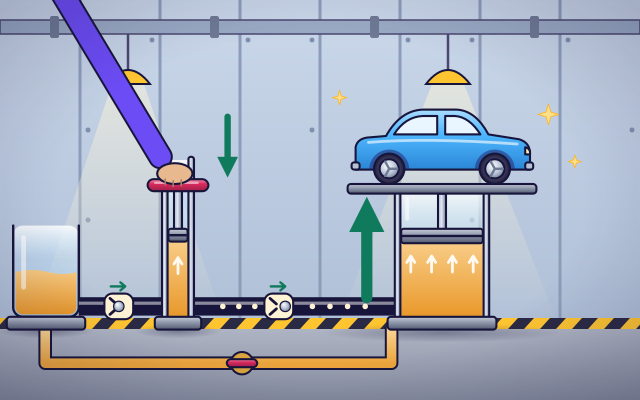
The interactive parts didn't load. The explanations below still work; try reloading the page.
How liquid lifts a car
- A car needs a new wheel, so it has to go up. But a car is far too heavy to lift with your arms. How can a small push lift it?
- Here are two pistons joined by a pipe full of oil. Oil cannot be squashed into a smaller space. So when one piston goes down, the oil has to move, and it pushes the other piston up.
- Your push squeezes the oil, and the squeeze spreads everywhere. Every patch of the walls and pistons gets the same push. That squeeze is called pressure. A bigger piston has more patches, so it gets more push.
- There is a catch. The oil from the thin tube has to spread out in the wide one. So the small piston moves a long way, and the big piston rises only a little. You trade distance for force.
- To lift higher, we pump many times. Two one-way valves act like little doors. One lets oil in from the tank. The other lets it out to the big piston and stops it from coming back.
- The car is up! Many small, easy pushes added up to one big lift. Brakes, diggers and dentist chairs all use liquid in this way.
Look inside a hydraulic jack
Tap each part of the jack. Watch where the oil goes.
- Pump handle. You push the handle down, and that pushes the small piston into the oil. Lift it and it is ready for the next push.
- Small piston. The small piston fits snugly in its tube. Because it is small, your push is squeezed onto a small patch of oil, which makes a strong squeeze.
- Oil. The oil is the messenger. It cannot be squashed, so it carries your push all the way to the big piston. It also keeps the parts slippery.
- One-way valves. Each valve has a ball that works like a one-way door. Oil can push the ball aside to go forward, but when oil tries to go back, the ball blocks the hole.
- Pipe. The pipe joins the two cylinders. It can be long and bendy, so the pushing and the lifting can happen in different places.
- Big piston. The big piston has much more area for the oil to push on. The same squeeze on more area makes a much bigger push, enough to lift the car.
- Oil tank. The tank holds spare oil. Each time the handle goes up, the small cylinder sucks in a little more oil from here.
- Release valve. Open this tap and the oil can flow back to the tank. The car sinks gently, because the oil can only squeeze through a small hole.
Small piston, big piston
Push the red handle and watch both pistons. Then make the lifting piston wider. What changes about the push, and about how far each piston moves?
Experiment: You make the lifting piston 4 times as wide. What happens when you push the small piston all the way down?
- Choose the heavy weight. Push the handle with both pistons the same size. Does it lift?
- Make the lifting piston wider, one step at a time, until the weight goes up.
- Compare how far the small piston went down with how far the big one came up.
What we found: A piston 4 times as wide gets 4 times the push from the oil, so it can lift a load 4 times as heavy. But the oil from the thin tube has to spread across the wide one, so the big piston rises only a quarter as far.
Turn on JavaScript to try it yourself.
Lift the car with few pumps
Lift the car to the green line. Choose a lifting piston wide enough to lift it, but you only have 10 pumps.
Why a big piston pushes harder
Fill a bottle to the brim with water and try to squeeze it smaller. You cannot. Liquids do not squash. That makes a liquid a good messenger: push on it in one place, and it pushes back everywhere else at once.
The push on each little patch of the liquid is called pressure. In a closed system the pressure is the same everywhere. A small piston touches only a few patches. A big piston touches many patches, and every one of them gets the same push. Add them up and the big piston gets a much bigger push in total.
But you never get something for nothing. The oil you push out of the thin tube has to spread out across the wide one, so the big piston rises only a little. A piston 10 times as wide pushes 10 times as hard and moves one tenth as far. That is why a jack needs many pumps to lift a car.
A seesaw trades distance for force in the same way, but our seesaw comparison breaks down in one place: liquid can go around corners and along hoses. That is why hydraulics are used in car brakes, diggers, dump trucks and airplane wheels, where a push has to reach places a stiff beam never could.
Key words
- Hydraulics
- Using a trapped liquid to carry a push from one place to another.
- Pressure
- How hard something pushes on each little patch of a surface.
- Piston
- A plug that slides inside a tube and seals it, so it can push on the liquid or be pushed by it.
- Pascal's principle
- A push on a trapped liquid spreads equally to every part of it.
- Check valve
- A one-way valve: fluid can pass in one direction but is blocked in the other.
Check your thinking
-
You push the small piston down. Why does the big piston go up?
Show the answer
The oil cannot be squashed, so it moves and pushes the big piston. Oil keeps its size. When you push some out of one tube, it has to go into the other and lift that piston.
-
Which lifting piston can lift the heaviest load with the same push?
Show the answer
The widest one. The oil pushes equally on every patch, and a wider piston has more patches, so the total push is bigger.
-
A big piston pushes 5 times as hard as your push. How far does it rise when you push the small piston down 10 centimeters?
Show the answer
2 centimeters. Five times the push means one fifth of the distance: 10 divided by 5 is 2.
-
Why does a jack need many pumps to lift a car a little way?
Show the answer
Each pump moves only a little oil into the wide cylinder. The big push is paid for with distance. Each stroke raises the wide piston only a little, so it takes many strokes.
-
What would happen if there were a big bubble of air in the oil?
Show the answer
The push would squash the air, so the big piston would move less. Air can be squashed. Your push would be used up squeezing the bubble.
You're a Forces & mechanisms expert!
You watched, looked inside, tried it, solved the challenge and went deeper. Pick another question below, or switch the age at the top to see this topic another way.
More about forces & mechanisms
 #118
Forces & mechanisms
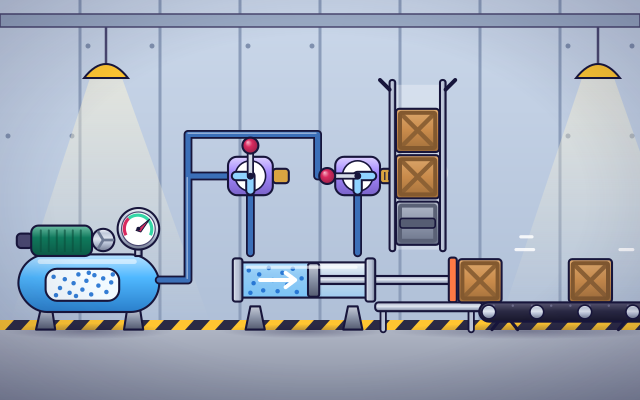
How do pneumatic machines use compressed air?
Route air through valves to extend and retract a model machine's piston.
#118
Forces & mechanisms
How do pneumatic machines use compressed air?
Route air through valves to extend and retract a model machine's piston.
 #119
Forces & mechanisms
How do gyroscopes help maintain orientation?
Spin a virtual rotor and investigate its response when its orientation changes.
#119
Forces & mechanisms
How do gyroscopes help maintain orientation?
Spin a virtual rotor and investigate its response when its orientation changes.
 #120
Forces & mechanisms
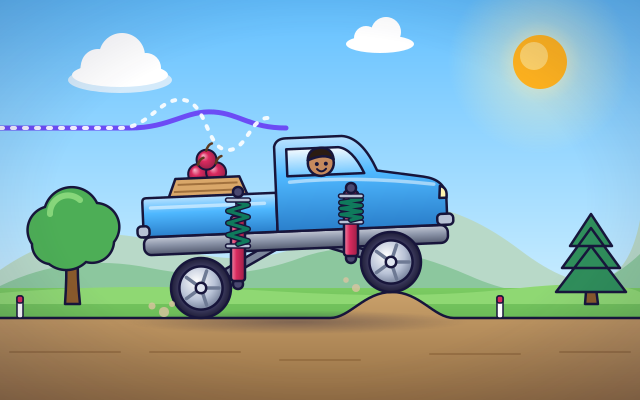
How do shock absorbers reduce bouncing?
Drive over model bumps and adjust damping to control repeated bouncing.
#120
Forces & mechanisms
How do shock absorbers reduce bouncing?
Drive over model bumps and adjust damping to control repeated bouncing.
 #121
Forces & mechanisms
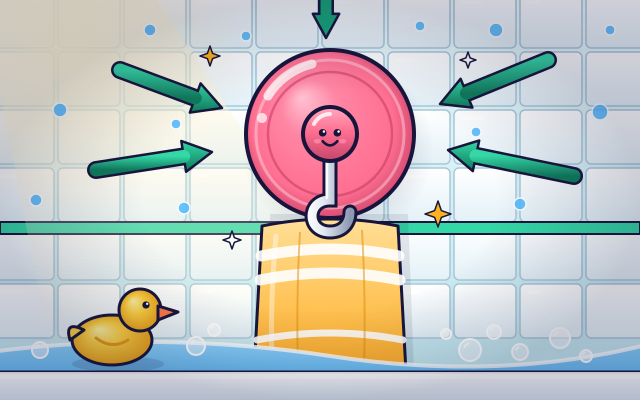
How do suction cups stay attached?
Press cups onto different surfaces and explore the pressure difference holding them in place.
#121
Forces & mechanisms
How do suction cups stay attached?
Press cups onto different surfaces and explore the pressure difference holding them in place.
Keep exploring
Games to play next
- Machine RepairFix levers, pulleys, gears and ramps so every contraption works.
- Marble MountainLay straights, curves, drops and splitters to roll marbles down the mountain.
- Bridge LabBuild a bridge from beams, brace it with triangles, and stay on budget.
Guide for grown-ups
- How to start homeschooling: a step-by-step guide for familiesA guide for parents · 7 min read
Science games by grade
Science worksheets by grade
- Preschool Science Worksheets
- Pre-K Science Worksheets
- Kindergarten Science Worksheets
- 1st Grade Science Worksheets
- 2nd Grade Science Worksheets
- 3rd Grade Science Worksheets
- 4th Grade Science Worksheets
- 5th Grade Science Worksheets
- 6th Grade Science Worksheets
- 7th Grade Science Worksheets
- 8th Grade Science Worksheets