How does fog form near the ground?
Fog is a cloud that sits on the ground. It forms when damp air cools until its invisible water turns into tiny floating drops.
The big idea: Warm air can hold a lot of invisible water vapor. Cold air can hold only a little. When damp air cools enough, the extra vapor turns into tiny drops that float: fog.
It's like a bathroom mirror after a hot shower. Warm, damp air touches something cold and its hidden water shows up as tiny drops.

The interactive parts didn't load. The explanations below still work; try reloading the page.
How fog forms
- Early in the morning the valley has vanished. The trees and the barn are hidden in white. This is fog: a cloud that touches the ground.
- The day before, the sun warmed the pond and the wet ground. Water evaporated into the air as water vapor, an invisible gas. The dots here are only pretend.
- After sunset, the ground loses its heat to the clear night sky. The cold ground chills the air just above it. All night the air gets colder and colder.
- At last the air is too cold to hold all its vapor. The extra vapor gathers on tiny specks of dust and salt in the air. Each speck grows a tiny drop of water.
- Fog drops are far smaller than raindrops, so they hang in the air. Light bounces off millions of them in every direction. That is why fog looks white and hides things.
- When the sun rises, it warms the ground and the air. Warmer air can hold more vapor, so the tiny drops evaporate again. People say the fog burns off.
Look inside a foggy morning
Tap each part of the valley and the close-up to see what it does.
- Cold ground. The ground lost its heat to the clear night sky. Now it is colder than the air and chills the air that touches it.
- Chilled air. The air next to the cold ground cools down. Cold air is heavy, so it stays low and pools in valleys. That is where fog forms first.
- Water vapor. Water vapor is water as an invisible gas. It came from the pond, the wet ground and the plants. The more vapor in the air, the sooner fog forms.
- Speck of dust. Vapor needs something to gather on. The air is full of specks too small to see: dust, sea salt and smoke. Every fog drop has one inside.
- Fog droplet. A fog drop is so small that a hundred of them side by side would be about as wide as a grain of rice. It floats instead of falling.
- Warmer air above. Above the fog the air is warmer and clear. If you climb a hill on a foggy morning, you can look down on the top of the fog.
- Morning sun. The rising sun warms the ground, and the ground warms the air. The tiny drops evaporate and the fog lifts.
Fog lab: warm and cold, dry and damp
Drag the sun to warm or cool the air, and tap the pond to add water to the air. When does fog appear? What clears it?
Experiment: The air is damp but clear. What happens if it gets colder and colder?
- Start with the sun high and the air warm.
- Drag the sun down a little at a time. Watch the far trees.
- When fog has formed, drag the sun back up.
What we found: Cooling damp air makes fog. Cold air cannot hold as much invisible water, so the extra turns into tiny floating drops. Warm the air again and the drops evaporate.
Turn on JavaScript to try it yourself.
Fog missions
Complete three fog missions. Read each one, set the air, then press Check.
Why fog appears and disappears
There is always some water in the air, even on a dry day. It is water vapor, an invisible gas. It gets there when water evaporates from ponds, wet ground, plants and even your breath.
Air can hold only so much vapor, and how much depends on how warm it is. Warm air can hold a lot. Cold air can hold only a little. So when damp air cools down, there comes a moment when it is holding all it can. Cool it a bit more, and the extra vapor has to go somewhere. It gathers on tiny specks of dust and salt and becomes tiny drops of liquid water.
Those drops are so small and light that they float. A cloud of them touching the ground is fog. Fog often forms on clear, calm nights, when the ground gets cold and chills the air above it. It also forms when warm, damp air drifts over cold water or cold land.
Fog disappears when the air warms up or when drier air blows in. The drops evaporate and become invisible vapor again. The water has not gone away. It has only changed back into a gas.
Key words
- Water vapor
- Water as an invisible gas in the air.
- Condense
- To change from a gas into a liquid, as when vapor becomes tiny drops.
- Dew point
- The temperature at which the air is holding all the water vapor it can.
- Relative humidity
- How much vapor the air holds compared with the most it could hold at that temperature, as a percentage.
- Condensation nucleus
- A tiny particle, such as dust or salt, that a droplet forms on.
- Visibility
- How far you can see clearly.
Check your thinking
-
What is fog made of?
Show the answer
Tiny drops of water floating in the air. Vapor is invisible. You see fog because the vapor has turned into tiny liquid drops.
-
Why does fog often form at night and early in the morning?
Show the answer
The air cools down, and cold air can hold less water vapor. As the air cools, it reaches the point where it cannot hold all its vapor, and the extra becomes drops.
-
It is a foggy morning. What will make the fog clear?
Show the answer
The sun warming the air. Warm air can hold more vapor, so the drops evaporate back into invisible gas.
-
Why do fog drops float instead of falling like rain?
Show the answer
They are far too small and light. A fog drop is about a hundred times narrower than a raindrop, so it falls extremely slowly and the air keeps it up.
-
Two valleys have the same temperature tonight. Valley A has a dew point of 8 °C, valley B a dew point of 3 °C. The temperature falls to 5 °C. Where does fog form?
Show the answer
Only in valley A. Fog forms where the temperature falls to the dew point. 5 °C is below A's dew point of 8 °C but still above B's dew point of 3 °C.
You're a Earth & weather expert!
You watched, looked inside, tried it, solved the challenge and went deeper. Pick another question below, or switch the age at the top to see this topic another way.
More about earth & weather
 #449
Earth & weather
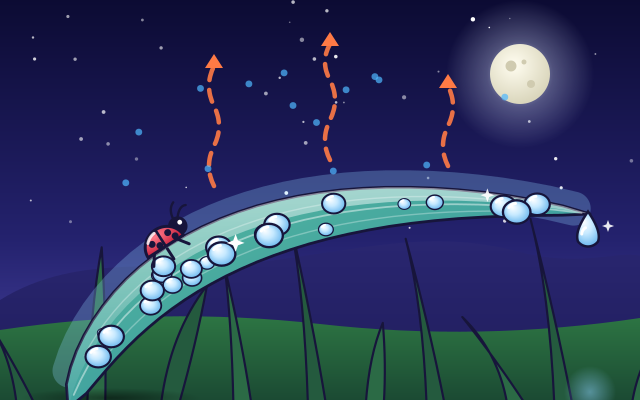
How does dew appear on grass?
Cool a model surface and follow water vapor condensing into droplets.
#449
Earth & weather
How does dew appear on grass?
Cool a model surface and follow water vapor condensing into droplets.
 #450
Earth & weather
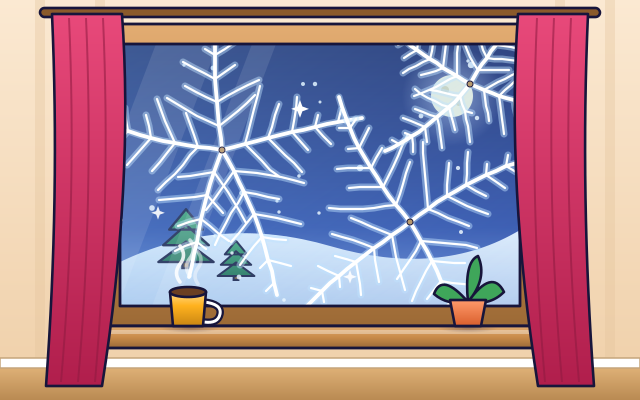
How does frost form?
Explore ice crystals growing on a cold surface from water vapor.
#450
Earth & weather
How does frost form?
Explore ice crystals growing on a cold surface from water vapor.
 #451
Earth & weather
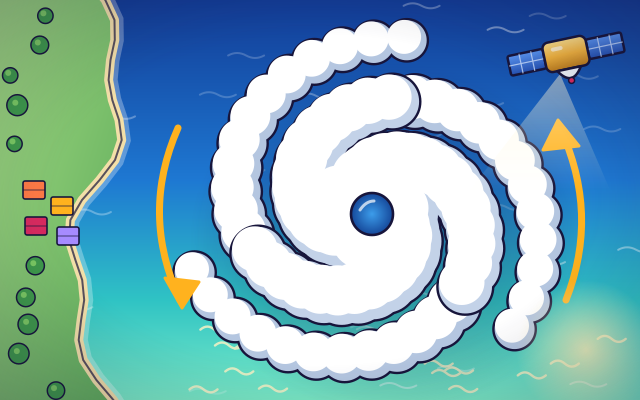
How do hurricanes develop?
Explore warm ocean water, moisture, rotation, and storm organization in a simplified model.
#451
Earth & weather
How do hurricanes develop?
Explore warm ocean water, moisture, rotation, and storm organization in a simplified model.
 #452
Earth & weather
How do weather forecasts get made?
Combine station readings, radar, satellite images, and a simplified forecast model.
#452
Earth & weather
How do weather forecasts get made?
Combine station readings, radar, satellite images, and a simplified forecast model.
Keep exploring
Games to play next
- Weather LabPredict the weather in a box, then run a fair test to find out why.
- Landform ExplorerMountains, valleys, peninsulas and deltas — learn the shapes of the land and find them on Earth.
- River MysterySomething changed the river. Sample sites with a limited budget, follow the evidence and find where the change begins.
Guide for grown-ups
- How to start homeschooling: a step-by-step guide for familiesA guide for parents · 7 min read
Science games by grade
Science worksheets by grade
- Preschool Science Worksheets
- Pre-K Science Worksheets
- Kindergarten Science Worksheets
- 1st Grade Science Worksheets
- 2nd Grade Science Worksheets
- 3rd Grade Science Worksheets
- 4th Grade Science Worksheets
- 5th Grade Science Worksheets
- 6th Grade Science Worksheets
- 7th Grade Science Worksheets
- 8th Grade Science Worksheets