How does frost form?
When a surface is colder than freezing, water vapor that touches it turns straight into ice crystals. The crystals branch out like feathers and ferns.
The big idea: Air holds invisible water vapor. When the vapor touches something colder than freezing, it turns straight into ice without becoming water first. The ice grows as branching crystals.
It's like the fuzzy ice inside a freezer. Damp air gets in when you open the door, touches the very cold walls, and turns straight into ice.
The interactive parts didn't load. The explanations below still work; try reloading the page.
How frost grows
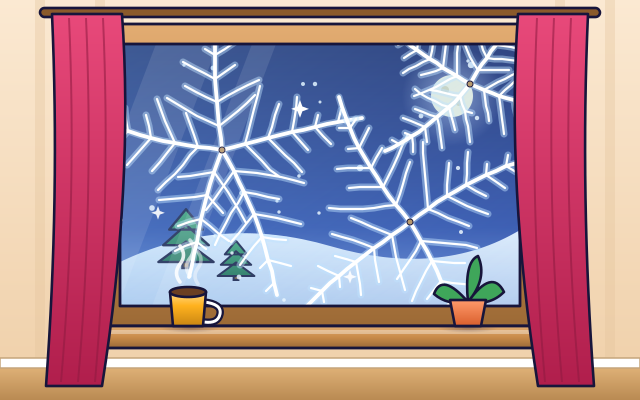
- On a freezing morning the window is covered in white feathers and ferns. Nobody drew them. They are frost: ice crystals that grew on the glass in the night.
- The warm air in the room holds water vapor, an invisible gas. It comes from cooking, hot drinks, plants and your own breath. The dots here are only pretend.
- Outside, the night is far below freezing. A thin sheet of glass cannot keep the cold out, so the glass itself drops below zero degrees Celsius.
- Vapor molecules hit the freezing glass and lock into place as ice. They skip being liquid water. Going straight from gas to solid is called deposition.
- Each crystal starts at a speck of dust or a tiny scratch. Its tip grows fastest because it reaches the most vapor. Side arms sprout, and the pattern spreads like a fern.
- The same thing happens outdoors on clear, cold nights. Grass, leaves and cars cool below freezing, and vapor turns to ice on them. In the morning the sun melts it.
Look inside window frost
Tap each part to see how the frost grew on the glass.
- Freezing night. The air outside is far below freezing. It pulls heat out of the room through the glass all night.
- Cold glass. A single sheet of glass is thin, so it gets almost as cold as the air outside. Frost can grow only when the glass is below freezing.
- Warm, damp room. Warm air holds a lot of water vapor. Hot drinks, cooking and breathing keep adding more. The damper the room, the more frost can grow.
- Water vapor. Water vapor is water as an invisible gas. When it reaches the freezing glass, it turns straight into ice.
- Starting speck. Every frost fern starts somewhere: a speck of dust, a fingerprint or a tiny scratch. Clean, smooth glass frosts over more slowly.
- Main arm. The tip of each arm sticks out into the damp air, so it grows fastest and the arm gets longer and longer.
- Side branches. Side branches sprout from each arm, and smaller ones sprout from those. That is what makes frost look like ferns and feathers.
Frost lab: cold glass and damp air
Change how cold it is outside and how damp the room is. Tap the glass to start crystals. When do you get frost, mist or nothing at all?
Experiment: A window is misty with tiny drops. What happens if the glass gets colder than freezing?
- Start with mild weather outside and a damp room. Look for mist on the glass.
- Make it colder outside, a little at a time.
- Watch the thermometer pass the freezing mark. What grows on the glass?
What we found: Above freezing, damp air leaves mist: tiny drops of liquid water. Once the glass is below freezing, the vapor turns straight into ice and grows as feathery crystals. Warm the glass and the frost melts.
Turn on JavaScript to try it yourself.
Frost before sunrise
Cover all five stars with frost before the sun comes up. First make the glass cold enough. You have only five crystals.
Why frost grows like ferns
Frost looks like snow that fell in a thin layer, but it did not fall at all. It grew right where you see it. The air always holds some water vapor, which is water as an invisible gas. When that vapor touches something colder than freezing, it turns straight into ice.
Most of the time, water goes from gas to liquid to solid: vapor becomes drops, and drops freeze. Frost skips the middle step. The vapor turns directly into ice crystals. Scientists call this deposition.
A frost crystal starts at a tiny speck or scratch. Its tip pokes out into the damp air, so the tip gets the most vapor and grows fastest. Bumps along the arm grow into side branches, and those grow branches of their own. That is why frost looks like feathers and ferns.
Frost needs two things: a surface below freezing, and enough vapor in the air. A window with one thin sheet of glass gets very cold, so it frosts over on the inside. Outdoors, grass and car roofs get frosty on clear, calm nights. When the sun warms them, the frost melts or turns back into vapor.
Key words
- Water vapor
- Water as an invisible gas in the air.
- Deposition
- When a gas turns straight into a solid, as when vapor becomes frost.
- Frost point
- How cold a surface must be for frost to grow on it.
- Crystal
- A solid whose tiny particles are arranged in a regular, repeating pattern.
- Insulation
- Material that slows the flow of heat, such as the gas between two panes of glass.
Check your thinking
-
How does frost get onto a window?
Show the answer
Water vapor in the air turns straight into ice on the cold glass. The frost grows where it is. Vapor touches glass that is colder than freezing and becomes ice crystals.
-
A window is covered in mist, not frost. What does that tell you about the glass?
Show the answer
It is cool, but not colder than freezing. Mist is liquid drops. Vapor becomes liquid on cool glass and becomes ice only when the glass is below freezing.
-
Why does frost look like ferns and feathers?
Show the answer
The tips grow fastest, and side arms keep sprouting from them. A tip sticks out into the damp air, so it grows fastest. Bumps on the arm do the same and become side branches.
-
Why do windows with two sheets of glass almost never get frost ferns?
Show the answer
The inside sheet stays too warm for ice. The gas trapped between the sheets slows the heat escaping, so the inside sheet stays above freezing.
-
What happens to frost when the sun warms it?
Show the answer
It melts or turns back into vapor. Above freezing the ice melts into water, and the water soon evaporates back into the air.
You're a Earth & weather expert!
You watched, looked inside, tried it, solved the challenge and went deeper. Pick another question below, or switch the age at the top to see this topic another way.
More about earth & weather
 #451
Earth & weather
How do hurricanes develop?
Explore warm ocean water, moisture, rotation, and storm organization in a simplified model.
#451
Earth & weather
How do hurricanes develop?
Explore warm ocean water, moisture, rotation, and storm organization in a simplified model.
 #452
Earth & weather
How do weather forecasts get made?
Combine station readings, radar, satellite images, and a simplified forecast model.
#452
Earth & weather
How do weather forecasts get made?
Combine station readings, radar, satellite images, and a simplified forecast model.
 #453
Earth & weather
How do weather fronts change the weather?
Move warm and cold air masses together and observe clouds and precipitation.
#453
Earth & weather
How do weather fronts change the weather?
Move warm and cold air masses together and observe clouds and precipitation.
 #454
Earth & weather
How do mountains create rain shadows?
Guide moist air over a mountain and compare its windward and sheltered sides.
#454
Earth & weather
How do mountains create rain shadows?
Guide moist air over a mountain and compare its windward and sheltered sides.
Keep exploring
Games to play next
- Weather LabPredict the weather in a box, then run a fair test to find out why.
- Landform ExplorerMountains, valleys, peninsulas and deltas — learn the shapes of the land and find them on Earth.
- River MysterySomething changed the river. Sample sites with a limited budget, follow the evidence and find where the change begins.
Guide for grown-ups
- How to start homeschooling: a step-by-step guide for familiesA guide for parents · 7 min read
Science games by grade
Science worksheets by grade
- Preschool Science Worksheets
- Pre-K Science Worksheets
- Kindergarten Science Worksheets
- 1st Grade Science Worksheets
- 2nd Grade Science Worksheets
- 3rd Grade Science Worksheets
- 4th Grade Science Worksheets
- 5th Grade Science Worksheets
- 6th Grade Science Worksheets
- 7th Grade Science Worksheets
- 8th Grade Science Worksheets