How do hurricanes develop?
A hurricane is a giant spinning storm that feeds on warm sea water. Take the warm water away and it fades.
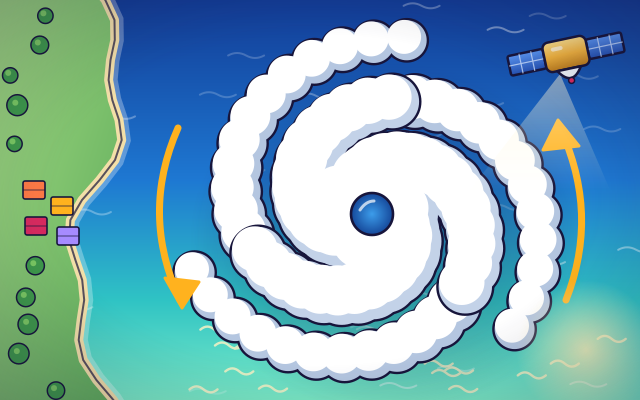
The big idea: Warm sea water fills the air with moisture. The moist air rises and makes tall clouds, more air rushes in below, and Earth's spin curls it into a spiral. Over cool water or land, the storm runs out of fuel.
It's like a pot of soup on the stove: heat below makes steam rise, and stirring makes it swirl. The warm sea is the stove, and the turning Earth does the stirring.
The interactive parts didn't load. The explanations below still work; try reloading the page.
From warm sea to spinning storm
- Far out at sea, near the hot middle of the Earth, the sun warms the water all summer. Warm water evaporates fast, so the air above it fills with invisible water vapor.
- Warm, moist air is light, so it rises. Higher up it cools, and the vapor turns back into tiny drops. That makes tall clouds, and it gives off heat, which pushes the air up even more.
- As air rises, it leaves less air pressing down on the sea. More air rushes in along the water to fill the gap. That air picks up moisture too, so the storm keeps feeding itself.
- The Earth is always turning, so air rushing toward the storm cannot travel straight. It curves and wraps into a spiral. Right on the equator this bending is too weak, so hurricanes never start there.
- Now the storm is organized. Air races up in a ring of tall clouds called the eyewall, where the wind and rain are strongest. In the middle, air sinks gently and makes a calm, clear eye.
- Forecasters watch every hurricane with satellites and tell people days ahead, so listen to the forecast and your grown-ups. Over land or cool water the storm loses its warm water, so it weakens and fades into rain.
Inside a hurricane
This is a simplified slice through the middle of a hurricane. Tap each part to see what the air is doing there.
- Warm ocean. The sea is warm, about as warm as a swimming pool. It evaporates quickly and fills the air above with moisture, the storm's fuel.
- Air rushing in. Near the sea, air spirals in toward the middle of the storm. It soaks up warmth and moisture from the water as it goes.
- Eyewall. The eyewall is a ring of towering clouds around the eye. Air shoots upward here, so this is where the wind is fastest and the rain is heaviest.
- The eye. In the eye, air sinks gently instead of rising, so the clouds clear and the wind is light. But the storm is still all around it.
- Rainbands. Rainbands are long curved lines of rain clouds that spiral in toward the middle. Between them there can be gaps with lighter rain.
- Air flowing out on top. At the top of the storm, the air that rose spreads outward. Getting rid of air up high lets more air keep rising from below.
What does a storm need to grow?
Drag the storm around the ocean: warm sea, cool sea, the equator, the land. Change the moisture in the air. Where does it grow, and where does it fade?
Experiment: Where will a little storm grow into a hurricane?
- Drag the storm onto the warm sea and wait. Watch it spin and grow.
- Now drag it to the cool sea, the equator and the land. What happens each time?
- Put it back on warm water and make the air dry.
What we found: The storm only grows over warm sea, with moist air, away from the equator. Warm water is its fuel, and the Earth's turning gives it spin. Over cool water or land the fuel is gone, so it fades. On the equator there is no spin to organize it.
Turn on JavaScript to try it yourself.
Storm scientist
Scientists watch little storm clusters to see which will grow. In each round, tap the one cluster that has everything a hurricane needs.
How a hurricane grows and fades
A hurricane starts as a cluster of ordinary thunderstorms over a tropical sea. Most clusters just rain and drift away. A few find everything they need, and over several days they grow into one giant spinning storm that can be hundreds of kilometers wide.
The first thing it needs is warm sea water, about as warm as a swimming pool. Warm water evaporates fast and fills the air with moisture. That moist air rises and cools, and the moisture turns back into cloud drops. This gives off heat, which makes the air rise even faster. More air rushes in along the sea to replace it, picks up more moisture, and rises too. The storm feeds itself.
The second thing is spin. Because the Earth is turning, air rushing toward the storm curves instead of going straight, and wraps into a spiral. This is where the soup pot comparison stops working: nobody stirs a hurricane. The turning Earth bends the wind. On the equator the bending is too weak, so hurricanes never form there.
A hurricane fades when it loses its fuel. Over cool water or over land there is no warm sea to feed it, so it weakens into rain. Hurricanes can be dangerous, but forecasters watch them from space and warn people days ahead. The safe thing to do is simple: listen to the forecast and to the grown-ups who look after you.
Key words
- Evaporation
- Liquid water turning into invisible water vapor in the air. Warm water evaporates faster.
- Eye
- The calm, clear middle of a hurricane, where air sinks gently.
- Eyewall
- The ring of tall clouds around the eye, with the strongest wind and heaviest rain.
- Coriolis effect
- The way the turning Earth makes moving air curve instead of going straight.
- Latent heat
- Heat that is given off when water vapor turns back into liquid drops.
- Wind shear
- A change in wind speed or direction with height. Strong shear tilts a storm and weakens it.
Check your thinking
-
What is the fuel of a hurricane?
Show the answer
Warm sea water that fills the air with moisture. Warm water evaporates fast. The moist air rises, makes clouds and gives off heat that powers the storm.
-
A hurricane is forecast for your area. What should you do?
Show the answer
Listen to the forecast and do what your grown-ups say. Forecasters can see a hurricane days ahead. Listening early gives your family time to get ready or move somewhere safe.
-
Why does a hurricane fade when it moves over land?
Show the answer
It loses the warm sea water that feeds it. No warm water means no more moist air to rise, so the storm runs out of fuel.
-
Why do hurricanes never start right on the equator?
Show the answer
There is no spin there to curl the wind into a spiral. The turning Earth bends the wind, but on the equator that bending is too weak to make a spiral.
-
What is the middle of a hurricane like?
Show the answer
Calm and quiet. The middle is called the eye. The air there sinks gently, so it is calm.
-
Strong wind shear (winds that change a lot with height) moves over a hurricane. What happens?
Show the answer
The storm is tilted and weakens. Shear pushes the top of the storm away from its base, so the heat is no longer released above the low pressure center.
You're a Earth & weather expert!
You watched, looked inside, tried it, solved the challenge and went deeper. Pick another question below, or switch the age at the top to see this topic another way.
More about earth & weather
 #452
Earth & weather
How do weather forecasts get made?
Combine station readings, radar, satellite images, and a simplified forecast model.
#452
Earth & weather
How do weather forecasts get made?
Combine station readings, radar, satellite images, and a simplified forecast model.
 #453
Earth & weather
How do weather fronts change the weather?
Move warm and cold air masses together and observe clouds and precipitation.
#453
Earth & weather
How do weather fronts change the weather?
Move warm and cold air masses together and observe clouds and precipitation.
 #454
Earth & weather
How do mountains create rain shadows?
Guide moist air over a mountain and compare its windward and sheltered sides.
#454
Earth & weather
How do mountains create rain shadows?
Guide moist air over a mountain and compare its windward and sheltered sides.
 #455
Earth & weather
How does lake-effect snow happen?
Move cold air across warmer lake water and follow moisture into snowfall.
#455
Earth & weather
How does lake-effect snow happen?
Move cold air across warmer lake water and follow moisture into snowfall.
Keep exploring
Games to play next
- Weather LabPredict the weather in a box, then run a fair test to find out why.
- River MysterySomething changed the river. Sample sites with a limited budget, follow the evidence and find where the change begins.
- Landform ExplorerMountains, valleys, peninsulas and deltas — learn the shapes of the land and find them on Earth.
Guide for grown-ups
- How to start homeschooling: a step-by-step guide for familiesA guide for parents · 7 min read
Science games by grade
Science worksheets by grade
- Preschool Science Worksheets
- Pre-K Science Worksheets
- Kindergarten Science Worksheets
- 1st Grade Science Worksheets
- 2nd Grade Science Worksheets
- 3rd Grade Science Worksheets
- 4th Grade Science Worksheets
- 5th Grade Science Worksheets
- 6th Grade Science Worksheets
- 7th Grade Science Worksheets
- 8th Grade Science Worksheets