How does a hammer drive a nail?
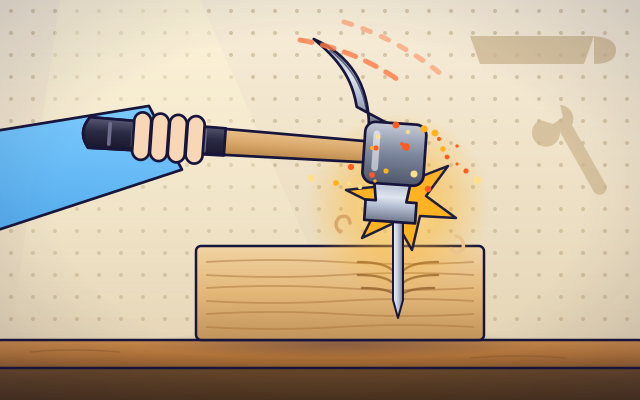
A swinging hammer stores up energy, then gives it to the nail in one quick, hard hit on a tiny point.
The big idea: A moving hammer head carries energy. When it stops suddenly on the nail, it pushes very hard for a moment, and the nail's sharp point pushes the wood fibers apart.
It's like poking a straw into a juice box: a slow push just bends it, but a quick jab on the pointed end pops it in.
The interactive parts didn't load. The explanations below still work; try reloading the page.
From swing to nail
- Zoe wants to nail two boards together. She pushes the nail as hard as she can with her thumb, but wood is tough and the nail does not move. She needs a hammer.
- Zoe swings the hammer. Her hand moves a little, but the head at the end of the long handle moves a long way, very fast. A heavy, fast head carries lots of energy.
- The head hits the nail and stops almost at once. Giving up all that energy in such a short moment makes a push far bigger than any hand could manage.
- The whole push arrives at the nail's sharp point, which is smaller than a grain of rice. On such a tiny spot the push is enormous, so the point forces the wood fibers apart.
- The fibers that were pushed aside press back against the nail from every side. That squeeze makes friction, and friction is what holds a nail in place.
- A nail in the wrong place? The claw hooks under its head. Pulling the long handle a long way lifts the nail a short way with a strong pull. The hammer is a lever.
The parts of a hammer and a nail
Tap each part of the hammer and the nail. Each shape has a job.
- Head. The steel head is the heavy part. The heavier it is, the more energy it carries when it moves.
- Face. The face is the flat end that meets the nail. It is very hard, so it does not dent, and wide, so it is easy to hit the nail.
- Handle. The long handle lets the head move much faster than your hand. Hold it near the end for a fast, strong swing, and nearer the head for a gentle tap.
- Claw. The curved, split claw slides under a nail's head. Pull back on the handle and the hammer rocks on its head, lifting the nail out.
- Nail head. The nail's wide, flat head gives the hammer a target. It also stops the nail from pulling right through the board it holds.
- Shank. The shank is the long, straight part. Wood fibers squeeze it from all sides, and that friction holds the nail in.
- Point. The sharp point squeezes the whole hammer blow onto a tiny spot. It wedges the wood fibers apart to make room for the nail.
Heavier or faster?
Each test hit gets a fresh nail, so you can compare them side by side. Try a heavier hammer, then a faster swing. Which helps more?
Experiment: Which drives the nail deeper: a hammer twice as heavy, or a swing twice as fast?
- Hit a nail with the light hammer and a slow swing.
- Hit the next nail with the heavy hammer and a slow swing.
- Hit the third nail with the light hammer and a fast swing. Compare the three.
What we found: Twice the weight gives twice the energy, so the nail goes about twice as deep. But twice the speed gives four times the energy. That is why a carpenter swings a hammer fast instead of just using a heavier one.
Turn on JavaScript to try it yourself.
Flush, and not bent
Drive the nail until its head is flat on the wood. Careful: a long nail bends if you hit it too hard too soon!
How a hammer really drives a nail
Try to push a straw slowly into a juice box and it just bends. Give it one quick jab and it pops right in. A hammer and nail work the same way. A slow push on a nail does nothing, but a quick, hard hit on its sharp point drives it into the wood.
The hit gets its strength from the swing. As the hammer comes down, its heavy head speeds up, and a moving object carries energy. A heavier head carries more. A faster head carries much more: twice the speed means four times the energy. The long handle helps, because it makes the head move far faster than your hand.
When the head lands on the nail, it stops almost instantly. All the energy it carried is handed over in that tiny moment, and that makes a push many times stronger than your arm could make by pressing. The nail then squeezes the whole push onto its tiny point, where it is strong enough to force the wood fibers apart.
The fibers that were pushed aside squeeze back on the nail from every side. That squeeze causes friction, and friction is what holds a nail in. It is also why each hit drives the nail a little less than the one before: more of the nail is being gripped. The juice box idea does not cover this part, because a juice box does not grip its straw.
Key words
- Kinetic energy
- The energy something has because it is moving.
- Impact
- A hit in which a moving object is stopped very quickly, which makes a large force.
- Pressure
- How strongly a push is squeezed onto a spot. The same push on a smaller spot gives more pressure.
- Friction
- The force that resists two surfaces sliding over each other. It holds a nail in wood.
- Lever
- A bar that turns about a pivot, used to trade distance for force or for speed.
Check your thinking
-
Why does a hit drive a nail in when a hard push with your thumb does not?
Show the answer
The moving head gives up its energy all at once, making a huge push. The swinging head carries energy and stops in an instant. That sudden stop makes a push far bigger than pressing.
-
What does the nail's sharp point do?
Show the answer
It puts the whole push on a tiny spot and wedges the fibers apart. A push on a tiny spot is very strong there. The point forces the wood fibers aside.
-
You can swing a hammer twice as fast, or use one twice as heavy. Which gives the hit more energy?
Show the answer
Twice as fast: that gives four times the energy. Twice the weight doubles the energy, but twice the speed makes it four times as big.
-
Why is a nail hard to pull out of wood?
Show the answer
Squeezed wood fibers grip it with friction. The fibers pushed aside by the nail press back on it. That makes friction, which holds it.
-
A carpenter chokes up, holding the handle close to the head, for the first taps on a nail. Why?
Show the answer
The head moves more slowly, so each tap carries less energy and is easier to aim. A shorter lever arm gives the head less speed. Gentle, accurate taps set the nail without bending it.
You're a Tools & workshop expert!
You watched, looked inside, tried it, solved the challenge and went deeper. Pick another question below, or switch the age at the top to see this topic another way.
More about tools & workshop
 #171
Tools & workshop
How does a rivet fasten sheets together?
Set a virtual rivet and watch its end deform to grip the sheets.
#171
Tools & workshop
How does a rivet fasten sheets together?
Set a virtual rivet and watch its end deform to grip the sheets.
 #172
Tools & workshop
How do wire strippers remove insulation?
Match virtual wire sizes to openings and separate insulation without cutting the conductor.
#172
Tools & workshop
How do wire strippers remove insulation?
Match virtual wire sizes to openings and separate insulation without cutting the conductor.
 #181
Tools & workshop
How does an air compressor store compressed air?
Watch a piston draw in air and push it into a storage tank.
#181
Tools & workshop
How does an air compressor store compressed air?
Watch a piston draw in air and push it into a storage tank.
 #163
Tools & workshop
How do scissors cut through materials?
Explore how two blades and a pivot create a controlled cutting action.
#163
Tools & workshop
How do scissors cut through materials?
Explore how two blades and a pivot create a controlled cutting action.
Keep exploring
Games to play next
- Machine RepairFix levers, pulleys, gears and ramps so every contraption works.
- Bridge LabBuild a bridge from beams, brace it with triangles, and stay on budget.
Guide for grown-ups
- How to start homeschooling: a step-by-step guide for familiesA guide for parents · 7 min read
Science games by grade
Science worksheets by grade
- Preschool Science Worksheets
- Pre-K Science Worksheets
- Kindergarten Science Worksheets
- 1st Grade Science Worksheets
- 2nd Grade Science Worksheets
- 3rd Grade Science Worksheets
- 4th Grade Science Worksheets
- 5th Grade Science Worksheets
- 6th Grade Science Worksheets
- 7th Grade Science Worksheets
- 8th Grade Science Worksheets