How do wire strippers remove insulation?
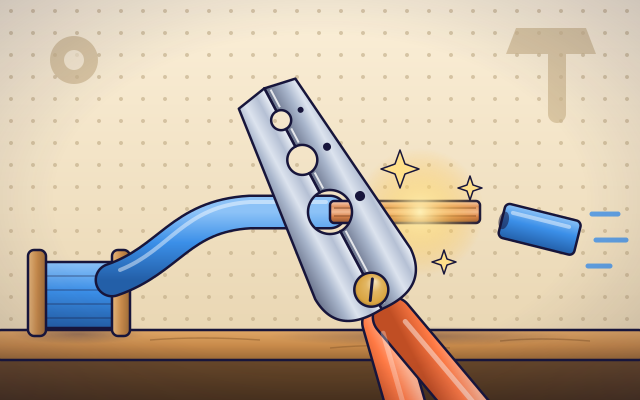
Wire strippers have a row of round holes. Pick the hole that fits the copper, squeeze, pull, and the plastic coat slides off.
The big idea: Each hole in the blades is just a little bigger than the copper inside one size of wire. The blades slice the plastic all the way around but never reach the copper.
It's like pulling the paper wrapper off a drinking straw: pinch only the wrapper, pull, and it slides off while the straw stays whole.
The interactive parts didn't load. The explanations below still work; try reloading the page.
Stripping a wire
- A wire has two parts. In the middle is copper, a metal that electricity flows through easily. Around it is a plastic coat called insulation, which keeps the electricity inside.
- To join a wire to a battery or a lamp, metal must touch metal. With the plastic still on the end, nothing flows. Bare the tip, and the bulb lights.
- Wire strippers look like pliers with sharp blades. Each blade has a row of half-round notches. When the jaws close, the notches meet and make round holes of different sizes.
- Lay the wire in the hole that matches its copper, then squeeze. The blades slice through the plastic all the way around, and stop just before they touch the copper.
- Keep squeezing and pull the tool toward the end of the wire. The cut piece of plastic slides off like a tiny sleeve, and the bare copper is ready to connect.
- If the hole is too small, the blades cut into the copper and weaken it. If it is too big, they never get through the plastic. Only the matching hole strips cleanly.
Look closely at wire strippers
Tap each part of the tool and the wire. Watch what it does.
- Handles. Squeezing the handles closes the jaws. The long handles work as levers, so a gentle squeeze makes a strong bite at the blades.
- Pivot. The pivot is a pin that joins the two halves. They swing around it, just like a pair of scissors.
- Spring. A small spring pushes the handles apart. When you let go, the jaws open by themselves, ready for the next wire.
- Notches. Each blade has sharp half-round notches. When the jaws shut, two notches meet and make a round hole. The edge of the hole cuts the plastic.
- Size numbers. A number beside each hole tells you which wire size it fits. The wire's size is often printed on its plastic coat, so you can match them.
- Cutter. Near the pivot the blades are straight, like scissors. This part cuts right through a wire to make it the length you need.
- Insulation. Insulation is the plastic coat around the copper. Electricity cannot flow through it, so it keeps the current in the wire and away from fingers and other wires.
- Copper conductor. The copper in the middle carries the electricity. It may be one solid piece or many thin strands twisted together, which bend more easily.
Match the wire to the hole
Drag the wire to a hole, or tap a hole. Try one that is too small, one that fits and one that is too big. Watch the close-up.
Experiment: What happens if you use a hole that is smaller than the copper?
- Tap the smallest hole and watch the close-up.
- Now find the hole where only the plastic is cut.
- Try the biggest hole too. What do the blades touch?
What we found: A hole smaller than the copper makes the blades cut into the metal, so strands are lost and the wire is weaker. A hole much bigger than the wire never cuts the plastic. The matching hole cuts all the plastic and none of the copper.
Turn on JavaScript to try it yourself.
Strip every wire
Strip all four wires cleanly to light the lamps. Careful: a thick coat can hide thin copper. Match the copper, not the coat!
Why the right hole matters
Electric wires are made of two very different materials. Copper lets electricity flow easily, so it is called a conductor. Plastic does not let electricity through, so it is called an insulator. The plastic coat keeps the electricity inside the wire.
At the ends, the copper has to touch another piece of metal, so a short piece of the plastic must come off. You could try with scissors, but it is very hard to cut the plastic without cutting some copper too.
Wire strippers solve this with shape. When the jaws close, each pair of notches makes a round hole. The hole is a tiny bit wider than the copper of one wire size. The blades can cut inward only as far as the edge of that hole, so they slice the plastic and stop.
A hole that is too small cuts some of the copper away. A thinner wire carries electricity less well and can break when it is bent. A hole that is too big never reaches through the plastic. Real wires can carry dangerous electricity, so stripping wires is a job for grown-ups, with the power switched off. Our straw wrapper comparison is not perfect: a wrapper is loose, but insulation has to be cut before it will slide.
Key words
- Conductor
- A material electricity flows through easily, like the copper inside a wire.
- Insulation
- The plastic coat that keeps electricity inside the wire.
- Wire gauge
- A number for how thick a wire's copper is. A bigger number means a thinner wire.
- Strand
- One of the many thin copper wires twisted together inside a flexible wire.
- Nick
- A small cut in the copper that makes the wire weaker.
Check your thinking
-
What should the blades cut when you strip a wire?
Show the answer
Only the plastic insulation. The copper has to stay whole so it can carry the electricity.
-
You pick a hole smaller than the copper. What happens?
Show the answer
The blades cut into the copper and weaken the wire. The blades close further than the copper is wide, so they cut some of it away.
-
A wire has a very thick plastic coat. Which hole should you choose?
Show the answer
The one that matches the copper inside. The hole must stop the blades at the copper, so it is the copper's size that counts.
-
A hole only 70 percent as wide as the conductor closes on a wire. About how much of the copper's cross-section is left?
Show the answer
About 49 percent. Area goes with the square of the diameter: 0.7 times 0.7 is 0.49.
-
Why must the end of a wire be bare copper before you connect it?
Show the answer
Electricity cannot flow through the plastic. Plastic is an insulator. Metal has to touch metal for electricity to flow.
-
What is the safe rule for real electric wires?
Show the answer
Only grown-ups, with the power switched off. Wires can carry dangerous electricity. Grown-ups switch the power off before they touch them.
You're a Tools & workshop expert!
You watched, looked inside, tried it, solved the challenge and went deeper. Pick another question below, or switch the age at the top to see this topic another way.
More about tools & workshop
 #181
Tools & workshop
How does an air compressor store compressed air?
Watch a piston draw in air and push it into a storage tank.
#181
Tools & workshop
How does an air compressor store compressed air?
Watch a piston draw in air and push it into a storage tank.
 #163
Tools & workshop
How do scissors cut through materials?
Explore how two blades and a pivot create a controlled cutting action.
#163
Tools & workshop
How do scissors cut through materials?
Explore how two blades and a pivot create a controlled cutting action.
 #164
Tools & workshop
How do pliers grip objects firmly?
Change handle length and gripping position while comparing the force at the jaws.
#164
Tools & workshop
How do pliers grip objects firmly?
Change handle length and gripping position while comparing the force at the jaws.
 #165
Tools & workshop
How does an adjustable wrench fit different nuts?
Turn its adjustment mechanism and compare turning effort with different handle lengths.
#165
Tools & workshop
How does an adjustable wrench fit different nuts?
Turn its adjustment mechanism and compare turning effort with different handle lengths.
Keep exploring
Games to play next
- Machine RepairFix levers, pulleys, gears and ramps so every contraption works.
- Bridge LabBuild a bridge from beams, brace it with triangles, and stay on budget.
Guide for grown-ups
- How to start homeschooling: a step-by-step guide for familiesA guide for parents · 7 min read
Science games by grade
Science worksheets by grade
- Preschool Science Worksheets
- Pre-K Science Worksheets
- Kindergarten Science Worksheets
- 1st Grade Science Worksheets
- 2nd Grade Science Worksheets
- 3rd Grade Science Worksheets
- 4th Grade Science Worksheets
- 5th Grade Science Worksheets
- 6th Grade Science Worksheets
- 7th Grade Science Worksheets
- 8th Grade Science Worksheets