How does a rivet fasten sheets together?
A rivet is a metal pin with a head. Push it through two sheets, squash the other end wide, and the sheets are locked together.
The big idea: A rivet has a head at one end. When you squash the other end into a second head, both heads are wider than the hole, so the sheets are trapped between them.
It's like a button on a thread: the button is wider than the buttonhole, so it cannot pull through. A rivet makes its own button out of metal.
The interactive parts didn't load. The explanations below still work; try reloading the page.
How a rivet grips
- Two metal sheets lie on a bench. Nothing holds them, so one push makes the top sheet slide away. We need something to lock them together.
- First we drill one hole straight through both sheets, so the two holes line up exactly. The hole is just a tiny bit wider than the rivet.
- A rivet is a short metal pin with a round head on one end. It slides through the holes until the head stops it. The plain end, called the tail, sticks out.
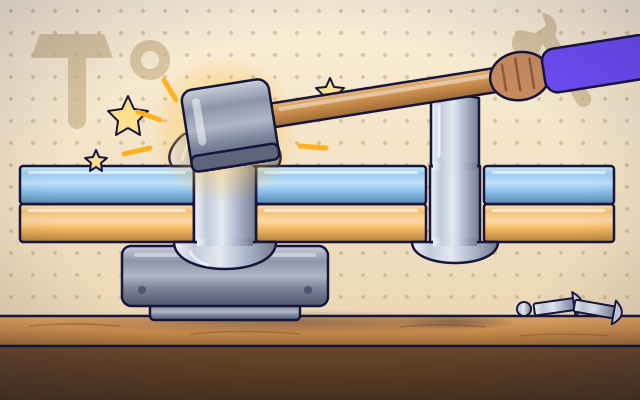
- A heavy block holds the head still while a hammer hits the tail. Each hit squashes the tail shorter and wider, until it becomes a second head.
- Now the rivet has a head on both sides, and both are wider than the hole. The sheets are squeezed in between. Pull them, and nothing moves.
- Rows of rivets hold together bridges, ships and airplanes, and tiny copper rivets even strengthen the pockets of jeans. Each one is a pin with two heads.
Look inside a riveted joint
This joint has been sliced down the middle. Tap each part to see what it does.
- Head. The head is shaped when the rivet is made. It is wider than the hole, so it stops the rivet on one side of the sheets.
- Shank. The shank is the smooth middle of the rivet. Hammering makes it swell a little, so it fills the hole and the sheets cannot wiggle.
- Squashed tail. The tail started as a plain end sticking out. Hammering squashed it into a second head, wider than the hole, so it can never slide back.
- Two sheets. The two sheets are trapped between the rivet's two heads. They cannot lift apart, and they cannot slide.
- Hammer. The hammer hits the tail many times. In factories a rivet gun does the same job, hitting very fast with a rattling sound.
- Holding block. A heavy block presses against the head. Without it the hammer would just knock the rivet back out of the hole.
Set a rivet and test it
Tap the hammer to squash the rivet's tail. Try the pull test early, and again when you finish. Then try a short tail and a long one.
Experiment: What happens if you pull the sheets while the tail is still thinner than the hole?
- Hit the rivet once or twice, then press Pull test.
- Keep hammering until the tail is wide and flat. Pull again.
- Start over with a short tail, then a long tail. Which one makes a good head?
What we found: A rivet only grips when its tail has been squashed wider than the hole. Before that, the sheet slides off. A tail that is too short has too little metal to make a head, and one that is too long bends over instead of squashing flat.
Turn on JavaScript to try it yourself.
Rivet the plates
Put a rivet in every hole and hammer each one just enough. Then hang the load. Will your joint hold?
Why rivets hold so well
A rivet is one of the oldest ways to join metal. It is a short pin with a head already made on one end. You drill a hole through both sheets, push the rivet through, and then squash the plain end, called the tail, until it spreads into a second head.
Why does squashing work? Metal can bend and flow without breaking if you push it hard enough. The hammer does not remove any metal. It just moves it sideways, so the tail gets shorter and wider. Once the tail is wider than the hole, it cannot go back through.
The length of the tail matters. If too little sticks out, there is not enough metal to make a proper head. If too much sticks out, the tail bends over like a bent nail instead of squashing flat. Rivet workers leave about one and a half times the rivet's width.
Rivets are very good at stopping sheets from sliding over each other, and they do not shake loose the way a screw can. That is why you see neat rows of them on airplanes, old steel bridges, ships and even the corners of jeans pockets. Our button comparison is not perfect, though: you can undo a button, but a rivet is there for good.
Key words
- Rivet
- A metal pin with a head, squashed at the other end to lock sheets together.
- Shank
- The smooth body of the rivet that sits inside the hole.
- Driven head
- The second head, made by squashing the tail.
- Plastic deformation
- When metal is pushed so hard that it changes shape and stays that way.
- Shear
- A sliding force, like two sheets trying to slip past each other.
- Clearance
- The tiny gap between the rivet and the hole before the rivet is driven.
Check your thinking
-
Why can't a finished rivet slide back out of its hole?
Show the answer
Both ends are now wider than the hole. The factory head is on one side and the squashed tail is on the other. Both are wider than the hole.
-
What happens to the tail's metal when it is hammered?
Show the answer
It moves sideways, so the tail gets shorter and wider. No metal is lost. The same metal is pushed into a new shape.
-
A rivet's tail barely pokes out of the hole. What will happen when you hammer it?
Show the answer
There is not enough metal to make a wide head, so it stays loose. The head is made only from the metal that sticks out. A short tail cannot spread far.
-
Why is a heavy block held against the rivet's head while the tail is hammered?
Show the answer
So the hammer squashes the tail instead of knocking the rivet out. With nothing behind it, the rivet would just slide back through the hole.
-
One rivet has twice the diameter of another, made of the same metal. About how much more sliding force (shear) can it resist?
Show the answer
Four times as much. Shear strength depends on cross-section area, which grows with the square of the diameter: 2 squared is 4.
-
Why do airplanes use rivets instead of only screws?
Show the answer
Rivets do not shake loose when things vibrate. A screw can slowly turn and work loose. A rivet has no thread to turn, so it stays put.
You're a Tools & workshop expert!
You watched, looked inside, tried it, solved the challenge and went deeper. Pick another question below, or switch the age at the top to see this topic another way.
More about tools & workshop
 #172
Tools & workshop
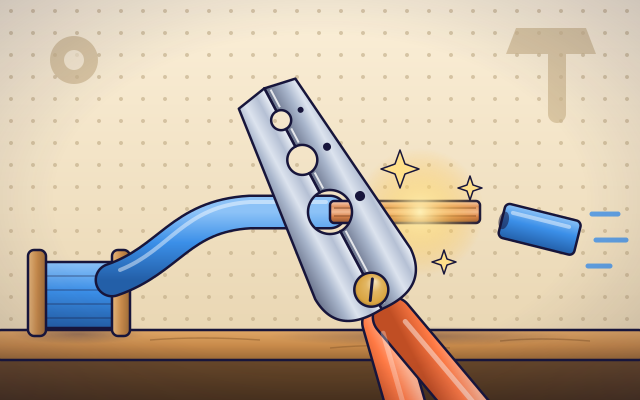
How do wire strippers remove insulation?
Match virtual wire sizes to openings and separate insulation without cutting the conductor.
#172
Tools & workshop
How do wire strippers remove insulation?
Match virtual wire sizes to openings and separate insulation without cutting the conductor.
 #181
Tools & workshop
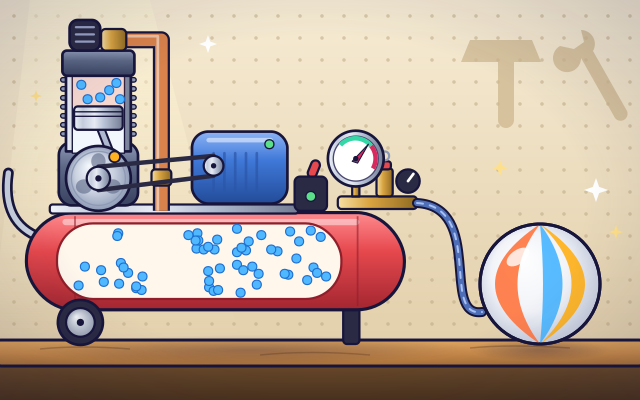
How does an air compressor store compressed air?
Watch a piston draw in air and push it into a storage tank.
#181
Tools & workshop
How does an air compressor store compressed air?
Watch a piston draw in air and push it into a storage tank.
 #163
Tools & workshop
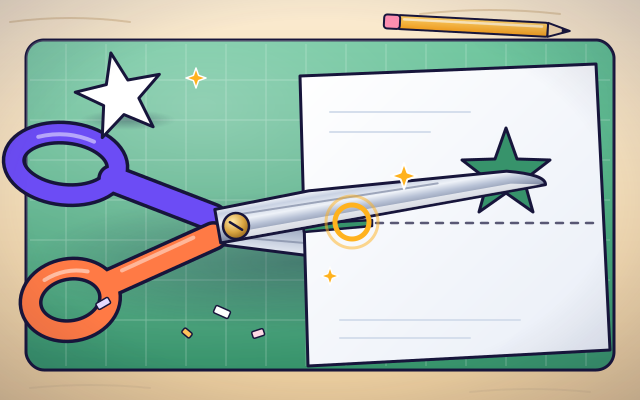
How do scissors cut through materials?
Explore how two blades and a pivot create a controlled cutting action.
#163
Tools & workshop
How do scissors cut through materials?
Explore how two blades and a pivot create a controlled cutting action.
 #164
Tools & workshop
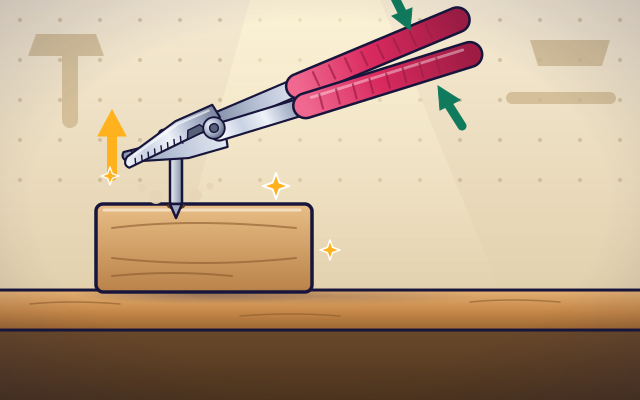
How do pliers grip objects firmly?
Change handle length and gripping position while comparing the force at the jaws.
#164
Tools & workshop
How do pliers grip objects firmly?
Change handle length and gripping position while comparing the force at the jaws.
Keep exploring
Games to play next
- Bridge LabBuild a bridge from beams, brace it with triangles, and stay on budget.
- Machine RepairFix levers, pulleys, gears and ramps so every contraption works.
Guide for grown-ups
- How to start homeschooling: a step-by-step guide for familiesA guide for parents · 7 min read
Science games by grade
Science worksheets by grade
- Preschool Science Worksheets
- Pre-K Science Worksheets
- Kindergarten Science Worksheets
- 1st Grade Science Worksheets
- 2nd Grade Science Worksheets
- 3rd Grade Science Worksheets
- 4th Grade Science Worksheets
- 5th Grade Science Worksheets
- 6th Grade Science Worksheets
- 7th Grade Science Worksheets
- 8th Grade Science Worksheets