How do helicopters fly and hover?
Spinning wings lift a helicopter, a tail rotor stops it spinning, and the pilot's controls tilt it to fly any way.
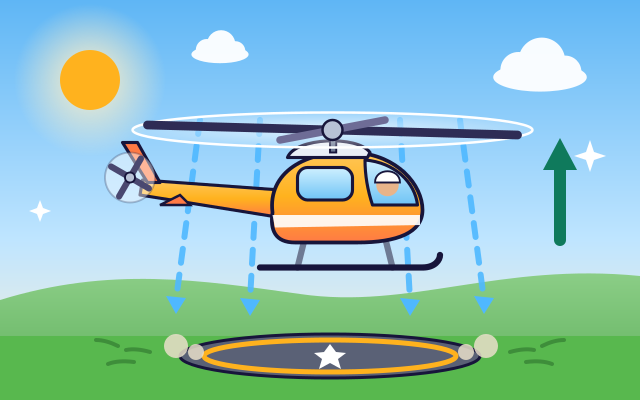
The big idea: A helicopter's rotor blades are long, thin wings that spin around. They push air down, which lifts the helicopter. Tilting the spinning blades makes it fly forward, backward or sideways, and the little tail rotor keeps it pointing the right way.
It's like
The interactive parts didn't load. The explanations below still work; try reloading the page.
How a helicopter flies
- The engine spins the main rotor. Each blade is shaped like a long, thin wing. As it whirls around, it slices through the air and pushes it down.
- To take off, the pilot pulls up a lever called the collective. All the blades tilt more steeply, push more air down, and the helicopter rises straight up.
- When the push from the rotor equals the helicopter's weight, it hovers, hanging in one spot. Airplanes can't do that!
- When the engine spins the rotor one way, the body gets pushed to spin the other way. The tail rotor blows air sideways to stop that spin and keep the nose pointing straight.
- To fly forward, the pilot pushes the stick called the cyclic. The spinning blades tilt forward, so the rotor pulls the helicopter forward as well as up.
- To land, the pilot lowers the collective a little at a time, so the lift is just less than the weight. The helicopter sinks gently until the skids touch down.
Inside a rescue helicopter
Tap each part to see what it does. Many of them move when you find them!
- Main rotor. The main rotor has long, thin blades shaped like wings. Spinning around, they push air down, and that lifts the helicopter.
- Swashplate. The swashplate is a ring around the rotor mast. Moving it up tilts all the blades more. Tipping it makes each blade change its tilt as it goes around.
- Engine. Most helicopters have a turbine engine. It sucks in air, burns fuel and spins very fast to turn the rotors.
- Gearbox. The engine spins much too fast for the rotor blades. The gearbox uses gears to slow the turning down and make it stronger.
- Tail drive shaft. A long shaft runs inside the tail boom. It carries spinning power back to the tail rotor.
- Tail rotor. The tail rotor blows air sideways. That push stops the body from spinning the opposite way to the big rotor, and it lets the pilot turn left or right.
- Pilot's controls. The collective lever makes the helicopter go up and down. The cyclic stick tilts it to go forward, backward or sideways. Foot pedals turn the nose left and right.
- Skids. Many helicopters land on skids instead of wheels. They are light and work on grass, snow or rooftops.
Hover lab: lift and the tail rotor
Use the lift lever to take off and hover. Tilt the rotor to move. What happens to the body if the tail rotor stops?
Experiment: What happens to a flying helicopter if its tail rotor stops pushing?
- Raise the lift until the helicopter takes off, then find the hover.
- Switch off the tail rotor and watch the body.
- Switch it back on. What does the tail rotor do?
What we found: Without the tail rotor, the body spins the opposite way to the big rotor. When the engine pushes the blades around, the blades push back on the helicopter. The tail rotor's sideways push stops that spin.
Turn on JavaScript to try it yourself.
Rescue landing
Turn the helicopter around, fly over the hill and land softly on the hospital roof.
Spinning wings
A helicopter's rotor blades are wings that go around in a circle instead of moving straight ahead. Because the blades are always moving through the air, a helicopter can make lift even when it isn't moving at all. That's why it can take off straight up, hover and land almost anywhere.
The pilot has three main controls. The collective lever tilts all the blades more or less steeply at once, to go up or down. The cyclic stick tips the spinning rotor so the helicopter moves forward, backward or sideways. Foot pedals change the push of the tail rotor to turn the nose.
Spinning the big rotor has a side effect. When the engine pushes the blades one way, the blades push the helicopter body the other way. Without a tail rotor, the body would spin around and around. Some helicopters use two rotors spinning in opposite directions instead.
Hovering takes a lot of power, so helicopters use more fuel than airplanes to carry the same load. In return they can rescue people from mountains, ships and rooftops where no airplane could land.
Key words
- Rotor
- The spinning set of blades that makes a helicopter's lift.
- Collective
- The lever that tilts all the blades together to go up or down.
- Cyclic
- The stick that tips the spinning rotor to move forward, backward or sideways.
- Torque
- A twisting push that makes something spin.
- Hover
- Staying still in the air because lift exactly equals weight.
- Downwash
- The air pushed down by a spinning rotor.
Check your thinking
-
How does a helicopter's main rotor lift it?
Show the answer
Its spinning blades push air down. The blades are wings that spin. Pushing air down makes an upward push on the helicopter.
-
Why does a helicopter need a tail rotor?
Show the answer
To stop the body spinning the opposite way to the main rotor. Spinning the rotor pushes the body the other way. The tail rotor pushes back.
-
Which control makes the helicopter go straight up or down?
Show the answer
The collective lever. The collective tilts all the blades together, making more or less lift.
-
When does a helicopter hover?
Show the answer
When the rotor's push up equals its weight. Balanced forces mean no speeding up or slowing down: it stays put.
-
A helicopter's rotor makes 12 kN of thrust at a blade pitch of 6°. In this simplified model thrust is proportional to pitch. About how much thrust at 9°?
Show the answer
18 kN. 9° is 1.5 times 6°, so thrust is about 1.5 × 12 = 18 kN.
-
Why do helicopters struggle to hover very high up?
Show the answer
The air is thinner, so the blades push less air. Thin air has less air to push down, so the rotor makes less lift.
You're a Flight & transportation expert!
You watched, looked inside, tried it, solved the challenge and went deeper. Pick another question below, or switch the age at the top to see this topic another way.
More about flight & transportation
 #4
Flight & transportation
How do rockets reach space?
Look inside a rocket and follow its launch stages. Watch exhaust leave as the rocket accelerates, then experiment with thrust and cargo weight.
#4
Flight & transportation
How do rockets reach space?
Look inside a rocket and follow its launch stages. Watch exhaust leave as the rocket accelerates, then experiment with thrust and cargo weight.
 #5
Flight & transportation
How do boats and huge ships float?
Explore buoyancy using different hull shapes. Build a virtual boat, add cargo, and investigate how its shape affects how much it can carry.
#5
Flight & transportation
How do boats and huge ships float?
Explore buoyancy using different hull shapes. Build a virtual boat, add cargo, and investigate how its shape affects how much it can carry.
 #6
Flight & transportation
How do submarines dive and surface?
Look inside ballast tanks and follow the movement of water and air. Control a submarine's depth and balance during an underwater mission.
#6
Flight & transportation
How do submarines dive and surface?
Look inside ballast tanks and follow the movement of water and air. Control a submarine's depth and balance during an underwater mission.
 #7
Flight & transportation
How do trains work?
Explore wheels, motors, brakes, and track switches. Build a small railway, move passengers or cargo, and guide trains through stations and junctions.
#7
Flight & transportation
How do trains work?
Explore wheels, motors, brakes, and track switches. Build a small railway, move passengers or cargo, and guide trains through stations and junctions.
Keep exploring
Games to play next
- Plane Flight SimulatorTake off from the runway and thread numbered sky hoops in order. Every clean flight is a new personal best.
- Fly with OllyBe Olly the owl: waddle, take off and fly over the city of Owlbridge, through hoops and between skyscrapers, snatching snacks as you go.
- Machine RepairFix levers, pulleys, gears and ramps so every contraption works.
Guide for grown-ups
- How to start homeschooling: a step-by-step guide for familiesA guide for parents · 7 min read
Science games by grade
Science worksheets by grade
- Preschool Science Worksheets
- Pre-K Science Worksheets
- Kindergarten Science Worksheets
- 1st Grade Science Worksheets
- 2nd Grade Science Worksheets
- 3rd Grade Science Worksheets
- 4th Grade Science Worksheets
- 5th Grade Science Worksheets
- 6th Grade Science Worksheets
- 7th Grade Science Worksheets
- 8th Grade Science Worksheets