How do rockets reach space?
Look inside a rocket, follow its stages to space, and test how thrust and cargo change a launch.
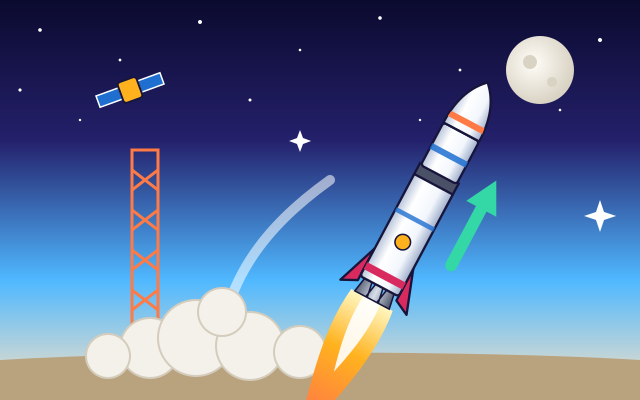
The big idea: A rocket burns fuel to make hot gas and blasts it out of the nozzle very fast. Pushing the gas down pushes the rocket up. When a part runs out of fuel, the rocket drops it to get lighter, and it must fly sideways very fast to stay in space.
It's like
The interactive parts didn't load. The explanations below still work; try reloading the page.
A rocket's trip to space
- The rocket stands on the launch pad, full of fuel. After the countdown, the engines light, and clouds of steam and smoke billow out.
- The rocket lifts off when its push, called thrust, is stronger than its weight. It starts slowly, then speeds up as it burns fuel and gets lighter.
- Inside the engine, fuel mixes with oxygen and burns, making very hot gas. The gas rushes out through the bell-shaped nozzle at enormous speed. Pushing gas down pushes the rocket up.
- When the first stage runs out of fuel, it separates and falls away. Dropping that heavy, empty part makes the rocket much lighter, and the second stage fires its engine.
- The pointy nose, called the fairing, protects the satellite from the rushing air. Once the rocket is above most of the air, the fairing splits open and falls away.
- To stay in space, the satellite must zoom sideways at about 28,000 kilometers per hour. Gravity pulls it down, but it moves so fast that it keeps falling around the Earth. That's an orbit!
Inside a two-stage rocket
Tap each part of the rocket. Many of them move when you find them!
- Engine and nozzle. The engine burns fuel and oxygen and shoots hot gas out of the bell-shaped nozzle. The nozzle can swivel to steer the rocket.
- Turbopump. A turbopump spins incredibly fast to push huge amounts of fuel and oxygen into the engine every second.
- Fuel tank. This tank holds the fuel, such as a kind of kerosene or very cold liquid hydrogen. Most of a rocket is just fuel and oxygen tanks!
- Liquid oxygen tank. There is no air to burn fuel in space, so rockets carry their own oxygen. It is kept super cold, so it stays liquid.
- Second stage. The second stage is a smaller rocket on top. It lights after the first stage drops away and carries the satellite the rest of the way.
- Guidance computer. The guidance computer is the rocket's brain. Sensors tell it where it is, and it steers the engines to follow the right path.
- Fairing (nose cone). The fairing is a smooth, pointy shell. It cuts through the air and protects the satellite, then splits open high above the air.
- Satellite. The satellite rides on top. Once in space, it unfolds its solar panels to make electricity from sunlight.
Launch lab: thrust and cargo
Pick a cargo and an engine power, then launch. Watch the exhaust and the rocket's speed. What changes when the cargo is heavier?
Experiment: If you add heavier cargo but keep the same engine power, what happens at liftoff?
- Choose no cargo, set medium power and launch.
- Now choose the big satellite and launch again with the same power.
- If it can't lift off, raise the power. What did you need?
What we found: A heavier rocket needs more push. With the same power, more cargo means a slower liftoff, and if the weight is bigger than the thrust, the rocket can't leave the pad at all.
Turn on JavaScript to try it yourself.
Put a satellite in orbit
Choose your satellite and launch. Drop the empty stage at the right moment, then open the fairing once you are above the air.
Push, stages and orbits
Have you ever let go of a blown-up balloon and watched it zoom around the room? Air rushes out of the back, and the balloon shoots forward. A rocket works the same way, but instead of air it blasts out hot gas from burning fuel, very fast.
Rockets carry their own oxygen because there is no air in space. The fuel and oxygen are pumped into the engine, where they burn and make hot gas. The gas rushes out of the nozzle, and the push it makes is called thrust. A rocket only lifts off if its thrust is bigger than its weight.
Most of a rocket is fuel tanks. As the fuel burns, the empty tanks become heavy luggage. So rockets are built in stages: when the bottom stage runs out of fuel, it drops away, and the next stage, lighter and already moving fast, keeps going.
Getting high is not enough to stay in space. A satellite must travel sideways at about 28,000 km/h. Gravity still pulls it down, but it moves so fast that the Earth curves away beneath it. It keeps falling around the planet: that is an orbit.
Key words
- Thrust
- The push a rocket engine makes by blasting out hot gas.
- Stage
- A section of a rocket with its own engines and fuel that is dropped when it is empty.
- Oxidizer
- The substance, often liquid oxygen, that lets fuel burn where there is no air.
- Orbit
- A path around a planet, falling all the way around without landing.
- Fairing
- The nose shell that protects the cargo while the rocket flies through the air.
- Thrust-to-weight ratio
- Thrust divided by weight. It must be greater than 1 for a rocket to lift off.
Check your thinking
-
What pushes a rocket up?
Show the answer
Hot gas blasted down out of the engine. Blasting gas down makes an equal push up on the rocket.
-
Why do rockets drop empty stages?
Show the answer
To get lighter so the rest can go faster. Empty tanks are heavy. Dropping them means the same push makes the rocket go faster.
-
Why do rockets carry liquid oxygen?
Show the answer
Fuel needs oxygen to burn, and there is no air in space. Fire needs oxygen. Up high there isn't enough air, so the rocket brings its own.
-
What keeps a satellite in orbit?
Show the answer
It moves sideways so fast that it keeps falling around the Earth. Gravity still pulls it, but its sideways speed makes it fall around the planet.
-
A rocket has 600 kN of thrust and a mass of 50,000 kg. What is its acceleration at liftoff (g ≈ 9.8 m/s²)?
Show the answer
About 2.2 m/s² upward. a = F/m − g = 600,000 ÷ 50,000 − 9.8 = 12 − 9.8 ≈ 2.2 m/s².
-
When does the fairing open?
Show the answer
High up, when the rocket is above most of the air. The fairing protects the satellite from the rushing air until the air is very thin.
You're a Flight & transportation expert!
You watched, looked inside, tried it, solved the challenge and went deeper. Pick another question below, or switch the age at the top to see this topic another way.
More about flight & transportation
 #5
Flight & transportation
How do boats and huge ships float?
Explore buoyancy using different hull shapes. Build a virtual boat, add cargo, and investigate how its shape affects how much it can carry.
#5
Flight & transportation
How do boats and huge ships float?
Explore buoyancy using different hull shapes. Build a virtual boat, add cargo, and investigate how its shape affects how much it can carry.
 #6
Flight & transportation
How do submarines dive and surface?
Look inside ballast tanks and follow the movement of water and air. Control a submarine's depth and balance during an underwater mission.
#6
Flight & transportation
How do submarines dive and surface?
Look inside ballast tanks and follow the movement of water and air. Control a submarine's depth and balance during an underwater mission.
 #7
Flight & transportation
How do trains work?
Explore wheels, motors, brakes, and track switches. Build a small railway, move passengers or cargo, and guide trains through stations and junctions.
#7
Flight & transportation
How do trains work?
Explore wheels, motors, brakes, and track switches. Build a small railway, move passengers or cargo, and guide trains through stations and junctions.
 #8
Flight & transportation
How do bicycles work?
Follow motion from the pedals through the chain to the rear wheel. Change gears on hills and explore steering, balance, and brakes.
#8
Flight & transportation
How do bicycles work?
Follow motion from the pedals through the chain to the rear wheel. Change gears on hills and explore steering, balance, and brakes.
Keep exploring
Games to play next
- Plane Flight SimulatorTake off from the runway and thread numbered sky hoops in order. Every clean flight is a new personal best.
- Machine RepairFix levers, pulleys, gears and ramps so every contraption works.
- Timetable TerminalRead the departure board, count the minutes and catch your connection on time.
Draw it or make it
- How to draw a rocketDrawing lesson
- Paper-Roll RocketPaper craft
Guide for grown-ups
- How to start homeschooling: a step-by-step guide for familiesA guide for parents · 7 min read
Science games by grade
Science worksheets by grade
- Preschool Science Worksheets
- Pre-K Science Worksheets
- Kindergarten Science Worksheets
- 1st Grade Science Worksheets
- 2nd Grade Science Worksheets
- 3rd Grade Science Worksheets
- 4th Grade Science Worksheets
- 5th Grade Science Worksheets
- 6th Grade Science Worksheets
- 7th Grade Science Worksheets
- 8th Grade Science Worksheets