How do pneumatic machines use compressed air?
Squeezed air stored in a tank flows through valves to push a piston out and pull it back again.
The big idea: Air squeezed into a tank pushes hard on everything. A valve lets it into one side of a cylinder, where it pushes a piston along. Letting the air out again makes the famous hiss.
It's like blowing through a straw to push a paper ball: your breath is the squeezed air, and the ball is the piston.
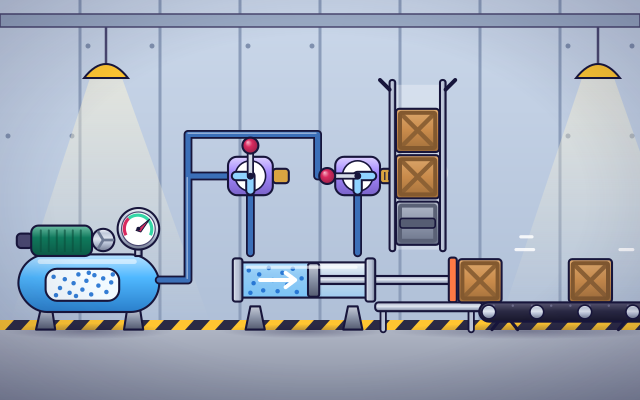
The interactive parts didn't load. The explanations below still work; try reloading the page.
How squeezed air moves a machine
- This machine pushes box after box onto a moving belt. Each push ends with a hiss. There is no motor on the pusher. So what is doing the pushing?
- A pump called a compressor squeezes more and more air into a strong tank. The crowded air pushes hard on the tank's walls. That push is called pressure, and the dial shows how big it is.
- Turn the first valve and squeezed air rushes down the hose into the left end of the cylinder. It pushes the piston along, and the rod pushes the box. The other valve lets the old air on the right escape.
- To pull the piston back, swap the valves. Now air flows into the right end, and the left end is opened to the room. The used air escapes with a hiss, and the piston slides home.
- Air in on one side pushes. Swap the valves and it pulls back. Bus doors, factory robots and the dentist's tools all work with squeezed air like this.
Look inside a pneumatic machine
Tap each part and follow the air from the pump to the piston and out again.
- Compressor. The compressor is a pump driven by a motor. It sucks in ordinary air and squeezes it into the tank.
- Air tank. The strong steel tank stores the squeezed air until it is needed. Look through the window: the air inside is very crowded.
- Pressure gauge. The gauge shows the pressure: how hard the air in the tank pushes on each bit of the wall.
- Hoses. Thin, bendy hoses carry the air from the tank to the valves and on to the cylinder. They can snake around corners easily.
- Valves. Each valve has a turning channel inside. One way, it joins the tank to the cylinder. The other way, it lets the cylinder's air out. The valves decide which way the piston moves.
- Cylinder. The cylinder is a smooth tube, closed at both ends. Air can be let into either end, so the piston can be pushed both ways.
- Piston and rod. The piston fits snugly inside the tube. Air pushes on its flat face. The rod carries that push outside to do a job, like moving a box.
- Silencer. Used air leaves through the silencer. It breaks the rushing air into many tiny streams, which turns a loud bang into a soft hiss.
Route the air with two valves
Tap each valve to send air in or let it out. Which settings push the piston out? Which bring it back? What happens when both sides get air?
Experiment: What happens if you send air into both ends of the cylinder at once?
- Set the left valve to air in and the right valve to let out. Watch the piston.
- Now swap them both. Listen for the hiss.
- Then set both valves to air in. Does the piston move?
What we found: A piston only moves when the air pushes harder on one side than the other. Air in on the left and out on the right pushes it out. Swap them and it comes back. With air on both sides the pushes cancel, so it stays where it is.
Turn on JavaScript to try it yourself.
Make the air last
Push all 5 boxes onto the belt before the tank runs out of air. Gray boxes are heavy and need more pressure. More pressure uses more air.
Why squeezed air can push
Air is made of tiny bits called molecules that zoom around and bump into everything. Each bump is a tiny push. When a compressor squeezes lots of air into a tank, there are many more molecules in the same space, so there are many more bumps. All those bumps add up to a strong, steady push called pressure.
A pneumatic machine uses that push. A valve opens a path from the tank to one end of a cylinder. The crowded air rushes in and pushes on the piston. At the same time the other end is opened to the room, so the air there can get out of the way. The piston moves toward the side with less push.
To go back, the valves swap. The used air escapes through a silencer with a hiss. That hiss is the sound of pneumatics: you can hear it when a bus opens its doors or a truck sets its brakes.
Air can be squashed, a bit like a spring. That makes pneumatic machines quick and gentle, and a leak only lets out air. But it also means they are not good at holding a heavy thing perfectly still. For that job, machines use liquid instead. Our straw comparison is not perfect either: your breath is weak, while tank air pushes many times harder.
Key words
- Pneumatics
- Using squeezed air to make machines move.
- Compressed air
- Air that has been squeezed into a smaller space, so it pushes harder than the air around us.
- Pressure
- How hard the air pushes on each little patch of a surface.
- Valve
- A part that opens, closes or redirects the path for air.
- Cylinder
- A tube with a sliding piston that air can push along.
Check your thinking
-
What pushes the piston along the cylinder?
Show the answer
Squeezed air pushing on one side of it. Air from the tank pushes on the piston's face, and nothing much pushes back on the other side.
-
Where does the hissing sound come from?
Show the answer
Used air escaping to the room through the silencer. Before the piston can come back, the squeezed air behind it has to get out. It rushes out and hisses.
-
You want the piston to come back. What should the valves do?
Show the answer
Let the air out behind the piston and send air into the rod end. The piston moves away from the side with more push. So the push has to be on the rod side, with the other side open.
-
A heavy box will not move. What could you change so the same cylinder can push it?
Show the answer
Raise the air pressure. More pressure means a harder push on the same piston.
-
Why are pneumatic machines not good at holding a heavy load perfectly still?
Show the answer
Air can be squashed, so it gives a little like a spring. Push on trapped air and it squashes, so the piston moves a bit. Liquid does not squash, so liquid holds firm.
You're a Forces & mechanisms expert!
You watched, looked inside, tried it, solved the challenge and went deeper. Pick another question below, or switch the age at the top to see this topic another way.
More about forces & mechanisms
 #119
Forces & mechanisms
How do gyroscopes help maintain orientation?
Spin a virtual rotor and investigate its response when its orientation changes.
#119
Forces & mechanisms
How do gyroscopes help maintain orientation?
Spin a virtual rotor and investigate its response when its orientation changes.
 #120
Forces & mechanisms
How do shock absorbers reduce bouncing?
Drive over model bumps and adjust damping to control repeated bouncing.
#120
Forces & mechanisms
How do shock absorbers reduce bouncing?
Drive over model bumps and adjust damping to control repeated bouncing.
 #121
Forces & mechanisms
How do suction cups stay attached?
Press cups onto different surfaces and explore the pressure difference holding them in place.
#121
Forces & mechanisms
How do suction cups stay attached?
Press cups onto different surfaces and explore the pressure difference holding them in place.
 #122
Forces & mechanisms
How do objects stay balanced without tipping?
Move weights around model objects and predict when their centers of mass cause tipping.
#122
Forces & mechanisms
How do objects stay balanced without tipping?
Move weights around model objects and predict when their centers of mass cause tipping.
Keep exploring
Games to play next
- Machine RepairFix levers, pulleys, gears and ramps so every contraption works.
- Marble MountainLay straights, curves, drops and splitters to roll marbles down the mountain.
- Bridge LabBuild a bridge from beams, brace it with triangles, and stay on budget.
Guide for grown-ups
- How to start homeschooling: a step-by-step guide for familiesA guide for parents · 7 min read
Science games by grade
Science worksheets by grade
- Preschool Science Worksheets
- Pre-K Science Worksheets
- Kindergarten Science Worksheets
- 1st Grade Science Worksheets
- 2nd Grade Science Worksheets
- 3rd Grade Science Worksheets
- 4th Grade Science Worksheets
- 5th Grade Science Worksheets
- 6th Grade Science Worksheets
- 7th Grade Science Worksheets
- 8th Grade Science Worksheets