How do shock absorbers reduce bouncing?
A spring soaks up a bump, but it keeps bouncing. A shock absorber pushes oil through tiny holes to calm the bounce.
The big idea: Springs hold a car up and soften bumps, but a spring alone keeps bouncing. A shock absorber slows the spring by pushing oil through small holes, so the car settles after one bounce.
It's like a door with a slow-closer: a spring pulls it shut, and a little oil cylinder keeps it from slamming or swinging.
The interactive parts didn't load. The explanations below still work; try reloading the page.
How a car stops bouncing
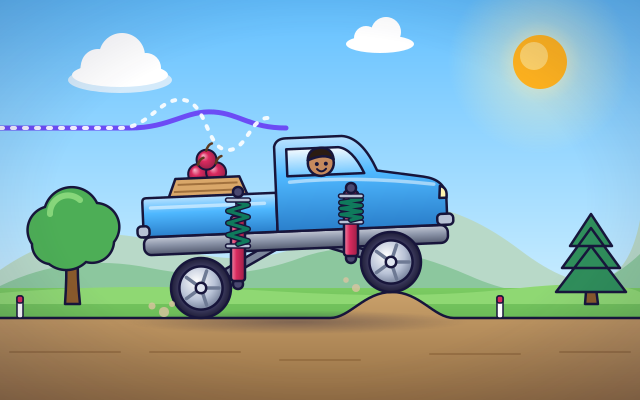
- This truck is driving over a bumpy road. Its wheels jump up and down, but the driver and the apples in the back stay almost steady. How?
- Each wheel is joined to the truck by a coil spring. When a wheel rides up a bump, the spring squashes. So the wheel can jump up quickly while the heavy body rises only a little.
- But a squashed spring pushes back. It throws the body up, the body falls and squashes it again, and so on. With springs alone, the truck keeps bouncing long after the bump.
- A shock absorber is a tube of oil with a piston inside. The piston has tiny holes. To move, it has to squeeze oil through those holes, and oil does not like to be rushed.
- Squeezing the oil through the holes takes energy. That energy comes from the bounce. Each time, the bounce gets smaller, and the oil gets a tiny bit warmer.
- Spring and shock absorber make a team. The spring soaks up the bump, and the shock absorber stops the bouncing. One gentle rise and fall, and the truck is steady again.
Look inside a shock absorber
Tap each part. Watch what moves when the wheel goes over bumps.
- Coil spring. The coil spring holds the truck up. It squashes when the wheel hits a bump and then pushes back.
- Oil cylinder. The cylinder is a strong, sealed tube filled with oil. It is fixed to the wheel's side of the suspension.
- Piston. The piston is a disc that fits the tube snugly. When the wheel moves, the piston has to push through the oil.
- Tiny holes. Small holes in the piston let the oil through, but only slowly. Smaller holes mean a stronger, slower shock absorber.
- Oil. The oil is thick and slippery. Being squeezed through the holes warms it up. That warmth is the bounce energy, used up.
- Piston rod. The smooth, shiny rod connects the piston to the truck's body. It slides in and out through a tight seal.
- Top mount. The top mount bolts to the body of the truck. A rubber bush stops small shakes and noises from getting through.
- Bottom mount. The bottom mount is fixed to the arm that carries the wheel. So when the wheel goes up, the cylinder goes up with it.
Drive over a bump
Change the shock absorbers from very weak to very stiff. Each time, the truck drives over the bump. Watch the purple trail. When is the ride calmest?
Experiment: What happens if the shock absorbers are made stiffer and stiffer?
- Slide the shock absorbers to very weak. Count the bounces in the trail.
- Slide to the middle. What does the trail look like now?
- Slide to very stiff. Watch the driver when the wheel hits the bump.
What we found: Weak shock absorbers let the spring bounce again and again. Medium ones calm it in about one bounce. But very stiff ones hardly move at all, so the spring cannot do its job, and the bump is passed straight to the truck as a jolt.
Turn on JavaScript to try it yourself.
Apples over the bumpy road
Drive the apples down the bumpy road. Set the shock absorbers so that no apples bounce out.
Why cars need springs and shock absorbers
Roads are never perfectly flat. If a car's wheels were bolted straight to its body, every bump would throw the whole car upward. So each wheel is joined to the body by a spring. When a wheel hits a bump, the spring squashes, and the wheel can jump up without lifting the heavy body very much.
But springs have a habit. A squashed spring pushes back, overshoots, gets stretched, pulls back and overshoots again. A car on springs alone would bounce down the road like a ball. That is uncomfortable, and it is unsafe too, because a bouncing wheel does not grip the road well.
The shock absorber fixes this. It is a tube of oil with a piston inside, and the piston has tiny holes. When the spring moves, the piston has to squeeze oil through the holes. That takes energy away from the bounce and turns it into a little heat. After one gentle rise and fall, the car is steady.
The amount matters. Too weak, and the car still bounces. Too stiff, and the suspension cannot move, so the bumps come straight through. You will find the same team of spring and damper on bikes, trains, airplane landing gear and washing machines. Our door-closer comparison has a limit: a door moves once, but a car meets bump after bump.
Key words
- Suspension
- The springs, shock absorbers and arms that join a vehicle's wheels to its body.
- Shock absorber
- An oil-filled tube with a piston that slows a spring's bouncing.
- Damping
- Taking the energy out of a bounce or a wobble so that it dies away.
- Natural frequency
- How fast something bounces by itself once you set it going.
- Oscillation
- A repeated back-and-forth or up-and-down movement.
Check your thinking
-
What is the spring's job when a wheel hits a bump?
Show the answer
It squashes, so the wheel can rise without throwing the body up. The spring gives way, so the light wheel moves a lot and the heavy body moves a little.
-
A car keeps bouncing long after every bump. What is probably worn out?
Show the answer
The shock absorbers. Worn shock absorbers cannot take the energy out of the springs, so the bouncing goes on.
-
Where does the energy of the bounce go?
Show the answer
It warms the oil in the shock absorber. Squeezing oil through the tiny holes turns movement into heat. Energy never just disappears.
-
Why are very stiff shock absorbers uncomfortable?
Show the answer
They hardly move, so bumps pass straight to the body. If the shock absorber will not move quickly, the spring cannot squash, and you feel every bump.
-
A truck is loaded with heavy boxes. What happens to its bouncing?
Show the answer
It bounces more slowly. A heavier body is slower to get moving, so each bounce takes longer.
You're a Forces & mechanisms expert!
You watched, looked inside, tried it, solved the challenge and went deeper. Pick another question below, or switch the age at the top to see this topic another way.
More about forces & mechanisms
 #121
Forces & mechanisms
How do suction cups stay attached?
Press cups onto different surfaces and explore the pressure difference holding them in place.
#121
Forces & mechanisms
How do suction cups stay attached?
Press cups onto different surfaces and explore the pressure difference holding them in place.
 #122
Forces & mechanisms
How do objects stay balanced without tipping?
Move weights around model objects and predict when their centers of mass cause tipping.
#122
Forces & mechanisms
How do objects stay balanced without tipping?
Move weights around model objects and predict when their centers of mass cause tipping.
 #178
Forces & mechanisms
How does a hand pump raise water?
Move a handle and follow water through a cylinder and one-way valves.
#178
Forces & mechanisms
How does a hand pump raise water?
Move a handle and follow water through a cylinder and one-way valves.
 #179
Forces & mechanisms
How does a siphon move water between containers?
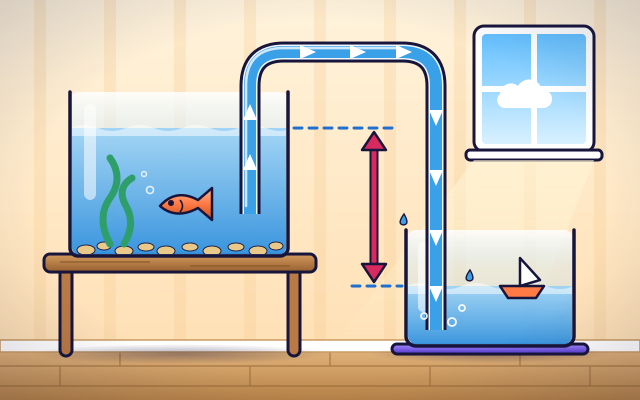
Connect virtual containers and investigate how differences in water level drive flow.
#179
Forces & mechanisms
How does a siphon move water between containers?
Connect virtual containers and investigate how differences in water level drive flow.
Keep exploring
Games to play next
- Machine RepairFix levers, pulleys, gears and ramps so every contraption works.
- Marble MountainLay straights, curves, drops and splitters to roll marbles down the mountain.
- Bridge LabBuild a bridge from beams, brace it with triangles, and stay on budget.
Guide for grown-ups
- How to start homeschooling: a step-by-step guide for familiesA guide for parents · 7 min read
Science games by grade
Science worksheets by grade
- Preschool Science Worksheets
- Pre-K Science Worksheets
- Kindergarten Science Worksheets
- 1st Grade Science Worksheets
- 2nd Grade Science Worksheets
- 3rd Grade Science Worksheets
- 4th Grade Science Worksheets
- 5th Grade Science Worksheets
- 6th Grade Science Worksheets
- 7th Grade Science Worksheets
- 8th Grade Science Worksheets