How do suction cups stay attached?
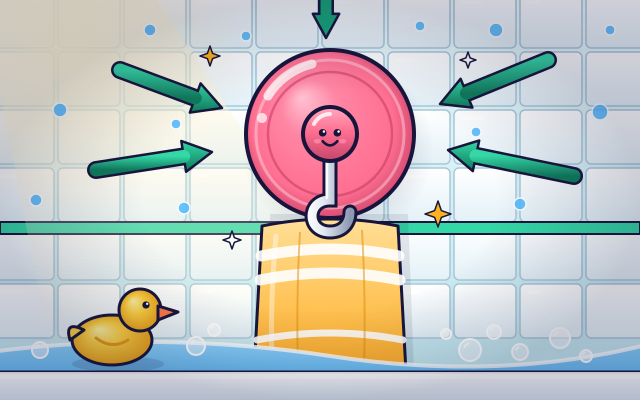
A suction cup has no glue. Press it, and the air all around pushes it onto the wall.
The big idea: Pressing a suction cup squeezes air out. With less air inside, the air outside pushes harder and holds the cup against a smooth surface.
It's like a drinking straw: take air out and the outside air pushes juice up. A suction cup has less air inside, so outside air pushes it onto the wall.
The interactive parts didn't load. The explanations below still work; try reloading the page.
Why a suction cup sticks
- A suction cup holds a towel on a smooth bathroom wall. It has no glue, no tape and no nails. So what is holding it there?
- Air is made of tiny bits that zoom around and bump into things. All those bumps add up to a push, called air pressure. Right now the push is the same inside the cup and outside.
- Press the cup against the wall. The soft dome flattens and most of the air inside is squeezed out under the rim.
- Let go, and the springy rubber tries to return to its dome shape. The space inside grows, but no new air can get in. A little air in a bigger space pushes only weakly.
- Outside, the air still pushes with full strength. Inside, the push is weak. The stronger push from outside presses the cup onto the wall, even with a towel hanging from it.
- On a rough brick wall the rim cannot seal. Air sneaks in through the tiny gaps until the push inside matches the push outside. With nothing holding it, the cup drops.
Look inside a suction cup
This cup is cut in half so you can see the air pocket. Tap each part to see what it does.
- Rubber dome. The dome is made of soft rubber or plastic. It flattens when you press it and then tries to spring back into shape. That springiness makes the low pressure.
- Sealing rim. The thin, flexible edge presses flat against the surface and makes a seal, so air cannot get back inside.
- Low-pressure pocket. This is the space under the dome. Most of its air was squeezed out, so the air left inside pushes only weakly.
- Outside air. The air outside pushes on the cup with full air pressure. Because it pushes harder than the air inside, it presses the cup onto the surface.
- Smooth surface. Glass, tiles and shiny plastic are smooth enough for the rim to seal. Rough or holey surfaces, like brick and bare wood, let air leak in.
- Hook and load. The hook carries the load. The cup holds as long as the push from the outside air is bigger than the pull of the load.
- Release tab. Lifting the tab peels up a bit of the rim. Air rushes in, the push becomes the same on both sides, and the cup comes off easily.
Test the cup on four surfaces
Tap a surface to press the cup onto it. Watch the air and the two pressure bars. Which surfaces hold, and which let go?
Experiment: Which surface will hold the suction cup the longest?
- Tap the glass to press the cup under it. Watch the pressure bars.
- Now tap the wood, and then the brick.
- Which cups fall? Look for air sneaking in at the rim.
What we found: The cup stays on smooth glass and tile because the rim seals and no air gets back in. On wood, air creeps in slowly and the cup lets go after a while. On rough brick, air rushes in and the cup drops almost at once.
Turn on JavaScript to try it yourself.
Hold the heavy bucket
Hang a 6 kilogram bucket for 6 seconds. Pick a surface and a cup size, then press Hang it! For 3 stars, use the smallest cup that works.
The push of the air
We live at the bottom of a deep ocean of air. The air is made of tiny bits called molecules that zoom around and bump into everything. All those bumps make a steady push called air pressure. You do not notice it because it pushes on you from every side at once, inside and out.
A suction cup makes the push uneven. When you press the cup, you squeeze most of the air out from under it. When you let go, the springy cup tries to pop back into its dome shape. That makes more room inside, but the rim is sealed, so no new air can get in. A little air in a big space pushes only weakly.
Now the air outside is pushing much harder than the air inside. That bigger push presses the cup against the wall. So the cup is not really sucking. It is being pushed on by the air around it. It is like a drinking straw, with one difference: in a straw you keep pulling air out, but a cup only gets one squeeze.
That is why the surface matters so much. On glass or a shiny tile, the rim seals all the way around. On brick or rough wood there are tiny gaps. Air sneaks in, the pushes become equal again, and the cup falls. A drop of water on the rim can fill the smallest gaps and help the seal.
Key words
- Air pressure
- The push of the air on everything it touches.
- Pressure difference
- When the air pushes harder on one side of something than on the other.
- Seal
- A tight join that does not let air through.
- Partial vacuum
- A space with much less air in it than normal.
- Porous
- Full of tiny holes that air or water can pass through, like brick or a sponge.
Check your thinking
-
What really holds a suction cup against a wall?
Show the answer
The air outside pushes harder than the air inside. With most of the air squeezed out, the push from outside is stronger, and it presses the cup on.
-
Why does a suction cup fall off a brick wall?
Show the answer
Air leaks in through the gaps under the rim. A rough surface cannot seal. Air gets in, the pushes even out and nothing holds the cup.
-
You lift the little tab on the rim. What happens?
Show the answer
Air rushes in and the cup comes off. Lifting the rim breaks the seal. Once the push is the same on both sides, the cup lets go.
-
On glass, you swap a cup for one that is twice as wide. About how much more can it hold?
Show the answer
Four times as much. Force = pressure difference x area, and area grows with the square of the width: 2 x 2 = 4.
-
Why can a drop of water on the rim help a suction cup stick?
Show the answer
Water fills tiny gaps so air cannot leak in. The water plugs the smallest gaps under the rim, which makes the seal better.
You're a Forces & mechanisms expert!
You watched, looked inside, tried it, solved the challenge and went deeper. Pick another question below, or switch the age at the top to see this topic another way.
More about forces & mechanisms
 #122
Forces & mechanisms
How do objects stay balanced without tipping?
Move weights around model objects and predict when their centers of mass cause tipping.
#122
Forces & mechanisms
How do objects stay balanced without tipping?
Move weights around model objects and predict when their centers of mass cause tipping.
 #178
Forces & mechanisms
How does a hand pump raise water?
Move a handle and follow water through a cylinder and one-way valves.
#178
Forces & mechanisms
How does a hand pump raise water?
Move a handle and follow water through a cylinder and one-way valves.
 #179
Forces & mechanisms
How does a siphon move water between containers?
Connect virtual containers and investigate how differences in water level drive flow.
#179
Forces & mechanisms
How does a siphon move water between containers?
Connect virtual containers and investigate how differences in water level drive flow.
 #197
Forces & mechanisms
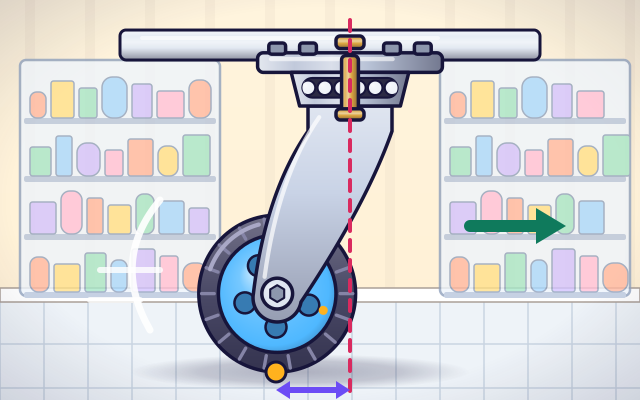
How do shopping-cart wheels swivel into position?
Push a model cart and watch offset caster wheels follow changes in direction.
#197
Forces & mechanisms
How do shopping-cart wheels swivel into position?
Push a model cart and watch offset caster wheels follow changes in direction.
Keep exploring
Games to play next
- Machine RepairFix levers, pulleys, gears and ramps so every contraption works.
- Marble MountainLay straights, curves, drops and splitters to roll marbles down the mountain.
- Bridge LabBuild a bridge from beams, brace it with triangles, and stay on budget.
Guide for grown-ups
- How to start homeschooling: a step-by-step guide for familiesA guide for parents · 7 min read
Science games by grade
Science worksheets by grade
- Preschool Science Worksheets
- Pre-K Science Worksheets
- Kindergarten Science Worksheets
- 1st Grade Science Worksheets
- 2nd Grade Science Worksheets
- 3rd Grade Science Worksheets
- 4th Grade Science Worksheets
- 5th Grade Science Worksheets
- 6th Grade Science Worksheets
- 7th Grade Science Worksheets
- 8th Grade Science Worksheets