How do self-righting lifeboats turn upright again?
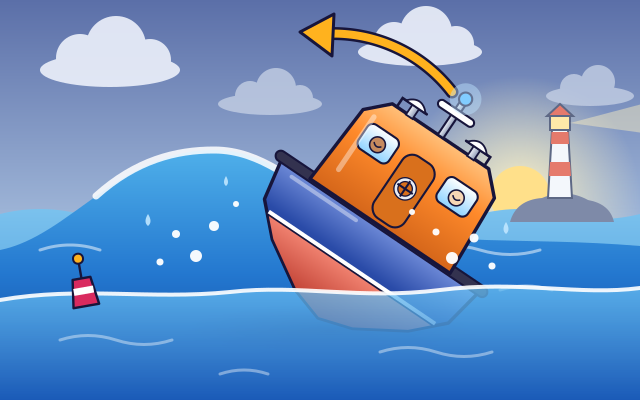
Heavy engines down low and a sealed cabin full of air up high make a rescue lifeboat roll upright again after a wave turns it over.
The big idea: A self-righting lifeboat keeps its heavy parts low and a big pocket of air high. Upside down, the weight pulls down and the air pushes up, and together they twist the boat upright.
It's like a roly-poly toy with a weight in its base. Push it flat and the heavy bottom swings back down. A lifeboat adds a bubble of air on top.
The interactive parts didn't load. The explanations below still work; try reloading the page.
Flipped by a wave, upright in seconds
- A rescue lifeboat heads out when the sea is at its roughest. The waves can be taller than the boat. What happens if one of them knocks it right over?
- Here is the boat from behind. A huge wave lifts one side and rolls the boat all the way over. An ordinary boat would stay like this.
- Let's look inside, back in calm water. The heaviest parts, the engines and the fuel, sit at the very bottom of the hull. That keeps the boat's weight low.
- On top is a tall cabin with watertight doors. It is a giant bubble of air. Tip the boat, and the water pushes that bubble back up, hard.
- Upside down, the heavy engines are up in the air pulling down, and the air-filled cabin is under water pushing up. The two never line up, so they twist the boat upright.
- Water pours off the decks and the boat is upright again, in just a few seconds. The crew were strapped into their seats, and the rescue goes on.
Look inside a self-righting lifeboat
You are looking at the boat from behind, cut open. Tap each part to see how it helps the boat roll back up.
- Watertight cabin. The tall cabin is sealed tight, so it stays full of air. If the boat rolls over, the water pushes this big bubble of air back toward the top.
- Watertight door. The doors have rubber seals and a wheel that clamps them shut. At sea in rough weather they stay closed, or water would rush in and the air bubble would be lost.
- Crew seats and harnesses. Each crew member sits in a padded seat with a harness, a strong seat belt. If the boat rolls over, everyone stays in place until it is upright again.
- Air vents with valves. Engines and people need fresh air, so the boat has vents. Valves inside them close when the boat tips, so the sea cannot pour in.
- Engines. The engines are some of the heaviest things on board. They are bolted low in the hull, so the boat's weight is near the bottom.
- Fuel tank and keel. The fuel tanks sit at the very bottom, next to the keel, the boat's backbone. More heavy stuff, kept as low as it can go.
- Sealed hull compartments. The hull is divided into separate sealed rooms full of air. If one gets a hole, the others still keep the boat afloat.
Test pool: which boat rolls back?
Drag the handle to tip a model boat and let go, or send a big wave. Change the hull and slide the heavy block up and down. Watch the two arrows.
Experiment: A big wave rolls the lifeboat upside down. When does it roll back up by itself?
- Keep the lifeboat hull with the block low. Send a big wave and watch.
- Slide the block up high and send another wave.
- Try the flat raft too. Each time, look at where the two arrows are.
What we found: The lifeboat rolls back only when its heavy block is low and its tall cabin is full of air. Upside down, the weight is then high up pulling down and the air is under water pushing up. They are not in line, so they twist the boat upright. Raise the weight, or use a flat raft, and the boat is steady upside down instead.
Turn on JavaScript to try it yourself.
Pass the storm test
Build a boat that rolls back upright after a big wave. Pick the hull, tap a spot for the engine and decide about the cabin door. Then run the storm test.
Why a lifeboat cannot stay upside down
Two things act on every floating boat. Its weight pulls it down, and the water pushes it up. The push of the water is called buoyancy. When a boat floats quietly, the pull and the push are equal and sit right in line, one above the other.
Tilt the boat and the shape of the part under water changes. The push of the water moves sideways, toward the side that has dipped in. Now the push and the pull are not in line any more. One pushes up on one side and the other pulls down on the other side, and that twists the boat back upright. A wide boat is hard to tip for this reason.
But a wide, flat boat is just as steady upside down. A self-righting lifeboat is built so that upside down is the one position it cannot keep. Its heavy engines and fuel are at the very bottom. Its tall cabin is sealed and full of air. Flip the boat and the heavy parts are high in the air while the bubble of air is forced under water. The weight wants to come down and the air wants to come up, so the boat rolls over again, usually in a few seconds.
It only works if the cabin stays sealed, which is why the doors are shut in rough seas, and why the crew are strapped into their seats. A roly-poly toy works in a similar way, but it rests on a table. A boat rests on water, so the point that holds it up moves every time it tilts.
Key words
- Buoyancy
- The upward push of water on anything in it.
- Center of gravity
- The balance point of an object, where all its weight seems to pull from.
- Capsize
- To be turned over in the water, onto the side or completely upside down.
- Ballast
- Heavy material placed low in a boat on purpose to keep it steady.
- Righting lever
- How far apart the push of the water and the pull of the weight are. The farther apart, the harder they twist the boat back.
- Watertight
- Sealed so that no water can get in.
Check your thinking
-
Why are a lifeboat's engines and fuel tanks placed low in the hull?
Show the answer
So the weight always pulls the bottom of the boat back down. With the weight low, any tilt leaves the weight trying to swing back down to the bottom.
-
When the boat is upside down, what does the sealed cabin do?
Show the answer
It is full of air, so the water pushes it back up. A big bubble of air held under water is pushed up strongly. That push helps twist the boat upright.
-
Why does a wide, flat raft stay upside down after a wave flips it?
Show the answer
It is just as steady upside down as it is the right way up. A flat shape floats the same way on either face. Nothing twists it back.
-
What would happen if the cabin door was left open in a storm and the boat rolled over?
Show the answer
Water could fill the cabin, so it would not push the boat back up. The cabin only helps while it holds air. Full of water, it gives no extra push.
-
Why are the crew strapped into their seats in rough seas?
Show the answer
So they stay in place while the boat rolls over and back. A harness keeps each person safely in their seat through the whole roll.
You're a Flight & transportation expert!
You watched, looked inside, tried it, solved the challenge and went deeper. Pick another question below, or switch the age at the top to see this topic another way.
More about flight & transportation
 #142
Flight & transportation
How do life jackets help people float?
Explore buoyant material, body position, and stability around a floating character.
#142
Flight & transportation
How do life jackets help people float?
Explore buoyant material, body position, and stability around a floating character.
 #195
Flight & transportation
How does a gas pump stop when the tank is full?
Follow fuel through pumping and metering, then explore the nozzle's shutoff mechanism.
#195
Flight & transportation
How does a gas pump stop when the tank is full?
Follow fuel through pumping and metering, then explore the nozzle's shutoff mechanism.
 #196
Flight & transportation
How does a manual wheelchair move and turn?
Operate push rims independently and explore steering, caster wheels, and brakes.
#196
Flight & transportation
How does a manual wheelchair move and turn?
Operate push rims independently and explore steering, caster wheels, and brakes.
 #1
Flight & transportation
How do airplanes fly?
Explore wings, engines, and flight controls. Watch airflow around a wing, adjust speed and wing angle, and try taking off and landing.
#1
Flight & transportation
How do airplanes fly?
Explore wings, engines, and flight controls. Watch airflow around a wing, adjust speed and wing angle, and try taking off and landing.
Keep exploring
Games to play next
- Downriver Kayak SlalomFind the rhythm of the current, one paddle stroke at a time.
- Plane Flight SimulatorTake off from the runway and thread numbered sky hoops in order. Every clean flight is a new personal best.
- Machine RepairFix levers, pulleys, gears and ramps so every contraption works.
Guide for grown-ups
- How to start homeschooling: a step-by-step guide for familiesA guide for parents · 7 min read
Science games by grade
Science worksheets by grade
- Preschool Science Worksheets
- Pre-K Science Worksheets
- Kindergarten Science Worksheets
- 1st Grade Science Worksheets
- 2nd Grade Science Worksheets
- 3rd Grade Science Worksheets
- 4th Grade Science Worksheets
- 5th Grade Science Worksheets
- 6th Grade Science Worksheets
- 7th Grade Science Worksheets
- 8th Grade Science Worksheets