How do scuba regulators deliver breathing gas?
A scuba regulator turns the tightly squeezed air in a tank into gentle breaths, and it always matches the push of the water around the diver.
The big idea: Air in the tank is squeezed far too hard to breathe. The regulator lowers its pressure in two steps and lets it flow only when the diver breathes in. Deeper down, where the water pushes harder, it gives the air a harder push too.
It's like a tap that turns itself on when you breathe in and off when you stop, and that knows how hard the water around you is pushing.
The interactive parts didn't load. The explanations below still work; try reloading the page.
From tank to breath
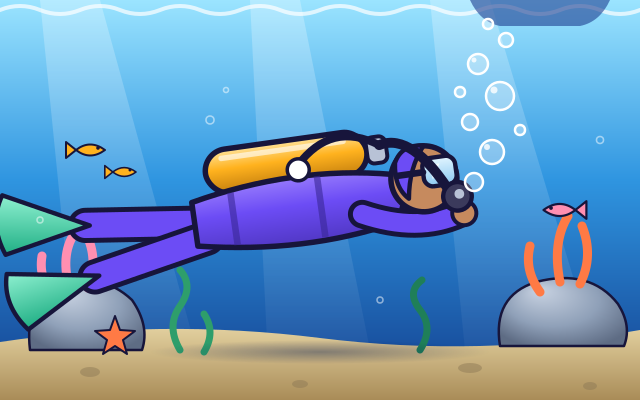
- A diver and her instructor swim slowly along a reef. Each carries a tank of air on their back. But how does the air get from the tank to the diver, one calm breath at a time?
- A pump has squeezed a huge amount of air into the tank, about as much as fills a large wardrobe. It pushes on the tank about 200 times harder than the air around you. Nobody could breathe that directly.
- The first stage is fixed to the top of the tank. Inside, a spring and a valve let out just a little air at a time. The air in the hose is now at a much lower, steady pressure.
- The second stage sits in the diver's mouth. When she breathes in, a rubber sheet called a diaphragm bends inward and presses a lever. The lever opens a valve and air flows. When she stops, it closes.
- The deeper the diver goes, the harder the water squeezes. The water also pushes on the diaphragm, so the regulator gives air at exactly the same pressure as the water. That keeps breathing easy, but each breath uses more air.
- Divers learn all of this from trained instructors before they ever go in the sea. They watch their pressure gauge, stay close to a buddy, breathe calmly and come up slowly with plenty of air to spare.
Look inside a regulator
Tap each part and follow the air from the tank to the diver's mouth.
- Tank. The tank is a thick metal bottle. A pump squeezes in far more air than the bottle could normally hold, so the diver can carry enough for a whole dive.
- First stage. The first stage screws onto the tank. A spring and a valve inside it turn the tank's huge pressure into a much smaller, steady pressure for the hose.
- Hose. A strong, bendy hose carries the air from the first stage on the tank around to the diver's mouth.
- Diaphragm. The diaphragm is a thin rubber sheet with water on one side and air on the other. When the diver breathes in, the water pushes it inward.
- Lever and valve. The diaphragm presses on a lever. The lever lifts a small valve off its seat, and air rushes in from the hose. When the diaphragm springs back, the valve closes.
- Mouthpiece. The diver bites gently on the soft mouthpiece and breathes in and out through it, slowly and calmly.
- Exhaust valve. When the diver breathes out, the used air pushes open a soft rubber flap and escapes as bubbles. The flap then closes so that no water gets in.
- Pressure gauge. The pressure gauge shows how much air is left in the tank. Divers check it often and start back up long before it gets low.
Breathe in, and go deeper
Press Breathe and follow the air through both stages. Then drag the diver deeper. What changes?
Experiment: The diver swims down to where the water pushes much harder. What will the regulator do?
- Near the surface, press Breathe. Watch the diaphragm, the lever and the valve.
- Drag the diver down deep and look at the pressure in the mouthpiece.
- Take a few breaths there. Watch the tank gauge.
What we found: Breathing in bends the diaphragm, which opens the valve and lets air flow. Deeper down the water pushes harder on the diaphragm, so the regulator gives air at a higher pressure that matches the water. Each breath then holds more air, so the tank empties faster.
Turn on JavaScript to try it yourself.
The photo dive
Swim down and stay for 3 breaths beside each sea creature to take its photo. Then come back up with at least 50 bar of air left.
Air on demand
Air can be squeezed. A pump can push a whole room's worth of air into one scuba tank. Squeezed air pushes back very hard on the tank, about 200 times harder than the air around you. That push is called pressure, and it is much too high to breathe.
The regulator fixes this in two steps. The first stage, on top of the tank, lets the air out a little at a time so the hose holds a much smaller, steady pressure. The second stage, in the diver's mouth, is the clever part. It stays shut until the diver breathes in. Then a thin rubber diaphragm bends inward, presses a lever, and the lever opens a valve. Air flows for as long as the diver keeps breathing in.
Water is heavy, so the deeper you go, the harder it squeezes you. To breathe, a diver needs air that pushes back just as hard as the water. The regulator does this by itself, because the water also presses on its diaphragm. But air at a higher pressure is packed more tightly, so every breath takes more air out of the tank.
That is why divers keep checking their pressure gauge. Scuba diving is safe only for people who have been trained by a qualified instructor. They learn to breathe calmly without ever holding their breath, to stay with a buddy, and to swim up slowly while there is still plenty of air left.
Key words
- Pressure
- How hard a gas or a liquid pushes on things.
- Regulator
- The device that lowers the pressure of the gas from the tank and delivers it when the diver breathes in.
- First stage
- The valve on the tank that lowers the very high tank pressure to a steady medium pressure.
- Second stage
- The part in the diver's mouth that gives air only when the diver breathes in.
- Diaphragm
- A thin, flexible sheet that moves when the pressure on one side is different from the other.
- Ambient pressure
- The push of the water (and the air above it) all around the diver.
Check your thinking
-
What makes the second stage open and give air?
Show the answer
The diver breathing in, which bends the diaphragm and moves the lever. Breathing in bends the diaphragm inward. It presses the lever, and the lever opens the valve.
-
Why can't a diver breathe straight from the tank?
Show the answer
The air is squeezed far too hard and would rush out much too strongly. Tank air pushes about 200 times harder than normal air. The regulator brings it down to a gentle breath.
-
A diver swims deeper. What happens to the air the regulator gives?
Show the answer
It comes at a higher pressure, matching the water. The water pushes harder on the diaphragm, so the air is delivered with a matching push.
-
Why does a tank of air run out faster on a deep dive?
Show the answer
Each breath is packed with more air when the pressure is higher. Deep air is squeezed more tightly, so every breath takes more of it from the tank.
-
How do people learn to scuba dive safely?
Show the answer
They take lessons from a trained instructor. Diving needs training. Instructors teach how to breathe, check the gauge and come up slowly.
You're a Flight & transportation expert!
You watched, looked inside, tried it, solved the challenge and went deeper. Pick another question below, or switch the age at the top to see this topic another way.
More about flight & transportation
 #141
Flight & transportation
How do self-righting lifeboats turn upright again?
Tilt model boats and compare how hull shape and weight placement affect recovery.
#141
Flight & transportation
How do self-righting lifeboats turn upright again?
Tilt model boats and compare how hull shape and weight placement affect recovery.
 #142
Flight & transportation
How do life jackets help people float?
Explore buoyant material, body position, and stability around a floating character.
#142
Flight & transportation
How do life jackets help people float?
Explore buoyant material, body position, and stability around a floating character.
 #195
Flight & transportation
How does a gas pump stop when the tank is full?
Follow fuel through pumping and metering, then explore the nozzle's shutoff mechanism.
#195
Flight & transportation
How does a gas pump stop when the tank is full?
Follow fuel through pumping and metering, then explore the nozzle's shutoff mechanism.
 #196
Flight & transportation
How does a manual wheelchair move and turn?
Operate push rims independently and explore steering, caster wheels, and brakes.
#196
Flight & transportation
How does a manual wheelchair move and turn?
Operate push rims independently and explore steering, caster wheels, and brakes.
Keep exploring
Games to play next
- Deep Sea ExplorationLight the blue, meet ocean wildlife and discover hidden treasures.
- City Driving AdventureExplore the city behind the wheel, park safely and collect roadside deliveries.
- Plane Flight SimulatorTake off from the runway and thread numbered sky hoops in order. Every clean flight is a new personal best.
Guide for grown-ups
- How to start homeschooling: a step-by-step guide for familiesA guide for parents · 7 min read
Science games by grade
Science worksheets by grade
- Preschool Science Worksheets
- Pre-K Science Worksheets
- Kindergarten Science Worksheets
- 1st Grade Science Worksheets
- 2nd Grade Science Worksheets
- 3rd Grade Science Worksheets
- 4th Grade Science Worksheets
- 5th Grade Science Worksheets
- 6th Grade Science Worksheets
- 7th Grade Science Worksheets
- 8th Grade Science Worksheets