How does a manual wheelchair move and turn?
Push rims, big drive wheels, swivelling front wheels and brakes let a wheelchair user go exactly where they want.
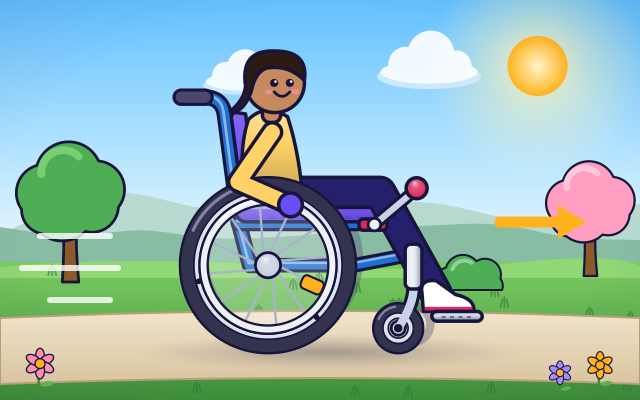
The big idea: Each big wheel has its own push rim. Push both rims the same and the chair rolls straight. Push one harder and the chair turns toward the slower wheel, while the small front wheels swivel to follow.
It's like rowing a boat: pull both oars the same and you go straight. Pull harder on one side and the boat swings toward the other side.
The interactive parts didn't load. The explanations below still work; try reloading the page.
Two wheels, two hands
- Maya uses a manual wheelchair. It has no motor and no steering wheel, yet she can go anywhere she likes. How does she move and turn?
- Each big wheel has a metal ring called a push rim. Maya grips it and pushes forward. The wheel turns, the tire grips the ground, and the chair rolls ahead.
- Seen from above, both hands push with the same strength. Both wheels turn at the same speed, so the chair rolls in a straight line.
- Now only the left hand pushes. The left wheel travels farther than the right wheel, so the chair curves to the right, toward the slower wheel.
- The small front wheels are called casters. They can swivel all the way round. When the chair turns, each caster swings to trail behind its pivot and follows along.
- To park, Maya pushes a lever beside each wheel. A bar presses hard on the tire so the wheel cannot turn. Now the chair stays still, even on a slope.
Look closely at a wheelchair
Tap each part of the wheelchair. Watch it move when you find it!
- Big drive wheels. The two big wheels carry most of the weight and drive the chair. Thin spokes keep them light, and each wheel can turn on its own.
- Push rims. The push rim is a smooth ring fixed to the wheel. Hands push the rim, not the tire, so they stay clean and can grip well.
- Front caster wheels. The two small front wheels are casters. Each one swivels freely, so it swings round to point wherever the chair is going.
- Wheel locks (brakes). Each big wheel has a lever. Pushing it presses a bar onto the tire, so the wheel cannot turn. Riders lock the wheels before moving to a bed or a car seat.
- Footrest. The footrest holds the rider's feet so they do not drag on the ground. On many chairs it flips up out of the way.
- Seat and backrest. A cushion spreads the rider's weight to keep sitting comfortable all day. The backrest supports the body while the arms push.
- Push handles. Handles at the back let a helper push when the rider asks for it, for example up a steep hill. Always ask before you touch someone's wheelchair.
One hand or two?
Tap the left rim, the right rim, or push with both hands. Watch the path the chair draws on the floor.
Experiment: What happens if you push only the left wheel?
- Push with both hands and watch the dotted path.
- Now push only the left rim a few times.
- Look at the small front wheels. Which way do they point?
What we found: Pushing both rims the same makes the chair roll straight. Pushing only the left rim makes the left wheel travel farther, so the chair curves to the right, toward the slower wheel. The casters swing round to follow.
Turn on JavaScript to try it yourself.
Cone course
Steer around the cones, stop inside the parking bay and put the brakes on.
How a wheelchair steers
A manual wheelchair is a clever machine with very few parts. It has two big drive wheels at the sides and two small caster wheels at the front. Each big wheel has a push rim, a smooth ring that the rider grips and pushes. There is no engine and no steering wheel. The rider's arms are the engine, and the difference between the two pushes is the steering.
When both rims are pushed the same, both wheels roll the same distance, so the chair goes straight. When one rim is pushed harder, that wheel rolls farther than the other. The only way both wheels can stay on the ground is for the chair to curve toward the slower wheel. Push one wheel forward and pull the other back, and the chair spins on the spot. That is very handy in a small room or an elevator.
The front casters do not steer anything. They simply follow. Each caster wheel sits a little behind its swivel pin, so the ground drags it into line, the same way a shopping-cart wheel swings round. The comparison with a rowing boat is close but not perfect: a boat keeps gliding sideways on water, while a wheelchair's tires grip the ground and go only where the wheels point.
Brakes on a wheelchair are mostly for parking. A lever presses a bar onto the tire so the wheel cannot turn. To slow down while rolling, the rider squeezes the push rims. Good wheelchairs are light, fitted to their user like a pair of shoes, and give people the freedom to go where they choose.
Key words
- Push rim
- The smooth ring fixed to each big wheel that the rider pushes with their hand.
- Caster
- A small wheel that swivels freely and follows wherever the chair goes.
- Differential drive
- Steering by making the left and right wheels turn at different speeds.
- Turning radius
- The size of the circle a vehicle follows when it turns. A smaller radius means a tighter turn.
- Wheel lock
- A parking brake: a lever that presses a bar onto the tire so the wheel cannot turn.
- Rolling resistance
- The drag that slows a rolling wheel, bigger on soft ground like carpet or grass.
Check your thinking
-
What makes a manual wheelchair roll in a straight line?
Show the answer
Pushing both rims with the same strength. Equal pushes turn both wheels at the same speed, so neither side gets ahead.
-
The rider pushes only the left rim. Which way does the chair curve?
Show the answer
To the right, toward the slower wheel. The faster wheel travels farther, so the chair curves toward the slower one.
-
What do the small front caster wheels do when the chair turns?
Show the answer
They swivel round by themselves and follow. Casters are free to swivel. The ground drags each one round so it trails behind its pivot.
-
When does a wheelchair user mainly use the wheel locks?
Show the answer
When parked, to keep the chair from rolling. Wheel locks are parking brakes. They hold the chair still, for example when moving to a car seat.
-
One wheel goes forward at 0.5 meters per second and the other goes backward at 0.5 meters per second. What does the chair do?
Show the answer
It spins on the spot without moving forward. The forward speed is the average of the two wheel speeds, which is zero. The difference is large, so the chair rotates about the middle of its axle.
-
Why is a wheelchair harder to push on thick carpet than on a smooth floor?
Show the answer
Soft ground squashes under the tires and slows them. Soft surfaces sink a little under each wheel, and that takes energy away from rolling.
You're a Flight & transportation expert!
You watched, looked inside, tried it, solved the challenge and went deeper. Pick another question below, or switch the age at the top to see this topic another way.
More about flight & transportation
 #1
Flight & transportation
How do airplanes fly?
Explore wings, engines, and flight controls. Watch airflow around a wing, adjust speed and wing angle, and try taking off and landing.
#1
Flight & transportation
How do airplanes fly?
Explore wings, engines, and flight controls. Watch airflow around a wing, adjust speed and wing angle, and try taking off and landing.
 #2
Flight & transportation
How do birds fly?
Watch wings and feathers in slow motion. Compare flapping, soaring, and gliding, then experiment with different wing shapes and flying conditions.
#2
Flight & transportation
How do birds fly?
Watch wings and feathers in slow motion. Compare flapping, soaring, and gliding, then experiment with different wing shapes and flying conditions.
 #3
Flight & transportation
How do helicopters fly and hover?
Explore the main rotor, tail rotor, and controls. Adjust a simplified helicopter's lift and direction to take off, hover, turn, and land.
#3
Flight & transportation
How do helicopters fly and hover?
Explore the main rotor, tail rotor, and controls. Adjust a simplified helicopter's lift and direction to take off, hover, turn, and land.
 #4
Flight & transportation
How do rockets reach space?
Look inside a rocket and follow its launch stages. Watch exhaust leave as the rocket accelerates, then experiment with thrust and cargo weight.
#4
Flight & transportation
How do rockets reach space?
Look inside a rocket and follow its launch stages. Watch exhaust leave as the rocket accelerates, then experiment with thrust and cargo weight.
Keep exploring
Games to play next
- Plane Flight SimulatorTake off from the runway and thread numbered sky hoops in order. Every clean flight is a new personal best.
- Machine RepairFix levers, pulleys, gears and ramps so every contraption works.
- Timetable TerminalRead the departure board, count the minutes and catch your connection on time.
Guide for grown-ups
- How to start homeschooling: a step-by-step guide for familiesA guide for parents · 7 min read
Science games by grade
Science worksheets by grade
- Preschool Science Worksheets
- Pre-K Science Worksheets
- Kindergarten Science Worksheets
- 1st Grade Science Worksheets
- 2nd Grade Science Worksheets
- 3rd Grade Science Worksheets
- 4th Grade Science Worksheets
- 5th Grade Science Worksheets
- 6th Grade Science Worksheets
- 7th Grade Science Worksheets
- 8th Grade Science Worksheets