How is lumber prepared for building?
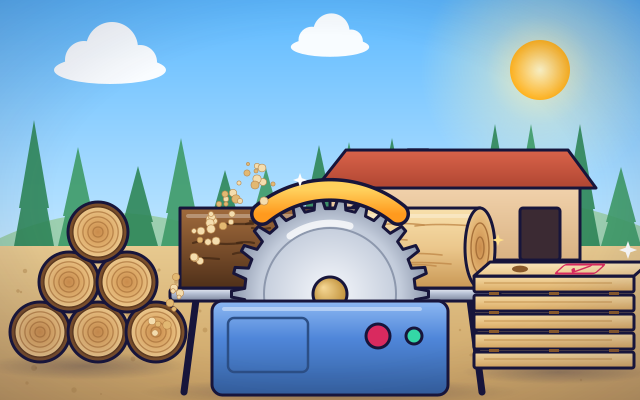
Follow a log through the sawmill: bark off, sawn into boards, dried in a kiln, planed smooth and stamped with a grade.
The big idea: A fresh log is round and full of water. The mill saws it into boards, dries them so they stop shrinking, then planes them to an exact size and checks how strong they are.
It's like a wet sponge left to dry: as the water leaves, it gets lighter, a bit smaller and stiffer. Boards do the same, so mills dry them before the final trim.
The interactive parts didn't load. The explanations below still work; try reloading the page.
A log's trip through the sawmill
- Trees are cut into logs and brought to a sawmill. A log is round, rough and wet. A house needs boards that are flat, straight and dry. Let's follow one log through the mill.
- First the bark comes off. A debarker's spinning tools scrape it away, because bark holds grit that would blunt the saw. The bark is not wasted: it becomes garden mulch or fuel.
- Next comes the head saw. It slices the log along its length into rough boards. A computer scans each log first and picks the cuts that give the most boards and the least waste.
- The rough boards are full of water. They are stacked with gaps between them and rolled into a kiln, a giant warm oven with fans. The moving air carries the water away, so the boards get lighter and shrink a little.
- Dry boards go through the planer. Spinning knives shave a thin layer off every side, so each board comes out smooth and exactly the same size as all the others.
- Finally each board is graded. A scanner and a trained grader look for big knots, splits and bends. Then a stamp is printed on the board to tell builders how strong it is and that it is dry.
- Sawn, dried, planed and graded: the round, wet log has become straight, dry lumber. Builders nail the boards into the frame of a house, and the frame stays straight because the wood has already dried.
Look inside a log and a board
Tap each part of the log, the board and the magnifying glass. Each one shows why the mill works the way it does.
- Bark. Bark is the tree's protective skin. It keeps out insects and weather. At the mill it comes off first, because the sand and grit caught in it would blunt the saws.
- Sapwood. The pale outer wood is sapwood. In the living tree it carried water from the roots up to the leaves, so in a fresh log it is soaking wet.
- Heartwood. The darker middle is heartwood. It no longer carries water. Its job is to be the stiff backbone that holds the tree up.
- Growth rings. Each ring is one year of growth: pale wood from fast spring growth, then a darker line from slow late-summer growth. Count the rings to find the tree's age.
- Knot. A knot is the base of a branch that the trunk grew around. The wood grain has to bend around it, so a big knot makes a weak spot in a board.
- Wood cells. Under a microscope, wood looks like a bundle of tiny tubes. In a fresh board the tubes are full of water. Drying empties the tubes first, then dries the tube walls, and that is when the board shrinks.
The drying kiln
Slide the time in the kiln and watch one board on the scales. Tap the fan to switch it off and on. How does the board change as it dries?
Experiment: What happens to a wet board as it dries in the kiln?
- Look at the fresh board: how wet and how heavy is it?
- Slide the time all the way up and watch the water leave.
- Compare the dry board with the dashed outline of its old size.
What we found: As the warm, moving air carries the water away, the board gets much lighter and a little smaller. That is why boards are dried before they are cut to their final size.
Turn on JavaScript to try it yourself.
Fill the builder's order
The builder needs a dry, smooth, stamped board. Send the wood to the machines in the right order, set the kiln time, then press Send to the builder.
Why the mill dries and checks every board
A living tree is a water pipe as well as a tower. Its wood is made of millions of tiny tubes that carry water from the roots up to the leaves. So when a tree is cut down, the log is soaking wet: about half of its weight can be water.
At the sawmill the bark comes off, and big saws slice the round log into flat, rough boards. But those boards are not ready to use. As wood dries, it shrinks. If you built a house with wet boards, they would shrink, twist and crack inside the walls, and the nails would work loose.
So the mill dries the boards first. They are stacked with small sticks between the layers, so air can flow past every board, and rolled into a kiln. A kiln is a giant warm oven with fans. In a day or more, the moving air carries most of the water away. The mill must not hurry too much: if the outside of a board dries much faster than the inside, the board cracks.
Only then are the boards planed. Spinning knives shave them smooth and cut every board to exactly the same size. Last, each board is graded: a scanner and a trained person check it for big knots, splits and bends, and a stamp tells the builder how strong it is. Our sponge comparison is not perfect: a sponge soaks water back up in seconds, but a dry board in a dry house takes in only a little.
Key words
- Lumber
- Wood that has been sawn into boards and beams for building.
- Green wood
- Freshly cut wood that is still full of water.
- Kiln
- A big, warm room with fans where boards are dried.
- Moisture content
- How much water is in a piece of wood.
- Planer
- A machine with spinning knives that shaves boards smooth and to an exact size.
- Grade
- A mark that tells builders how strong and straight a board is.
- Fiber saturation point
- The moisture level, about 30 percent, where the cell hollows are empty but the cell walls are still full of water. Shrinking starts below it.
Check your thinking
-
Why are boards dried in a kiln before they are used for building?
Show the answer
So they finish shrinking before they are built into a house. Wood shrinks as it dries. It is better for that to happen at the mill than inside a wall.
-
A fresh board and a dried board come from the same log. How are they different?
Show the answer
The dried board is lighter and a little smaller. Water is heavy. When it leaves, the board loses weight, and the wood shrinks a little.
-
Why are boards stacked with small sticks between the layers in the kiln?
Show the answer
So warm air can flow past every board. A board can only dry where air touches it. The gaps let the moving air reach every face.
-
A grader finds a very big knot near the edge of a board. What does that mean?
Show the answer
The board is weaker there, so it gets a lower grade. The wood has to bend around a knot, which makes a weak spot. Graders check the size and place of every knot.
-
A board has 10 kg of water in it and would weigh 20 kg if it were completely dry. What is its moisture content?
Show the answer
50%. Moisture content is water mass divided by dry wood mass: 10 ÷ 20 = 0.5, or 50%.
-
What would happen if the grade stamp went on before the board was dried and planed?
Show the answer
The stamp could be wrong, because drying can crack or bend a board. The stamp has to describe the finished board. A board can split or twist as it dries, so it is checked last.
You're a Making everyday things expert!
You watched, looked inside, tried it, solved the challenge and went deeper. Pick another question below, or switch the age at the top to see this topic another way.
More about making everyday things
 #312
Making everyday things
How is wooden furniture made?
Turn a design into measured pieces, assemble joints, and choose a finish.
#312
Making everyday things
How is wooden furniture made?
Turn a design into measured pieces, assemble joints, and choose a finish.
 #313
Making everyday things
How is rope made?
Twist fibers into yarns and strands and compare different arrangements.
#313
Making everyday things
How is rope made?
Twist fibers into yarns and strands and compare different arrangements.
 #314
Making everyday things
How are carpets made?
Watch yarn enter a backing and compare looped and cut-pile surfaces.
#314
Making everyday things
How are carpets made?
Watch yarn enter a backing and compare looped and cut-pile surfaces.
 #315
Making everyday things
How are metal objects cast?
Fill a virtual mold, allow cooling, and remove and finish the casting.
#315
Making everyday things
How are metal objects cast?
Fill a virtual mold, allow cooling, and remove and finish the casting.
Keep exploring
Games to play next
- Geometry Architect 3DCount, build and fold solids like a real architect.
- Machine RepairFix levers, pulleys, gears and ramps so every contraption works.
- Sorting FactoryTurn a work order into if/else rules and watch the conveyor sort every item.
Guide for grown-ups
- How to start homeschooling: a step-by-step guide for familiesA guide for parents · 7 min read
Science games by grade
Science worksheets by grade
- Preschool Science Worksheets
- Pre-K Science Worksheets
- Kindergarten Science Worksheets
- 1st Grade Science Worksheets
- 2nd Grade Science Worksheets
- 3rd Grade Science Worksheets
- 4th Grade Science Worksheets
- 5th Grade Science Worksheets
- 6th Grade Science Worksheets
- 7th Grade Science Worksheets
- 8th Grade Science Worksheets