How is rope made?
Short, weak fibers are twisted into yarns, yarns into strands and strands into rope. The twist makes them grip each other and share the pull.
The big idea: One fiber snaps easily, and loose fibers just slide apart. Twisting squeezes them together so they grip each other. Twisting again the opposite way locks the rope so it cannot untwist.
It's like wringing out a wet towel: the more you twist, the tighter its threads squeeze together. In a rope, that squeeze stops the fibers from sliding apart.
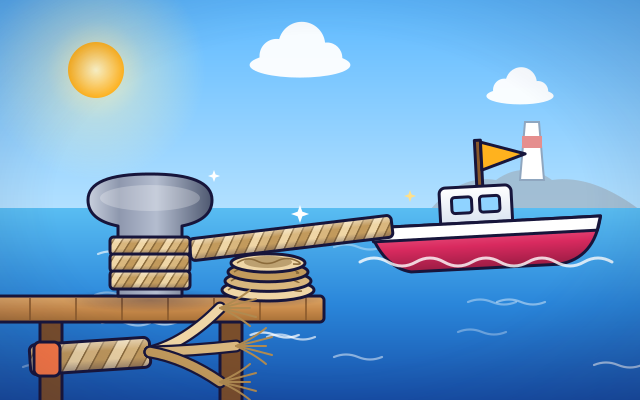
The interactive parts didn't load. The explanations below still work; try reloading the page.
From fluffy fibers to strong rope
- One rope keeps this boat safe at the dock, even when the waves tug at it. Look closely and you will see that the rope is made of many thin threads, twisted together.
- Rope begins as fibers, often from plants such as hemp or cotton. They start out tangled. Pulling them through a comb of steel pins lines them all up side by side.
- Straight fibers would just slide apart. So they are twisted into a yarn. The twist squeezes the fibers against each other, and now they grip instead of slipping.
- Next, several yarns are twisted together to make a strand. Here is the clever part: the strand is twisted in the opposite direction to the yarns inside it.
- Finally, three strands are twisted around each other, opposite again, to make the rope. Because every twist pushes against the one before, the rope stays together and does not unravel.
- When a wave pulls the boat, the pull is shared by thousands of fibers, all gripping each other. No single fiber could hold the boat, but together they can.
Look inside a rope
This rope has been unwound, level by level. Tap each part to see what it is made of.
- Rope. The finished rope is three strands twisted around each other. Rope made this way is called laid rope.
- Strand. Each strand is itself made of many yarns twisted together, in the opposite direction to the rope.
- Yarn. A yarn is a thin thread made by twisting loose fibers together. A big rope can contain hundreds of yarns.
- Fibers. At the very bottom are the fibers: thin as hairs and easy to snap one at a time. Everything else is made by twisting these together.
- Opposite twists. Look at the arrows. Each level is twisted the opposite way to the level inside it. Each one tries to untwist, and by trying, it tightens the next. So the rope locks itself.
- Whipping. A cut rope end wants to come unwound. A whipping, thin twine wrapped tightly around the end, holds everything in place.
The rope tester
Twist the fibers with the crank, choose how they are arranged, then press Pull to test. Try at least two different ropes. Which is strongest?
Experiment: What happens to the strength as you add more and more twist?
- Leave the fibers untwisted and press Pull.
- Tap the crank about 5 times, then press Pull again.
- Now twist it all the way to 10 and test once more. Record each test.
What we found: With no twist the fibers simply slide apart. Some twist makes them grip, and the rope becomes strong. But too much twist makes the rope kink, and it gets weaker again. Rope makers aim for the middle.
Turn on JavaScript to try it yourself.
A rope for the crane
The crane must lift a 350 kg crate, and its hook can spin. Choose the arrangement, the number of yarns and the twist, then press Lift.
Why twisted fibers are strong
Pull a single fiber of cotton or hemp, and it snaps easily. Lay a hundred fibers side by side and pull, and they simply slide past each other. So how can a rope made of the same fibers hold a boat, a climber or a ship's anchor?
The secret is the twist. When fibers are twisted together, each one wraps around the others in a spiral. Now pull on the ends. The spirals try to straighten out, and to do that they have to squeeze inward. The fibers are pressed hard against each other, and rubbing surfaces that are pressed together are hard to slide. That grip is called friction. The harder you pull, the harder the fibers squeeze, so the tighter they hold.
A twisted yarn has one problem: it wants to untwist. Rope makers solve this with a trick. They twist several yarns together in the opposite direction to make a strand, then twist three strands together in the first direction again to make the rope. Each level tries to unwind, and that tightens the level above it. The whole rope locks itself. Some ropes are braided instead, with strands woven over and under each other.
There can be too much of a good thing. A rope that is twisted too hard becomes stiff, kinks into little loops and is actually weaker. People have been making rope like this for tens of thousands of years, at first from plant stems and bark and today mostly from strong plastics like nylon. Our towel comparison breaks down in one way: a towel untwists as soon as you let go, but a rope's opposite twists hold each other in place.
Key words
- Fiber
- A single thin thread of material, like a hair. The smallest part of a rope.
- Yarn
- Fibers twisted together into a thin thread.
- Strand
- Several yarns twisted together. Three strands usually make a laid rope.
- Friction
- The grip between surfaces that are pressed together, which makes them hard to slide.
- Lay
- The way the strands of a rope are twisted around each other.
- Safety factor
- How many times stronger a rope is than the biggest load it is allowed to carry.
Check your thinking
-
Why does twisting fibers together make them strong?
Show the answer
The twist squeezes the fibers together, so they grip instead of sliding. Pulling a twisted yarn presses its fibers against each other. That grip, called friction, stops them from slipping.
-
Why is each level of a rope twisted the opposite way to the one before?
Show the answer
So the twists lock each other and the rope does not unravel. Each twisted part tries to untwist. Twisting the next level the other way uses that push to keep everything tight.
-
A rope maker keeps twisting and twisting a rope, far more than usual. What happens?
Show the answer
It kinks into loops and gets weaker. There is a best amount of twist. Past it, the rope is stiff, kinks easily and breaks sooner.
-
Put these in order from smallest to biggest.
Show the answer
Fiber, yarn, strand, rope. Fibers are twisted into yarns, yarns into strands, and strands into rope.
-
A rope breaks at 2,000 kg. With a safety factor of 5, what is the heaviest load it should be used to lift?
Show the answer
400 kg. Safe working load = breaking strength ÷ safety factor = 2,000 ÷ 5 = 400 kg.
You're a Making everyday things expert!
You watched, looked inside, tried it, solved the challenge and went deeper. Pick another question below, or switch the age at the top to see this topic another way.
More about making everyday things
 #314
Making everyday things
How are carpets made?
Watch yarn enter a backing and compare looped and cut-pile surfaces.
#314
Making everyday things
How are carpets made?
Watch yarn enter a backing and compare looped and cut-pile surfaces.
 #315
Making everyday things
How are metal objects cast?
Fill a virtual mold, allow cooling, and remove and finish the casting.
#315
Making everyday things
How are metal objects cast?
Fill a virtual mold, allow cooling, and remove and finish the casting.
 #316
Making everyday things
How is sandpaper made?
Coat backing with abrasive grains and compare the resulting surfaces on virtual wood.
#316
Making everyday things
How is sandpaper made?
Coat backing with abrasive grains and compare the resulting surfaces on virtual wood.
 #317
Making everyday things
How does welding join metal?
Watch a simplified joint form and inspect the connection after cooling.
#317
Making everyday things
How does welding join metal?
Watch a simplified joint form and inspect the connection after cooling.
Keep exploring
Games to play next
- Machine RepairFix levers, pulleys, gears and ramps so every contraption works.
- Geometry Architect 3DCount, build and fold solids like a real architect.
- Sorting FactoryTurn a work order into if/else rules and watch the conveyor sort every item.
Guide for grown-ups
- How to start homeschooling: a step-by-step guide for familiesA guide for parents · 7 min read
Science games by grade
Science worksheets by grade
- Preschool Science Worksheets
- Pre-K Science Worksheets
- Kindergarten Science Worksheets
- 1st Grade Science Worksheets
- 2nd Grade Science Worksheets
- 3rd Grade Science Worksheets
- 4th Grade Science Worksheets
- 5th Grade Science Worksheets
- 6th Grade Science Worksheets
- 7th Grade Science Worksheets
- 8th Grade Science Worksheets