How is olive oil made?
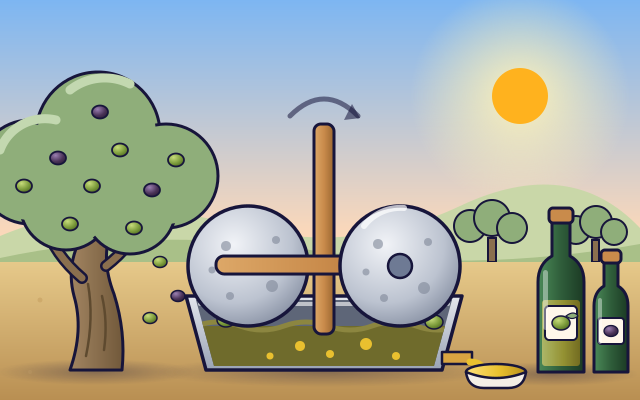
Olives are cleaned, crushed and slowly mixed. Then spinning separates the light, golden oil from the water and the solid bits.
The big idea: An olive holds tiny drops of oil. Crushing lets them out, slow mixing lets the tiny drops join into big ones, and spinning sorts everything by how heavy it is. Oil is the lightest, so it separates from the water and the solids.
It's like a bottle of salad dressing: shake it and wait, and the oil floats to the top. A spinning machine does the waiting in seconds.
The interactive parts didn't load. The explanations below still work; try reloading the page.
From olive grove to bottle
- Olives grow on trees in sunny groves. At harvest the branches are shaken and the olives fall into nets. Each olive holds tiny drops of oil in its soft flesh.
- At the mill a strong fan blows away the leaves and twigs, which are much lighter than olives. Then the olives are washed to rinse off the dust and soil.
- Heavy wheels or spinning hammers crush the whole olives, pits and all, into a thick paste. Crushing breaks the olives open so the oil can get out.
- The paste is stirred slowly for about half an hour. The tiny drops of oil bump into each other and join into bigger drops, which are much easier to collect.
- Then the paste is spun very fast. Spinning pushes the heavy bits of skin and pit to the outside, then the water. The oil is lightest, so it ends up apart from the rest.
- Out flows golden-green olive oil. It is kept in dark bottles or steel tanks, because light, heat and air slowly spoil its taste.
Inside the spinning separator
This machine is cut open so you can see inside. Tap each part to see what it does.
- Feed pipe. Olive paste from the mixer is pumped in through this pipe, right into the middle of the spinning drum.
- Spinning drum. The drum spins thousands of times every minute. Everything inside is pushed hard against its wall, heaviest things first.
- Screw. A giant screw turns inside the drum, just a little slower than the drum itself. It scrapes the solid bits along the wall toward the narrow end.
- Solids. The crushed skin, flesh and pits are the heaviest part, so they pack against the wall. They come out here as a damp crumble called pomace.
- Olive water. Olives hold water as well as oil. The water is heavier than oil, so it makes the middle layer and leaves through its own outlet.
- Olive oil. Oil is the lightest part, so it stays nearest the middle of the spin and flows out here, golden-green and fresh.
Does slow stirring matter?
Spin a tube of paste straight away. Then stir the paste slowly for a while and spin again. Compare the tubes on the rack.
Experiment: What does slow stirring do before the paste is spun?
- Press Spin without stirring. Look at how thick the golden layer is.
- Tap the mixer until it shows 20 minutes or more. Watch the drops in the magnifying glass.
- Spin again and compare the two tubes on the rack.
What we found: Stirring first gives a much thicker layer of oil. In fresh paste the oil is in drops so tiny that they stay mixed in. Slow stirring lets them join into big drops, and big drops separate easily when the tube is spun.
Turn on JavaScript to try it yourself.
Fill the bottles
Get at least 15 liters of oil from the batch. Mix, choose the spin speed, spin, then tap the oil layer to bottle it.
Why the oil comes out
An olive is a small fruit with a hard pit. Its soft flesh is full of tiny drops of oil, far too small to see, mixed in with water. To get the oil, you have to break the olive open and then sort the oil from everything else. Nothing needs to be added: olive oil is made just by crushing, stirring and separating.
Crushing turns the olives into a thick paste. Now the oil is out of the fruit, but it is still in very tiny drops, spread all through the paste. Tiny drops do not separate well. So the paste is stirred slowly for about half an hour. As it turns over, the tiny drops bump into each other and join up, like raindrops running together on a window.
Then comes the separating. Oil is lighter than water, which is why it floats on top of a puddle or a bowl of soup. The bits of skin and pit are heavier than water. If you left the paste in a jar, it would slowly settle into three layers: solids at the bottom, water in the middle and oil on top. That takes hours.
A spinning machine does the same job in seconds. Spinning pushes everything outward, and the heaviest things are pushed hardest. The salad dressing comparison is good for the layers, but not perfect: dressing only has to separate oil from water, while olive paste has solid bits to remove as well.
Key words
- Olive paste
- The thick mash made by crushing whole olives, pits and all.
- Malaxation
- Slowly stirring olive paste so tiny drops of oil join into bigger ones.
- Density
- How heavy something is for its size. Oil is less dense than water, so it floats.
- Centrifuge
- A machine that spins things very fast to separate heavy parts from light parts.
- Pomace
- The solid leftovers: bits of skin, flesh and pit.
- Coalesce
- When small drops merge into bigger drops.
Check your thinking
-
Where is the oil before the olives are crushed?
Show the answer
In tiny drops inside the olive's flesh. The soft flesh of the olive is full of tiny oil drops. Crushing lets them out.
-
A jar of oil, water and sand is shaken and left to stand. What order do the layers settle in, from top to bottom?
Show the answer
Oil, water, sand. The lightest goes on top and the heaviest sinks. Oil is lighter than water, and sand is heavier.
-
Why is the olive paste stirred slowly before it is spun?
Show the answer
So tiny drops of oil can join into big drops. Big drops separate easily. Tiny drops stay stuck in the paste.
-
Why does a mill spin the paste instead of leaving it to settle in a tank?
Show the answer
Spinning separates it in seconds instead of hours. Spinning pushes outward much harder than gravity pulls down, so the layers form very quickly.
-
A miller warms the paste to 35 degrees Celsius to get more oil. What is the trade-off?
Show the answer
A little more oil, but delicate flavors are lost and the oil spoils sooner. Warm oil flows and coalesces more easily, which raises yield slightly, but aroma compounds escape and oxidation speeds up. That is why quality oil is kept below about 27 degrees.
-
Why is olive oil kept in dark bottles?
Show the answer
Light slowly spoils its taste. Light, heat and air slowly change the oil and make it taste stale.
You're a Food & farming expert!
You watched, looked inside, tried it, solved the challenge and went deeper. Pick another question below, or switch the age at the top to see this topic another way.
More about food & farming
 #281
Food & farming
How is sugar made from plants?
Extract juice from cane or beets and explore purification, concentration, and crystallization.
#281
Food & farming
How is sugar made from plants?
Extract juice from cane or beets and explore purification, concentration, and crystallization.
 #282
Food & farming
How is maple syrup made?
Collect virtual sap and follow filtering and evaporation as it becomes concentrated.
#282
Food & farming
How is maple syrup made?
Collect virtual sap and follow filtering and evaporation as it becomes concentrated.
 #283
Food & farming
How does fruit become jam?
Combine fruit, sugar, and pectin and observe thickening as the mixture cools.
#283
Food & farming
How does fruit become jam?
Combine fruit, sugar, and pectin and observe thickening as the mixture cools.
 #284
Food & farming
How is peanut butter made?
Follow peanuts through shelling, roasting, grinding, and mixing to compare textures.
#284
Food & farming
How is peanut butter made?
Follow peanuts through shelling, roasting, grinding, and mixing to compare textures.
Keep exploring
Games to play next
- Ratio KitchenScale recipes, fill ratio tables and find the better buy.
- Garden AutomationProgram a garden robot with sensor rules — then watch a whole day play out.
- Label LabPut the right labels on beautiful science diagrams, from bean plants to heart chambers.
Guide for grown-ups
- How to start homeschooling: a step-by-step guide for familiesA guide for parents · 7 min read
Science games by grade
Science worksheets by grade
- Preschool Science Worksheets
- Pre-K Science Worksheets
- Kindergarten Science Worksheets
- 1st Grade Science Worksheets
- 2nd Grade Science Worksheets
- 3rd Grade Science Worksheets
- 4th Grade Science Worksheets
- 5th Grade Science Worksheets
- 6th Grade Science Worksheets
- 7th Grade Science Worksheets
- 8th Grade Science Worksheets