How is sugar made from plants?
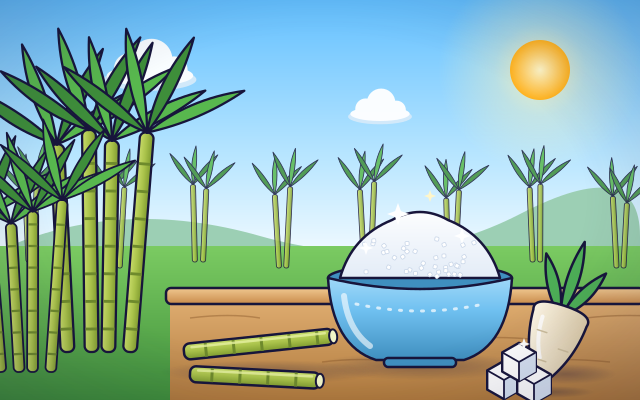
Sugar hides in the juice of sugarcane and sugar beets. Squeeze it out, clean it, boil off the water and crystals appear.
The big idea: Plants make sugar and store it in their juice. A mill squeezes the juice out, cleans it and boils off the water until the sugar has to come out as crystals.
It's like sea water drying on your skin at the beach: the water leaves, and the salt that was hiding in it shows up as white crystals.
The interactive parts didn't load. The explanations below still work; try reloading the page.
How a mill makes sugar
- Sugar comes from plants. Sugarcane and sugar beets make sugar in their leaves using sunlight, then store it as sweet juice in a stalk or a fat root.
- At the mill, heavy rollers crush the cane and squeeze out its juice. Beets are sliced thin and soaked in hot water instead, so their sugar soaks out.
- The raw juice is cloudy with bits of plant and soil. Workers stir in lime, which makes the bits clump together and sink as mud. Clear juice flows on.
- Next the juice is boiled. Water leaves as steam, but sugar cannot fly away with it. The same sugar is crowded into less and less water: a thick syrup.
- When the syrup holds more sugar than its water can keep dissolved, sugar pieces lock together in neat rows. Tiny seed crystals are added, and they grow bigger.
- A spinning basket with tiny holes flings the dark syrup, called molasses, outward. The crystals are too big to fit through, so they stay. Dried, they are the sugar in your bowl.
Look inside a sugar mill
Follow the juice from left to right. Tap each machine to make it work.
- Crusher. Three heavy rollers turn and squeeze the cane between them. The juice drips into a tray underneath and is pumped to the next tank.
- Leftover fiber. The squeezed-out fiber is called bagasse. Mills burn it to make the steam that heats every other machine, so the cane powers its own factory.
- Settling tank. Lime is stirred into the warm juice. It makes tiny bits of dirt and plant clump together and sink. The clear juice is taken from the top.
- Evaporator. Steam pipes heat the juice until it boils. Water leaves as steam, the level drops, and the thin juice becomes a thick, golden syrup.
- Crystal pan. With the lid shut and the air pumped out, the syrup boils gently without burning. Seed crystals are dropped in, and sugar builds up on them.
- Centrifuge. The basket has thousands of tiny holes. When it spins, the syrup is flung out through the holes, but the crystals are too big to follow.
From juice to crystals
Crush some cane, clean the juice, then boil it. Watch the level, the sugar meter and the close-up. When do crystals appear?
Experiment: You boil sweet juice until most of the water is gone. What happens to the sugar?
- Tap the crusher three times to fill the pan with juice.
- Press Add lime and watch the mud sink.
- Turn up the heat. Watch the level drop and the sugar meter climb.
- When the syrup is thick, add seed crystals.
What we found: The juice level dropped a long way, but the amount of sugar never changed. Sugar cannot leave with the steam, so it was squeezed into less and less water. When the water could not hold it all, the sugar came out as crystals.
Turn on JavaScript to try it yourself.
Clean white sugar
Make clean, white sugar. Clean the juice first, and spin the crystals before the syrup gets too hot and turns brown.
How juice becomes crystals
Plants are sugar factories. Their green leaves use sunlight, water and air to make sugar, which the plant uses as food. Sugarcane stores extra sugar in its tall stalk, and the sugar beet stores it in a fat white root. That is why these two plants are grown for sugar all over the world: cane where it is hot, and beets where it is cooler.
The sugar is dissolved in the plant's juice, which means it is mixed into the water so finely that you cannot see it. A mill gets the juice out by crushing cane between rollers, or by soaking thin slices of beet in hot water. Then lime is added. It makes bits of soil and plant stick together and sink, so the juice can be drained off clear.
Now comes the big idea. When the juice boils, only the water turns into steam. The sugar stays in the pan, squeezed into less and less water. Water can only hold so much sugar. When there is more sugar than the water can hold, the sugar pieces join up in neat rows and become solid crystals.
The crystals are still sitting in sticky brown syrup called molasses. A basket full of tiny holes spins them very fast, the syrup flies out, and the crystals stay. Raw sugar is golden brown because a thin coat of molasses is left on it. Washing that coat off gives white sugar. The comparison with salty sea water drying is a good one, but it misses one thing: a sugar mill does not wait for the sun. It boils the water away in minutes.
Key words
- Sucrose
- The scientific name for the sugar in your sugar bowl.
- Dissolve
- To mix into a liquid so finely that the pieces are too small to see.
- Evaporation
- Water turning into steam and leaving, as it does from a boiling pan.
- Concentration
- How much sugar is crowded into the water. Thick syrup is more concentrated than thin juice.
- Supersaturated
- Holding more sugar than the water can keep dissolved, so crystals are ready to form.
- Molasses
- The dark, sticky syrup left over when sugar crystals are spun out.
Check your thinking
-
Where does a sugarcane plant keep its sugar?
Show the answer
In the juice of its stalk. The leaves make the sugar, and the plant stores it in the juicy stalk.
-
When sweet juice boils, what leaves the pan?
Show the answer
Only the water. Sugar cannot turn into steam at these temperatures, so it stays behind and the juice gets thicker.
-
Why do sugar crystals start to form in the pan?
Show the answer
There is too little water left to hold all the sugar. Water can only hold so much sugar. When more water boils away, the extra sugar has to come out as crystals.
-
What would happen if a mill skipped the cleaning step with lime?
Show the answer
Bits of dirt and plant would end up in the sugar. Lime makes the impurities clump and sink. Without it they stay in the juice and spoil the crystals.
-
How does the spinning basket separate sugar from molasses?
Show the answer
The syrup fits through the tiny holes but the crystals do not. Spinning pushes everything outward. Liquid syrup passes through the holes and solid crystals are held back.
You're a Food & farming expert!
You watched, looked inside, tried it, solved the challenge and went deeper. Pick another question below, or switch the age at the top to see this topic another way.
More about food & farming
 #282
Food & farming
How is maple syrup made?
Collect virtual sap and follow filtering and evaporation as it becomes concentrated.
#282
Food & farming
How is maple syrup made?
Collect virtual sap and follow filtering and evaporation as it becomes concentrated.
 #283
Food & farming
How does fruit become jam?
Combine fruit, sugar, and pectin and observe thickening as the mixture cools.
#283
Food & farming
How does fruit become jam?
Combine fruit, sugar, and pectin and observe thickening as the mixture cools.
 #284
Food & farming
How is peanut butter made?
Follow peanuts through shelling, roasting, grinding, and mixing to compare textures.
#284
Food & farming
How is peanut butter made?
Follow peanuts through shelling, roasting, grinding, and mixing to compare textures.
 #285
Food & farming
How is chewing gum made?
Mix a virtual gum base with flavorings, then roll, cut, and wrap it.
#285
Food & farming
How is chewing gum made?
Mix a virtual gum base with flavorings, then roll, cut, and wrap it.
Keep exploring
Games to play next
- Ratio KitchenScale recipes, fill ratio tables and find the better buy.
- Garden AutomationProgram a garden robot with sensor rules — then watch a whole day play out.
- Label LabPut the right labels on beautiful science diagrams, from bean plants to heart chambers.
Guide for grown-ups
- How to start homeschooling: a step-by-step guide for familiesA guide for parents · 7 min read
Science games by grade
Science worksheets by grade
- Preschool Science Worksheets
- Pre-K Science Worksheets
- Kindergarten Science Worksheets
- 1st Grade Science Worksheets
- 2nd Grade Science Worksheets
- 3rd Grade Science Worksheets
- 4th Grade Science Worksheets
- 5th Grade Science Worksheets
- 6th Grade Science Worksheets
- 7th Grade Science Worksheets
- 8th Grade Science Worksheets