How does a piano make music?
Inside a piano, every key throws a felt hammer at tight steel strings. Follow one key press all the way to the sound.
The big idea: Pressing a key works a set of levers that throws a felt hammer at a string. The hammer bounces straight off, so the string can ring. A damper stops the string when you let the key go, and a big wooden soundboard makes the sound loud.
It's like ringing a bell by tossing a ball at it. The ball hits once and falls away, so the bell rings on. A ball pressed against it would only clunk.
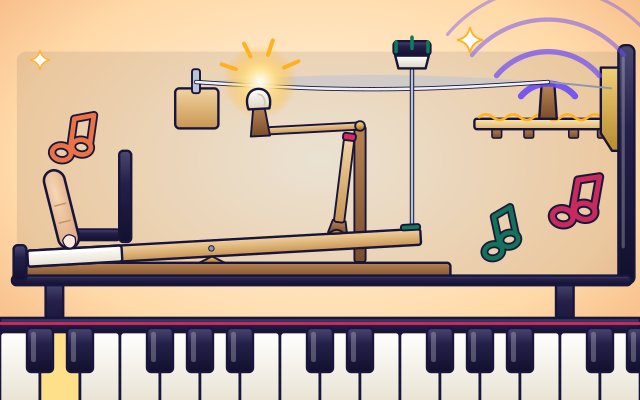
The interactive parts didn't load. The explanations below still work; try reloading the page.
From key to sound
- Lena presses the keys, and each one plays its own note. A piano has 88 keys, and inside that big case each key has its own little machine. Let's look inside.
- Each key is a long wooden lever that rocks on a point in the middle, like a seesaw. When your finger pushes the front down, the back end rises and lifts the parts above it.
- The back of the key lifts a pusher called the jack, and the jack flips the hammer upward. Just before the hammer reaches the string, the jack lets go. The hammer flies the last bit by itself, hits the string and bounces off.
- A felt pad called the damper rests on each string and keeps it quiet. Pressing the key lifts the damper, so the string is free to ring. When you let the key go, the damper drops back and stops the sound.
- Seen from above, the strings fan out like a harp. The low notes have long, thick strings that shake slowly. The high notes have short, thin strings that shake fast. That is why a grand piano has its curved shape.
- A string alone is too thin to move much air. So each string passes over a wooden bridge that is glued to a wide, thin board called the soundboard. The board shakes with the string and fills the room with sound.
Look inside a grand piano
This is one key of a grand piano, cut open and seen from the side. Tap each part to see what it does.
- Key. The part you touch is only the front of a long wooden lever. Most of the key is hidden inside the piano.
- Balance point. The key rests on a pin near its middle and rocks on it like a seesaw. Front down, back up.
- Jack. The jack is the pusher that throws the hammer. Just before the hammer reaches the string, the jack slips aside and lets it fly free. Without that trick the hammer would jam against the string.
- Hammer. The hammer has a wooden head covered in tightly packed wool felt. It strikes the string and bounces away at once. Press the key harder, and the hammer flies faster and the note is louder.
- Damper. The damper is a felt pad that rests on the string to keep it quiet. The key lifts it while you play the note, and it drops back when you let go.
- String. The string is a tightly stretched steel wire. The hammer's knock sets it shaking back and forth hundreds of times each second. That shaking is the note.
- Bridge. The string passes over a wooden bridge that is glued to the soundboard. The bridge carries the string's shaking down into the board.
- Soundboard. The soundboard is a wide, thin sheet of wood. It shakes along with the strings and pushes a lot of air, so the piano fills a whole room with sound.
- Right pedal. The right pedal lifts every damper off the strings at once. Notes keep ringing after you let the keys go, and the other strings hum along softly.
Follow one key press
Press and hold the key, and watch it happen in slow motion: jack, hammer, damper, string. Then let go. Try a soft press, a hard press and the pedal.
Experiment: The note is ringing. What happens when you let go of the key?
- Press the key and hold it down. Watch the damper lift and the hammer strike.
- Let go of the key. What does the damper do, and what happens to the sound?
- Now switch the pedal on and try again. Then try a soft press and a hard one.
What we found: The hammer hits once and bounces away, and the string rings while the key is held, because the damper is lifted. Let go, and the damper drops onto the string and stops it. With the pedal down, the damper stays up and the note rings on. A harder press throws the hammer faster and makes a louder note.
Turn on JavaScript to try it yourself.
Piano doctor
This piano has a problem. Press the key, watch and listen. Then tap the part that is not doing its job. Fix three pianos.
How a piano works
A piano looks like a box with keys, but inside it is full of strings and tiny wooden machines. Each key is the front end of a long lever. When you push the front down, the back end goes up and lifts a pusher called the jack. The jack flips a hammer toward the strings.
Here is the clever part. Just before the hammer reaches the string, the jack slips out of the way. The hammer flies the last bit by itself, strikes the string and bounces straight off. If the hammer stayed pressed against the string, the string could not shake, and you would hear only a dull thud.
A felt pad called the damper rests on each string to keep it quiet. Pressing a key lifts that key's damper, so its string can ring. Let go of the key, and the damper drops back and stops the note. The right pedal lifts all the dampers together, so the notes ring on and blend.
A string by itself would be very quiet. So every string crosses a wooden bridge that is glued to a wide, thin board called the soundboard. The board shakes with the strings and pushes lots of air. Low notes come from long, thick strings and high notes from short, thin ones. Our ball and bell comparison leaves one thing out: a real hammer is caught on its way back, ready to strike again.
Key words
- Action
- The set of levers between a key and its hammer.
- Lever
- A bar that turns on a fixed point. Push one end down and the other end goes up.
- Hammer
- A wooden head covered in wool felt that strikes the string.
- Escapement
- The trick that lets the hammer go just before it hits, so that it can bounce off the string.
- Damper
- A felt pad that rests on a string and stops it from vibrating.
- Soundboard
- A large, thin wooden board that vibrates with the strings and makes their sound much louder.
Check your thinking
-
What makes a piano string start to shake?
Show the answer
A felt hammer strikes it. Pressing a key throws a felt hammer at the string. A harpsichord plucks its strings instead.
-
Why does the note stop when you let go of a key?
Show the answer
The damper drops back onto the string and stops it shaking. The felt damper soaks up the string's shaking, so the sound ends.
-
How do you play a louder note on a piano?
Show the answer
Press the key faster, so the hammer flies faster. A faster hammer hits the string harder, and the string swings wider. That makes a louder sound.
-
Why are the strings for low notes long and thick?
Show the answer
Long, heavy strings shake slowly, and slow shaking makes low notes. A longer, heavier string swings back and forth more slowly, and that gives a lower note.
-
What is the soundboard for?
Show the answer
It shakes with the strings and pushes lots of air, making the sound loud. A thin string cannot move much air. The wide soundboard can, so the note fills the room.
You're a Light & sound expert!
You watched, looked inside, tried it, solved the challenge and went deeper. Pick another question below, or switch the age at the top to see this topic another way.
More about light & sound
 #440
Light & sound
How do flutes produce different notes?
Open and close holes and explore changing vibrations in an air column.
#440
Light & sound
How do flutes produce different notes?
Open and close holes and explore changing vibrations in an air column.
 #441
Light & sound
How do drums make different sounds?
Change membrane tension and drum size and compare vibration patterns.
#441
Light & sound
How do drums make different sounds?
Change membrane tension and drum size and compare vibration patterns.
 #442
Light & sound
How does soundproofing reduce noise?
Compare absorption, barriers, and gaps around a model noisy room.
#442
Light & sound
How does soundproofing reduce noise?
Compare absorption, barriers, and gaps around a model noisy room.
 #443
Light & sound
How do noise-canceling headphones work?
Combine a noise waveform with an opposing signal in a simplified model.
#443
Light & sound
How do noise-canceling headphones work?
Combine a noise waveform with an opposing signal in a simplified model.
Keep exploring
Games to play next
- Listen and FindOlly whispers a clue or plays a sound. Can you find it in the picture?
- Mirror MazeBend a beam of light with mirrors to light up every crystal — in the right order.
- Shadow SculptorStack cubes under three lamps until every shadow matches the outline.
Guide for grown-ups
- How to start homeschooling: a step-by-step guide for familiesA guide for parents · 7 min read
Science games by grade
Science worksheets by grade
- Preschool Science Worksheets
- Pre-K Science Worksheets
- Kindergarten Science Worksheets
- 1st Grade Science Worksheets
- 2nd Grade Science Worksheets
- 3rd Grade Science Worksheets
- 4th Grade Science Worksheets
- 5th Grade Science Worksheets
- 6th Grade Science Worksheets
- 7th Grade Science Worksheets
- 8th Grade Science Worksheets