How do plants grow toward light?
A plant has no muscles, yet it bends toward the light. It does it by growing more on its shady side.
The big idea: The tip of a plant can tell where light is coming from. It sends a growth messenger to the shady side, which grows faster, so the stem curves toward the light.
It's like a line of children holding hands and turning a corner: the ones on the outside take longer steps than the ones on the inside, so the line swings around.
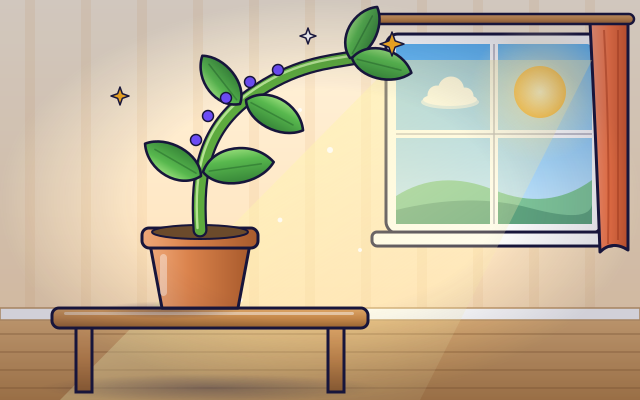
The interactive parts didn't load. The explanations below still work; try reloading the page.
Why plants bend toward light
- A plant near a window does not grow straight up. Over a few days it leans toward the glass, as if it were reaching for the light. How can a plant move with no muscles?
- Zoom in on the stem. The very tip is the part that notices light. Here the light comes from the right, so the right side of the tip is bright and the left side is in shade.
- The tip makes a chemical messenger called auxin. Auxin tells cells to grow longer. When light comes from one side, more of the auxin moves to the shady side and flows down the stem.
- Cells with more auxin stretch longer. So the shady side of the stem grows faster than the sunny side. One long side and one short side make the stem curve toward the light.
- Turn the pot so the plant leans away from the window. The old bend stays, because those cells have finished growing. But the new growth at the top curves back toward the light.
- Bending toward the light is worth it. Leaves use light to make the plant's food, so a plant that turns its leaves to the light can make more food and grow better.
Look inside a bending stem
The big circle shows the stem cut open. Tap each part to see what it does.
- Light from one side. Light is coming from one side only. That is the signal the plant responds to.
- Growing tip. The tip is the plant's light sensor. If you cover just the tip, the plant cannot tell where the light is and grows straight up.
- Auxin, the growth messenger. Auxin is a messenger made in the tip. More of it travels down the shady side, and wherever it goes it tells cells to grow longer.
- Shady-side cells. The cells on the shady side receive more auxin, so they stretch longer than their neighbors.
- Sunny-side cells. The cells facing the light receive less auxin, so they grow more slowly and stay shorter.
- Bending zone. Just below the tip is where the stem is still growing. Because one side grows more than the other, this is where the bend forms.
- Leaves. The leaves are the reason for all this. Turned toward the light, they can make more food for the plant.
Lamp and time: which way does it grow?
Drag the lamp along the rail. Slide the time from day 0 to day 5 and watch which way the stem grows. Then move the lamp to the other side.
Experiment: The lamp is on the left. After a few days, which way will the stem grow?
- Put the lamp on the left.
- Slide the time to day 5 and watch the stem.
- Move the lamp to the right and look again.
What we found: The stem curves toward the lamp, whichever side the lamp is on. With the lamp straight above, both sides of the stem grow the same amount, and it grows straight up.
Turn on JavaScript to try it yourself.
Aim the stem
Place the lamp so that the tip of the stem ends up inside the ring after 5 days. Then press Grow.
How a plant steers its growth
Plants make their own food from light, air and water, so finding light matters a great deal to them. But a plant is rooted in one place and has no muscles. It cannot walk into the sunshine. What it can do is grow in a chosen direction. Growing toward light is called phototropism.
The work starts at the very tip of the shoot. The tip can tell which side the light is coming from. It also makes a chemical messenger called auxin, which travels down the stem and tells cells to grow longer. When light comes from one side, more auxin goes down the shady side than the sunny side.
Now the two sides of the stem grow at different speeds. The shady side, with more auxin, stretches quickly. The sunny side grows slowly. A stem with one long side and one short side has to curve, just as a line of children turns a corner when the outside ones take longer steps. The curve points the tip, and the leaves, toward the light.
The bend only forms in the young part of the stem just below the tip, where cells are still growing. Older parts keep whatever shape they have. That is why a plant that has been turned around ends up with an S-shaped stem. The comparison with children turning a corner is not perfect: nobody in the stem walks anywhere. The cells stay where they are and simply grow to different lengths.
Key words
- Phototropism
- Growing toward (or away from) light.
- Auxin
- A chemical messenger made in the tip that tells plant cells to grow longer.
- Shoot tip
- The very top of a growing stem. It senses light and makes auxin.
- Elongation
- Growth in which cells get longer instead of dividing.
- Phototropin
- A light-sensing substance in the tip that notices blue light.
Check your thinking
-
A lamp shines on a seedling from the left. After a few days, what does the stem do?
Show the answer
It curves to the left, toward the lamp. The shady side grows faster, and that curves the stem toward the light.
-
Why is bending toward light useful to a plant?
Show the answer
Its leaves catch more light and can make more food. Leaves make the plant's food using light, so more light means more food.
-
You turn a leaning plant around so it points away from the window. A week later, what does the stem look like?
Show the answer
The old bend is still there, and the top has curved back toward the window. Only the young part near the tip is still growing, so only that part can make a new bend.
-
What happens if you cover only the very tip of a seedling with a tiny cap that blocks light?
Show the answer
It keeps growing but does not bend toward the light. The tip is the part that can tell where the light is. Covered up, it has no direction to grow toward.
-
A seedling is lit from one side with pure red light. Why does it not bend?
Show the answer
The receptors that guide phototropism absorb blue light, not red. Phototropins are blue-light receptors. Without blue light there is no signal to move auxin sideways.
-
What does auxin do to the cells it reaches?
Show the answer
It tells them to grow longer. Auxin is a growth messenger. Cells that receive more of it stretch longer.
You're a Plants & ecosystems expert!
You watched, looked inside, tried it, solved the challenge and went deeper. Pick another question below, or switch the age at the top to see this topic another way.
More about plants & ecosystems
 #233
Plants & ecosystems
How do mangroves survive in salty, muddy places?
Explore specialized roots and adaptations for salt, unstable ground, and limited soil oxygen.
#233
Plants & ecosystems
How do mangroves survive in salty, muddy places?
Explore specialized roots and adaptations for salt, unstable ground, and limited soil oxygen.
 #234
Plants & ecosystems
How do tree rings record growth?
Build successive rings under changing conditions and inspect a trunk cross-section.
#234
Plants & ecosystems
How do tree rings record growth?
Build successive rings under changing conditions and inspect a trunk cross-section.
 #235
Plants & ecosystems
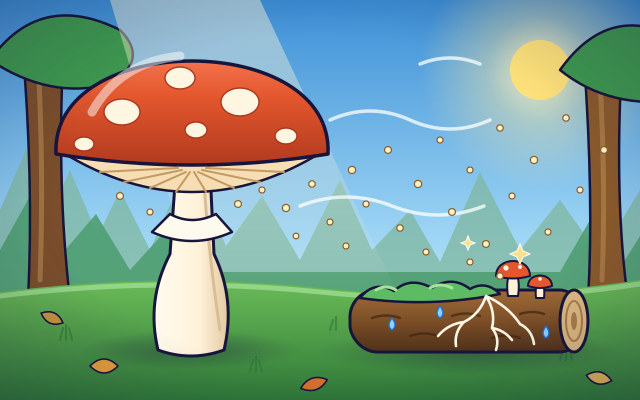
How do mushrooms and other fungi obtain food?
Follow fungal threads and visualize external digestion followed by nutrient absorption.
#235
Plants & ecosystems
How do mushrooms and other fungi obtain food?
Follow fungal threads and visualize external digestion followed by nutrient absorption.
 #236
Plants & ecosystems
How do fungi reproduce using spores?
Release spores, compare landing conditions, and follow suitable spores into new growth.
#236
Plants & ecosystems
How do fungi reproduce using spores?
Release spores, compare landing conditions, and follow suitable spores into new growth.
Keep exploring
Games to play next
- Classification ExplorerSort living things by what you can see, then follow and build yes-or-no keys.
- Label LabPut the right labels on beautiful science diagrams, from bean plants to heart chambers.
- Garden AutomationProgram a garden robot with sensor rules — then watch a whole day play out.
Guide for grown-ups
- How to start homeschooling: a step-by-step guide for familiesA guide for parents · 7 min read
Science games by grade
Science worksheets by grade
- Preschool Science Worksheets
- Pre-K Science Worksheets
- Kindergarten Science Worksheets
- 1st Grade Science Worksheets
- 2nd Grade Science Worksheets
- 3rd Grade Science Worksheets
- 4th Grade Science Worksheets
- 5th Grade Science Worksheets
- 6th Grade Science Worksheets
- 7th Grade Science Worksheets
- 8th Grade Science Worksheets