How do mushrooms and other fungi obtain food?
Fungi cannot make food like plants or swallow it like animals. They digest their food on the outside, then soak it in through a web of tiny threads.
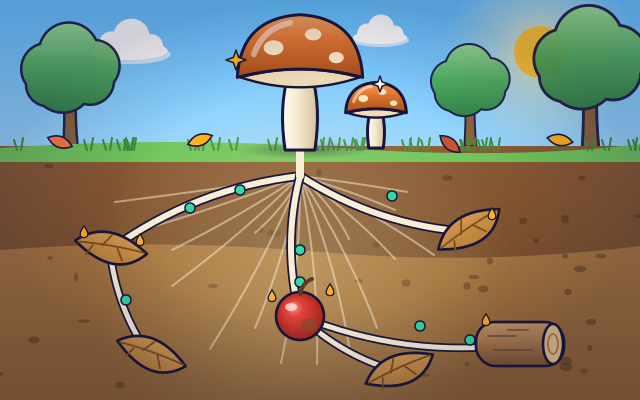
The big idea: A fungus is mostly a hidden web of threads. The threads release digestive juices onto dead leaves and wood, which break the food into tiny pieces. The threads then soak up those pieces.
It's like dunking a hard cookie in milk until it goes soft and crumbles, then drinking the milk: the food is broken up outside you first, and then taken in.
The interactive parts didn't load. The explanations below still work; try reloading the page.
The fungus that eats without a mouth
- A mushroom is not a plant. It has no green leaves, so it cannot make food from sunlight. It is not an animal either, and it has no mouth. Yet it grows fast. Where does its food come from?
- The mushroom is only the part that makes spores. The real body of the fungus is underground: a huge web of threads, each much thinner than a hair. The threads grow through dead leaves and wood.
- When the tip of a thread reaches a dead leaf, it releases digestive juices called enzymes. You make enzymes too, inside your stomach. The fungus sends its enzymes outside its body, onto the food.
- A leaf is made of long, chain-like molecules that are far too big to get into the thread. The enzymes snip the chains into small pieces, such as sugars, that dissolve in water.
- The small pieces soak in through the thin wall of the thread. Then the food travels along the web to wherever the fungus is growing.
- With enough food, the fungus can push up new mushrooms. And the dead leaf slowly disappears. What the fungus does not use goes back into the soil, where plants can use it again.
Look inside a feeding fungus
Tap each part of the fungus. The lens shows the tip of one thread feeding on a dead leaf.
- Mushroom. The mushroom is only the fruit of the fungus. Its job is to make spores and spread them. It does not do the feeding.
- The web of threads. This web is called the mycelium. It is the main body of the fungus, and it spreads through soil, dead leaves and wood.
- One thread. Each thread is called a hypha. It is a hollow tube, far thinner than a hair, with a thin wall.
- Growing tip. A thread grows only at its tip. The tip pushes forward through the soil and into the food, and it is where most of the digestive juices come out.
- Digestive juices. These are enzymes. They work like tiny scissors, snipping the long chains in the leaf into small pieces.
- Soaking in. Once the food is in small pieces dissolved in water, it passes through the thin wall into the thread.
- Food on the move. Inside the threads, food flows through the web to the places that need it, such as growing tips and new mushrooms.
Follow the threads to the food
Tap a piece of food and a thread grows to it. Watch the juices go out and the food flow back. Then change how damp the soil is.
Experiment: The soil dries out completely. What happens to the fungus's feeding?
- Tap the leaf and watch the fungus digest it in damp soil.
- Tap another food, then slide the soil to dry.
- Slide it back to damp and watch again.
What we found: In dry soil, feeding stops. The digestive juices can only reach the food through water, and the broken-down food can only soak in when it is dissolved. Damp soil sets the fungus feeding again.
Turn on JavaScript to try it yourself.
Spend your threads wisely
Growing a thread costs energy, and food gives energy back. Reach 150 energy to grow a mushroom. For 3 stars, do it with as little thread as you can.
Eating from the outside in
Mushrooms, molds and yeasts are all fungi. A fungus is not a plant, because it cannot make its own food from sunlight. It is not an animal either, because it cannot swallow anything. Fungi have their own way of feeding, and it happens out of sight.
The mushroom you see is only the fruit. The real body of the fungus is a web of very fine threads called the mycelium. The threads grow through the fungus's food: dead leaves, fallen wood, an old slice of bread. The fungus lives inside its meal.
The tip of each thread releases digestive juices called enzymes. They snip the big, tough molecules of the food into small pieces that dissolve in water. Then the small pieces soak into the thread through its thin wall. You digest food too, but you do it inside your stomach. A fungus does it on the outside.
This is why damp things go moldy and dry things keep: the juices need water to spread. It is also why fungi matter so much. By digesting dead leaves and wood, they clear the forest floor and return useful materials to the soil for plants. The lollipop comparison is not perfect: your spit melts the lollipop inside your mouth, while a fungus has no mouth at all. Never eat a wild mushroom, because many are poisonous.
Key words
- Fungus
- A living thing, such as a mushroom, mold or yeast, that feeds by absorbing food it has digested outside its body.
- Hypha
- One of the tiny threads that make up a fungus. More than one are called hyphae.
- Mycelium
- The whole web of threads that makes up the body of a fungus.
- Enzyme
- A digestive juice that snips big pieces of food into small ones.
- Absorb
- To soak something in. Fungi absorb food that is already broken into small, dissolved pieces.
- Decomposer
- A living thing that breaks down dead plants and animals and returns their materials to the soil.
Check your thinking
-
Which part of a fungus does most of the feeding?
Show the answer
The hidden web of threads. The mycelium grows through the food and takes it in. The mushroom only makes spores.
-
A fungus has no mouth. How does it get the food out of a dead leaf?
Show the answer
It releases juices that break the leaf into tiny pieces, then soaks them up. The digesting happens outside the fungus. Only the small, dissolved pieces go in.
-
Why does a damp slice of bread go moldy much sooner than a dry cracker?
Show the answer
The mold's juices need water to spread and work. Enzymes travel in water, and food can only soak in when it is dissolved. No water, no feeding.
-
How is the way a fungus digests food different from the way you do?
Show the answer
A fungus digests food outside its body; you digest it inside. Both use enzymes. Yours work in your stomach and gut, and the fungus's work out in the food itself.
-
A mycelium grows thickly into a rotting log but sends only a few threads across bare sand. What is the best explanation?
Show the answer
Threads and enzymes cost energy, so growth is concentrated where food repays the cost. Building hyphae and secreting enzymes is an investment. A fungus that puts its growth where the food is gets more energy back than it spends.
-
Why are fungi important in a forest?
Show the answer
They break down dead leaves and wood and return materials to the soil. Without fungi, dead leaves and wood would pile up, and plants would run short of what they need from the soil.
You're a Plants & ecosystems expert!
You watched, looked inside, tried it, solved the challenge and went deeper. Pick another question below, or switch the age at the top to see this topic another way.
More about plants & ecosystems
 #236
Plants & ecosystems
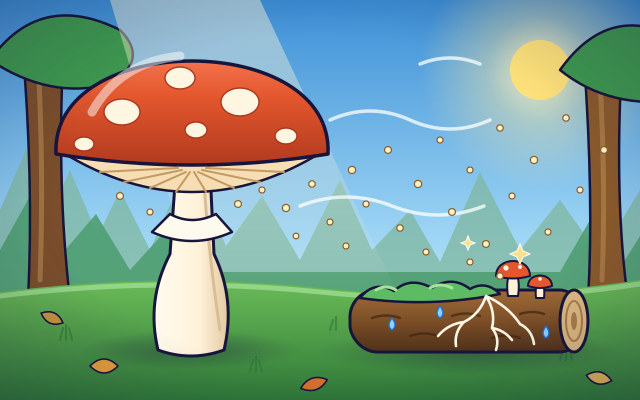
How do fungi reproduce using spores?
Release spores, compare landing conditions, and follow suitable spores into new growth.
#236
Plants & ecosystems
How do fungi reproduce using spores?
Release spores, compare landing conditions, and follow suitable spores into new growth.
 #237
Plants & ecosystems
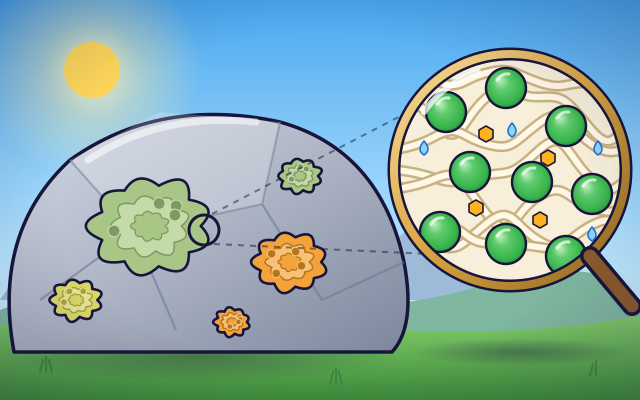
How do lichens work as living partnerships?
Explore their partners and trace the exchanges that support growth.
#237
Plants & ecosystems
How do lichens work as living partnerships?
Explore their partners and trace the exchanges that support growth.
 #238
Plants & ecosystems
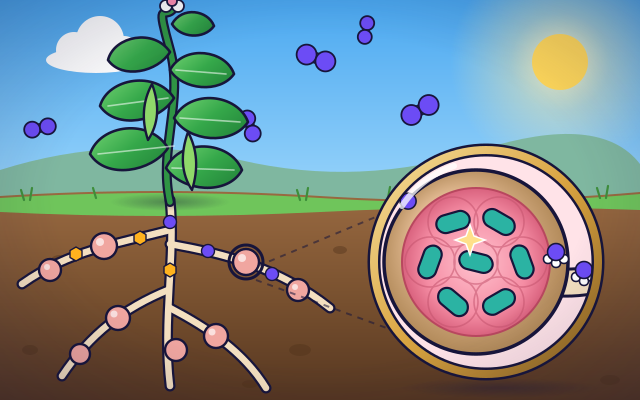
How do root bacteria help plants obtain nitrogen?
Look inside legume root nodules and follow exchanges between plants and bacteria.
#238
Plants & ecosystems
How do root bacteria help plants obtain nitrogen?
Look inside legume root nodules and follow exchanges between plants and bacteria.
 #239
Plants & ecosystems
How do decomposers break down fallen leaves?
Accelerate a forest-floor timeline and follow fungi, bacteria, and small animals at work.
#239
Plants & ecosystems
How do decomposers break down fallen leaves?
Accelerate a forest-floor timeline and follow fungi, bacteria, and small animals at work.
Keep exploring
Games to play next
- Classification ExplorerSort living things by what you can see, then follow and build yes-or-no keys.
- Habitat Builder 3DFind the right home for frogs, camels, polar bears and more.
- Label LabPut the right labels on beautiful science diagrams, from bean plants to heart chambers.
Guide for grown-ups
- How to start homeschooling: a step-by-step guide for familiesA guide for parents · 7 min read
Science games by grade
Science worksheets by grade
- Preschool Science Worksheets
- Pre-K Science Worksheets
- Kindergarten Science Worksheets
- 1st Grade Science Worksheets
- 2nd Grade Science Worksheets
- 3rd Grade Science Worksheets
- 4th Grade Science Worksheets
- 5th Grade Science Worksheets
- 6th Grade Science Worksheets
- 7th Grade Science Worksheets
- 8th Grade Science Worksheets