How do fungi reproduce using spores?
Fungi do not make seeds. They send out millions of tiny spores, and the few that land somewhere damp with food start a new fungus.
The big idea: A mushroom drops millions of spores from under its cap. Wind carries them away. Most land in bad places. A few land where it is damp and there is food, and those grow threads that become a new fungus.
It's like blowing a dandelion puff: hundreds of bits float off on the wind, but only the ones that land on good ground grow.
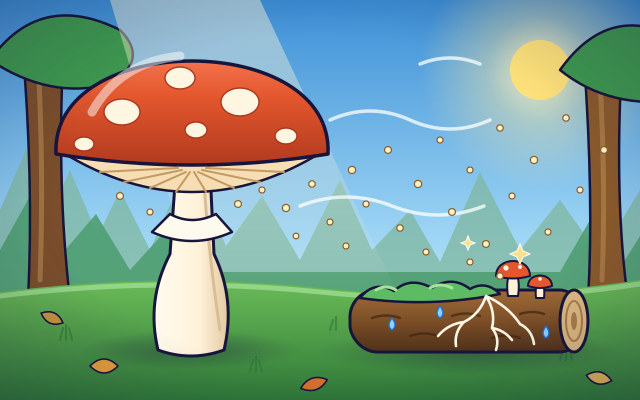
The interactive parts didn't load. The explanations below still work; try reloading the page.
How a mushroom makes more mushrooms
- After rain, a mushroom pushes up from the forest floor. It has no flowers and it never makes seeds. So how does a fungus make more of itself?
- Look under the cap. It is lined with thin flaps called gills. All over the gills grow tiny specks, far too small to see one at a time. They are spores.
- The spores drop out from between the gills like fine dust. The stem holds the cap up high, so the wind can catch the spores and carry them away.
- Spores land wherever the wind drops them. Bare rock has no food. Dry leaves have food but no water. A damp, rotting log has both, so only there can a spore grow.
- On the damp log, the spore soaks up water and swells. A thin thread grows out of it. The thread branches again and again, feeding on the wood as it spreads.
- The threads form a hidden web. When the webs from two spores meet and join, they can build a new mushroom. It pushes up, opens its cap and drops spores of its own.
Look inside a mushroom
Tap each part of the mushroom, above the ground and below it, to see what it does.
- Cap. The cap is like an umbrella. It keeps the gills and their spores dry, because wet spores stick together and cannot float away.
- Gills. Gills are thin flaps that hang under the cap like the pages of a book. So many flaps make lots of room for spores to grow.
- Spores. Spores are tiny specks, much smaller than a grain of sand. Each one is a single living cell that can start a whole new fungus.
- Stem. The stem lifts the cap off the ground. Up there the air is moving, so falling spores get carried away instead of landing right below.
- Thread web (mycelium). Under the ground is a web of thin threads. This is the main body of the fungus. It feeds on dead leaves and wood all year long.
- Baby mushroom. A baby mushroom starts as a tight knot of threads, about the size of a pinhead. After rain it fills with water and swells up fast.
Where can a spore grow?
Tap the mushroom to release spores. Then drag the rain cloud, or tap a landing place, to water it. Find out which spores grow.
Experiment: Will a spore grow anywhere it lands, as long as it gets water?
- Tap the mushroom cap. Watch the spores drift and land.
- Look at the damp log. What happens to the spores there?
- Rain on the dry leaves, then on the bare rock. Compare them.
What we found: Spores land everywhere, but they do not grow everywhere. The damp log grew threads straight away. The dry leaves grew threads only after rain. The rock never did, even when wet, because bare rock has no food.
Turn on JavaScript to try it yourself.
Land the spores
Only one landing place has both food and water. Set the wind so the spore cloud lands there, then release the spores.
How spores really work
A mushroom is not a plant, and it does not make seeds. It is a part of a fungus, and its only job is to make and spread spores. The main body of the fungus is a web of thin threads hidden in the soil or inside a rotting log. The mushroom is like an apple on a tree: the part you notice, but not the whole living thing.
Spores grow on the gills under the cap. Each spore is one tiny living cell. A single mushroom can drop millions of them in a day. The cap keeps them dry, and the stem holds them up where the air moves, so the wind can carry them away.
Why so many? Because the wind drops spores anywhere, and most places are wrong. A spore needs water, food and gentle warmth all at once. On a damp log it swells, and a thread grows out and starts to feed on the wood. On a dry stone, nothing happens.
Our dandelion comparison is not perfect. A dandelion seed carries a baby plant and a packed lunch. A spore is far smaller and carries almost no food, so it must land right on its meal. Also remember: many wild mushrooms are poisonous. Look, but never taste.
Key words
- Spore
- A tiny single cell that can grow into a new fungus.
- Gills
- The thin flaps under a mushroom's cap where spores grow.
- Hypha
- One thin thread of a fungus. Many of them are called hyphae.
- Mycelium
- The hidden web of threads that is the main body of a fungus.
- Germinate
- To wake up and start growing.
Check your thinking
-
What does a mushroom make instead of seeds?
Show the answer
Spores. Fungi reproduce with spores: tiny single cells that grow under the cap.
-
A spore lands on a wet, bare rock. What happens?
Show the answer
Nothing grows, because there is no food. A spore needs water and food together. Rock gives it nothing to eat.
-
Why does a mushroom make millions of spores?
Show the answer
Because most spores land in places where they cannot grow. The wind drops spores anywhere. Making millions means a few will land somewhere good.
-
What would happen if a mushroom had no stem and its cap sat on the ground?
Show the answer
Most spores would land right beside it. The stem lifts the cap into moving air. Without it, the spores would drop straight down.
-
A spore has landed on a damp log on a mild day. What is the first thing that grows out of it?
Show the answer
A thin thread called a hypha. A germinating spore puts out a hypha, which branches into a mycelium. Mushrooms come much later.
You're a Plants & ecosystems expert!
You watched, looked inside, tried it, solved the challenge and went deeper. Pick another question below, or switch the age at the top to see this topic another way.
More about plants & ecosystems
 #237
Plants & ecosystems
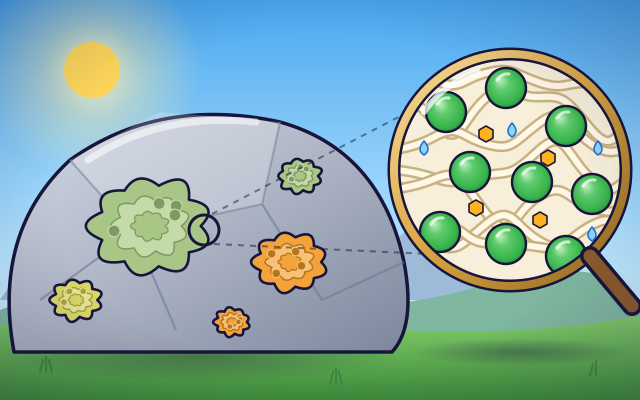
How do lichens work as living partnerships?
Explore their partners and trace the exchanges that support growth.
#237
Plants & ecosystems
How do lichens work as living partnerships?
Explore their partners and trace the exchanges that support growth.
 #238
Plants & ecosystems
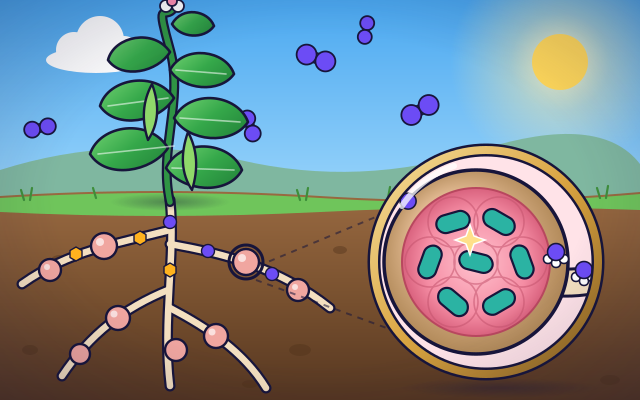
How do root bacteria help plants obtain nitrogen?
Look inside legume root nodules and follow exchanges between plants and bacteria.
#238
Plants & ecosystems
How do root bacteria help plants obtain nitrogen?
Look inside legume root nodules and follow exchanges between plants and bacteria.
 #239
Plants & ecosystems
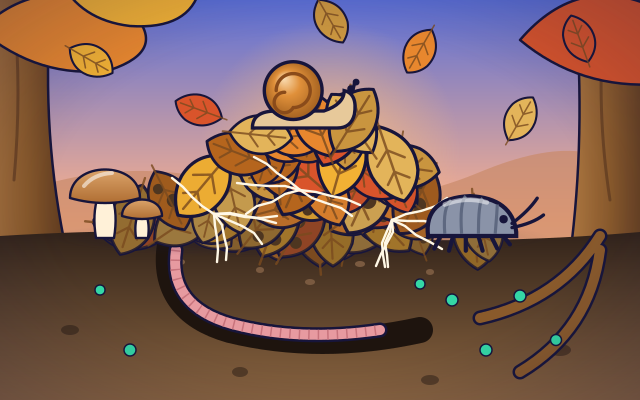
How do decomposers break down fallen leaves?
Accelerate a forest-floor timeline and follow fungi, bacteria, and small animals at work.
#239
Plants & ecosystems
How do decomposers break down fallen leaves?
Accelerate a forest-floor timeline and follow fungi, bacteria, and small animals at work.
 #240
Plants & ecosystems
How do earthworms change the ground?
Follow tunnels and compare their effects on air spaces and organic material.
#240
Plants & ecosystems
How do earthworms change the ground?
Follow tunnels and compare their effects on air spaces and organic material.
Keep exploring
Games to play next
- Classification ExplorerSort living things by what you can see, then follow and build yes-or-no keys.
- Habitat Builder 3DFind the right home for frogs, camels, polar bears and more.
- Label LabPut the right labels on beautiful science diagrams, from bean plants to heart chambers.
Guide for grown-ups
- How to start homeschooling: a step-by-step guide for familiesA guide for parents · 7 min read
Science games by grade
Science worksheets by grade
- Preschool Science Worksheets
- Pre-K Science Worksheets
- Kindergarten Science Worksheets
- 1st Grade Science Worksheets
- 2nd Grade Science Worksheets
- 3rd Grade Science Worksheets
- 4th Grade Science Worksheets
- 5th Grade Science Worksheets
- 6th Grade Science Worksheets
- 7th Grade Science Worksheets
- 8th Grade Science Worksheets