How do tree rings record growth?
A tree adds one ring of new wood each year. Wide rings mean good growing years, and thin rings mean hard ones.
The big idea: A thin growing layer under the bark adds new wood every year: pale wood in spring, dark wood in late summer. One pale band and one dark band make one ring, and its width shows how well the tree grew.
It's like a growth chart on a door frame: one mark each year, a big gap when you grew a lot and a small gap when you grew a little.
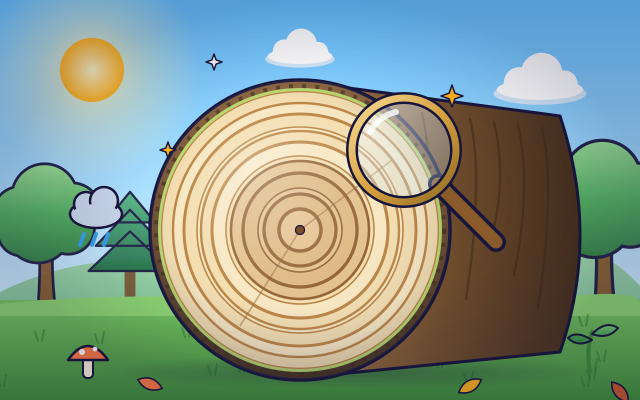
The interactive parts didn't load. The explanations below still work; try reloading the page.
How a tree makes its rings
- A tree fell in a storm, and the forester cut the trunk. Inside are circles within circles, like ripples in a pond. Every one of them tells part of the tree's story.
- A trunk does not grow from the middle. Just under the bark is a very thin layer of growing cells. It adds new wood on the outside of the old wood, all the way around.
- In spring the tree wakes up and grows fast. The new wood cells are big, with thin walls, so they can carry lots of water up to the new leaves. This wood looks pale.
- By late summer, growth slows down. The new cells are small with thick walls, and this wood looks dark. In winter the tree stops growing. Next spring, big pale cells start again right beside the dark ones, and that sharp line marks a new year.
- Not all rings are the same. In a year with plenty of rain and warmth, the tree grows a wide ring. In a dry or cold year, it can only grow a thin one.
- Count the rings from the center to the bark and you know the tree's age. Look at their widths and you can tell which years were good and which were hard. A tree keeps a diary in its wood.
Look inside a tree trunk
This is a slice across a trunk. Tap each part. The round lens shows the wood cells close up.
- Bark. Bark is the tree's tough outer coat. It protects the living parts from bumps, insects, sun and cold.
- Growing layer. The growing layer, called the cambium, is thinner than a sheet of paper. Every year it adds a new ring of wood just inside itself.
- Sapwood. The outer, newer rings are the sapwood. Water travels up through them from the roots to the leaves.
- Heartwood. The older rings in the middle no longer carry water. They become heartwood: hard, often darker wood that works like a backbone.
- Pith. The very center is the pith. It marks the tree's first year, when it was a thin little sapling.
- Spring wood. Spring wood is made of big cells with thin walls. They carry lots of water. This is the pale part of each ring.
- Summer wood. Summer wood is made of small cells with thick walls. It is strong and dark, and it makes the thin dark line at the edge of each ring.
Build rings in wet and dry years
Choose the weather for the next year, then tap the tree (or press Grow) to add that year's ring. Tap any ring on the slice to read about it.
Experiment: A tree has a very dry year. What will that year's ring look like?
- Choose Rainy and grow the tree for two years.
- Choose Dry and grow one more year.
- Compare the new ring with the ones before it.
What we found: The dry year's ring is much thinner. With little water, the tree could make only a little new wood. Rainy years leave wide rings.
Turn on JavaScript to try it yourself.
Tree detective
First tap the ring that grew in the driest year. Then work out how old the tree was when it was cut.
The diary inside a tree
A tree trunk grows fatter in a surprising way. The wood in the middle is the oldest, and it never changes. All the growing happens in a paper-thin layer just under the bark, called the cambium. Each year the cambium adds a new layer of wood on top of last year's, like putting on a new coat over the old ones.
The new wood does not look the same all year. In spring the tree grows fast and makes big, thin-walled cells that look pale. In late summer it grows slowly and makes small, thick-walled cells that look dark. In winter it rests. So each year leaves one pale band and one dark band, and together they make one ring.
Rings are not all the same width. In a year with plenty of rain, warmth and sunlight, the tree makes lots of new wood and the ring is wide. In a dry or cold year, or when bigger trees shade it, the ring is thin. A fire can leave a dark scar. The rings are like a diary of the tree's whole life.
Scientists read that diary without cutting the tree down. They drill out a core as thin as a pencil and count its stripes. The door-frame comparison is not perfect, though. Marks on a door frame show how tall you grew, but tree rings show how much fatter the trunk grew, and a tree keeps adding rings for as long as it lives.
Key words
- Growth ring
- One year's layer of new wood: a pale band and a dark band together.
- Cambium
- The thin growing layer under the bark that makes new wood every year.
- Earlywood
- Pale wood made in spring, with big, thin-walled cells.
- Latewood
- Dark wood made in late summer, with small, thick-walled cells.
- Core
- A pencil-thin sample of wood drilled from the bark to the center of a tree, so its rings can be read without cutting it down.
- Dendrochronology
- The science of dating wood and studying the past by measuring tree rings.
Check your thinking
-
How do you find a tree's age from a slice of its trunk?
Show the answer
Count the rings from the middle to the bark. The tree adds one ring each year, so the number of rings is the number of years.
-
One ring in a slice is much thinner than the others. What probably happened that year?
Show the answer
A hard year, such as a drought. With little water the tree could make only a little new wood, so the ring is thin.
-
Where is the newest wood in a tree trunk?
Show the answer
Just under the bark. The growing layer is under the bark, so the youngest ring is the outermost one and the oldest is in the middle.
-
Why is part of each ring pale and part of it dark?
Show the answer
Big spring cells look pale, and small summer cells look dark. Fast spring growth makes big, thin-walled cells. Slow summer growth makes small, thick-walled ones.
-
An old roof beam has a ring pattern that matches the years 1701 to 1760 in a dated regional record. What can you conclude?
Show the answer
The tree was still alive in 1760, so the beam was cut in that year or later. The last ring present grew in 1760. If outer rings were trimmed away, the tree was felled even later, but never earlier.
-
How can scientists read a living tree's rings without cutting it down?
Show the answer
They drill out a core as thin as a pencil. A thin core shows all the rings as stripes, and the small hole heals over.
You're a Plants & ecosystems expert!
You watched, looked inside, tried it, solved the challenge and went deeper. Pick another question below, or switch the age at the top to see this topic another way.
More about plants & ecosystems
 #235
Plants & ecosystems
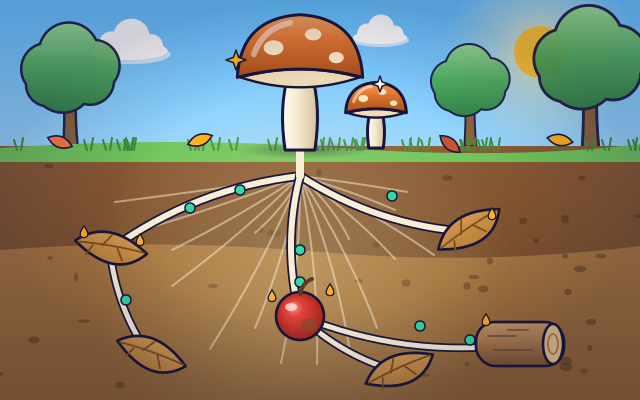
How do mushrooms and other fungi obtain food?
Follow fungal threads and visualize external digestion followed by nutrient absorption.
#235
Plants & ecosystems
How do mushrooms and other fungi obtain food?
Follow fungal threads and visualize external digestion followed by nutrient absorption.
 #236
Plants & ecosystems
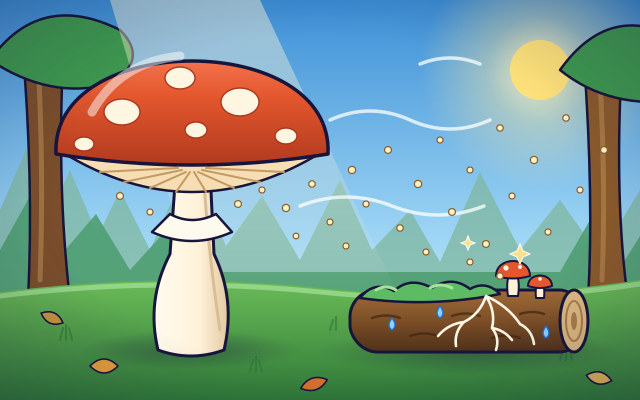
How do fungi reproduce using spores?
Release spores, compare landing conditions, and follow suitable spores into new growth.
#236
Plants & ecosystems
How do fungi reproduce using spores?
Release spores, compare landing conditions, and follow suitable spores into new growth.
 #237
Plants & ecosystems
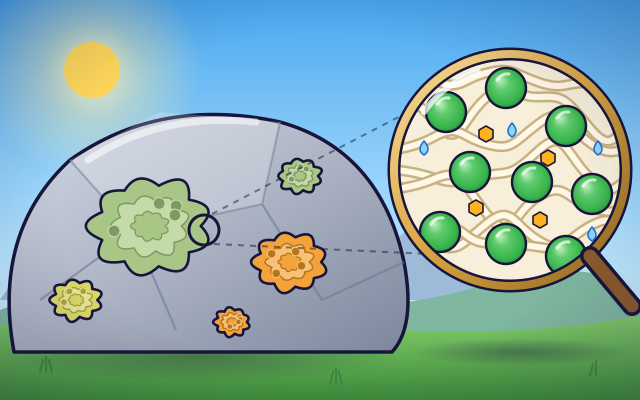
How do lichens work as living partnerships?
Explore their partners and trace the exchanges that support growth.
#237
Plants & ecosystems
How do lichens work as living partnerships?
Explore their partners and trace the exchanges that support growth.
 #238
Plants & ecosystems
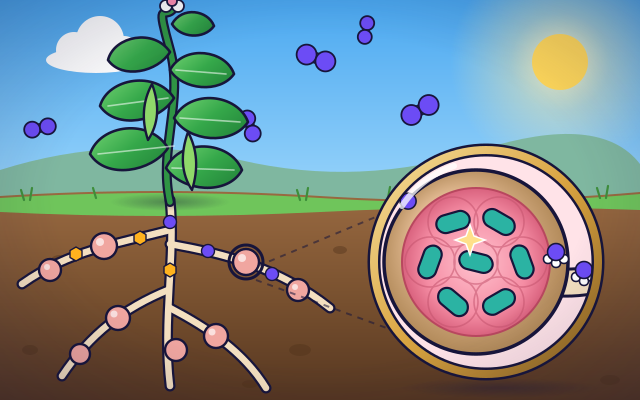
How do root bacteria help plants obtain nitrogen?
Look inside legume root nodules and follow exchanges between plants and bacteria.
#238
Plants & ecosystems
How do root bacteria help plants obtain nitrogen?
Look inside legume root nodules and follow exchanges between plants and bacteria.
Keep exploring
Games to play next
- Habitat Builder 3DFind the right home for frogs, camels, polar bears and more.
- Classification ExplorerSort living things by what you can see, then follow and build yes-or-no keys.
- Label LabPut the right labels on beautiful science diagrams, from bean plants to heart chambers.
Draw it or make it
- How to draw a tree with branchesDrawing lesson
- Torn-Paper Tree CollagePaper craft
Guide for grown-ups
- How to start homeschooling: a step-by-step guide for familiesA guide for parents · 7 min read
Science games by grade
Science worksheets by grade
- Preschool Science Worksheets
- Pre-K Science Worksheets
- Kindergarten Science Worksheets
- 1st Grade Science Worksheets
- 2nd Grade Science Worksheets
- 3rd Grade Science Worksheets
- 4th Grade Science Worksheets
- 5th Grade Science Worksheets
- 6th Grade Science Worksheets
- 7th Grade Science Worksheets
- 8th Grade Science Worksheets