How do mangroves survive in salty, muddy places?
Mangroves grow where most trees would die: in salty water and soft mud with no air. Special roots and leaves make it possible.
The big idea: The shore gives a mangrove three problems: wobbly mud, mud with no air, and salty water. Stilt roots, snorkel roots and salt defenses each solve one of them.
It's like a swimmer with a snorkel standing in the waves: feet spread wide to stay steady, a tube to reach the air, and a mouth kept shut against the salty water.
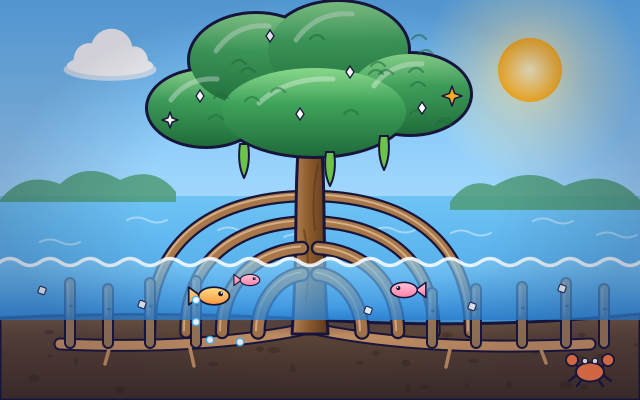
The interactive parts didn't load. The explanations below still work; try reloading the page.
How mangroves live on the shore
- Twice a day the tide floods this muddy shore with salty water. An ordinary tree would wilt, choke and fall over. The mangrove grows here anyway. It has to solve three problems.
- First problem: soft mud and pushing waves. The mangrove grows stilt roots that arch out from its trunk like the legs of a stool. They spread its weight and hold it steady.
- Second problem: roots need air, and this soggy mud has almost none. So some roots grow straight up, like snorkels. When the tide is low, they take in air and send it down to the buried roots.
- Third problem: salt. The roots work like a very fine filter. Water gets in, but most of the salt stays outside. Some mangroves also push leftover salt out through their leaves, where it dries into tiny crystals.
- A mangrove's seeds sprout while they are still on the tree. The long seedling drops into the water and floats away. When it reaches mud, it sends out roots and stands up.
- Together, mangroves make a living wall. Their roots slow the waves, trap mud and give young fish and crabs a safe place to hide. Three clever answers to three hard problems.
Look closely at a mangrove
Tap each part of the tree, above and below the mud. The round windows show close-ups.
- Stilt roots. Stilt roots arch out from the trunk and down into the mud. Like spreading your feet, they keep the tree from tipping when waves push.
- Snorkel roots. Snorkel roots grow up out of the mud. At low tide they stand in the air and take it in for the roots below.
- Breathing pores. The roots are dotted with tiny pores. Air goes in through them. They do not let water in when the tide covers them.
- Root filter. The skin of the root is a very fine filter. Water passes through, but most of the salt cannot.
- Salt glands. Some salt still gets in. Tiny glands on the leaves push it out, and it dries into white crystals that rain washes away.
- Floating seedling. This long green pod is a seedling that has already started to grow. It drops, floats on the tide, and plants itself in new mud.
- Fish nursery. The tangle of roots is a safe hiding place. Many young fish, crabs and shrimp grow up here before they move out to sea.
Tides, waves and three kinds of help
Tap the trunk for stilt roots, the mud for snorkel roots and the leaves for salt defenses. Tap again for more. Then change the tide and the waves.
Experiment: The mangrove has no snorkel roots, and its other roots are buried in mud. What happens to those roots?
- Start with no snorkel roots and look at the Root air readout.
- Tap the mud to grow snorkel roots. Watch the air go down.
- Slide the tide up until the snorkels are covered.
What we found: Without snorkel roots, the buried roots have no air. With them, air flows down whenever the tips stand above the water. When the tide covers them, the roots must hold their breath until it falls again.
Turn on JavaScript to try it yourself.
Survive the open coast
This spot has storm waves, a medium tide and mild salt. The tree has 7 energy to spend. Build what it needs, then press Tide in! For 3 stars, keep 1 energy spare for growing.
Living where land meets sea
Mangroves are trees and shrubs that live on warm, muddy coasts, right where the tide goes in and out. Twice a day the sea covers their roots, and twice a day it drains away. Few plants can live like that. A garden tree planted here would face three problems at once.
The first problem is the ground. The mud is soft and the waves push. Many mangroves grow stilt roots, which arch out from the trunk like the legs of a stool. Spreading your feet apart makes you harder to push over, and stilt roots do the same for the tree.
The second problem is air. Roots are alive, and they need air just as you do. Soggy mud holds almost no air, so some mangroves grow snorkel roots that stick straight up. At low tide, air enters tiny pores in these roots and travels down to the buried ones. At high tide the snorkels are covered, and the roots use the air they have stored.
The third problem is salt. Too much salt pulls water out of living cells. Mangrove roots filter the water they take in and leave most of the salt outside. Some kinds also push salt out through their leaves. Comparing a mangrove to a swimmer with a snorkel helps, but it is not exact: the tree does not breathe in and out. Air simply seeps into the roots through the pores.
Key words
- Mangrove
- A tree or shrub that can live in salty water on a tidal shore.
- Tide
- The rise and fall of the sea, usually twice a day.
- Prop root
- A stilt root that grows out from the trunk and down into the mud to hold the tree steady.
- Pneumatophore
- A snorkel root that grows up out of the mud to take in air.
- Lenticel
- A tiny pore in bark that lets air in.
- Propagule
- A mangrove seedling that starts growing on the tree, then drops and floats away.
Check your thinking
-
Why do mangroves grow roots that arch out like stilts?
Show the answer
To stay steady in soft mud and pushing waves. A wide base is hard to tip over, just like standing with your feet apart.
-
Why do snorkel roots grow up out of the mud instead of down?
Show the answer
To reach the air, because the mud has almost none. Roots need air. Soggy mud has almost none, so these roots reach up to where the air is.
-
The tide is high and the snorkel roots are completely under water. What do the buried roots do?
Show the answer
They use stored air until the tide goes out again. No air can come in while the snorkels are covered, so the roots rely on the air stored inside them.
-
How do mangroves cope with salty water?
Show the answer
Their roots filter out most of the salt, and some push the rest out through their leaves. The root skin is a fine filter. Leaf glands remove salt that slips through.
-
Why do mangroves usually grow more slowly where the water is saltier?
Show the answer
Excluding and excreting salt costs energy that could have gone into growth. Filtering and pumping out salt takes energy. The more salt there is, the less energy is left for growing.
-
Why are mangrove forests good for a coast?
Show the answer
Their roots slow the waves and shelter young fish. Waves lose strength passing through the roots, and young sea animals hide there.
You're a Plants & ecosystems expert!
You watched, looked inside, tried it, solved the challenge and went deeper. Pick another question below, or switch the age at the top to see this topic another way.
More about plants & ecosystems
 #234
Plants & ecosystems
How do tree rings record growth?
Build successive rings under changing conditions and inspect a trunk cross-section.
#234
Plants & ecosystems
How do tree rings record growth?
Build successive rings under changing conditions and inspect a trunk cross-section.
 #235
Plants & ecosystems
How do mushrooms and other fungi obtain food?
Follow fungal threads and visualize external digestion followed by nutrient absorption.
#235
Plants & ecosystems
How do mushrooms and other fungi obtain food?
Follow fungal threads and visualize external digestion followed by nutrient absorption.
 #236
Plants & ecosystems
How do fungi reproduce using spores?
Release spores, compare landing conditions, and follow suitable spores into new growth.
#236
Plants & ecosystems
How do fungi reproduce using spores?
Release spores, compare landing conditions, and follow suitable spores into new growth.
 #237
Plants & ecosystems
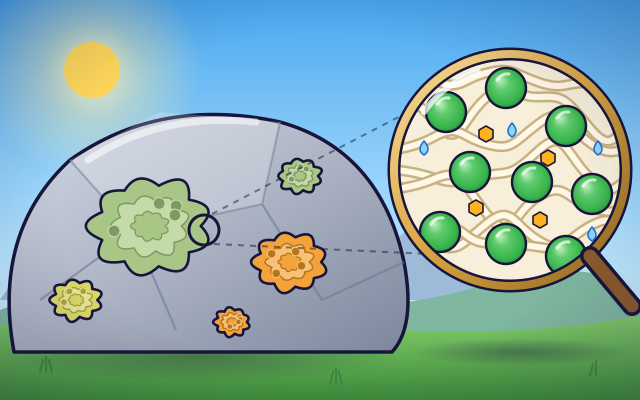
How do lichens work as living partnerships?
Explore their partners and trace the exchanges that support growth.
#237
Plants & ecosystems
How do lichens work as living partnerships?
Explore their partners and trace the exchanges that support growth.
Keep exploring
Games to play next
- Habitat Builder 3DFind the right home for frogs, camels, polar bears and more.
- Label LabPut the right labels on beautiful science diagrams, from bean plants to heart chambers.
- Classification ExplorerSort living things by what you can see, then follow and build yes-or-no keys.
Guide for grown-ups
- How to start homeschooling: a step-by-step guide for familiesA guide for parents · 7 min read
Science games by grade
Science worksheets by grade
- Preschool Science Worksheets
- Pre-K Science Worksheets
- Kindergarten Science Worksheets
- 1st Grade Science Worksheets
- 2nd Grade Science Worksheets
- 3rd Grade Science Worksheets
- 4th Grade Science Worksheets
- 5th Grade Science Worksheets
- 6th Grade Science Worksheets
- 7th Grade Science Worksheets
- 8th Grade Science Worksheets