How is plywood made?
A log is peeled into thin sheets. The sheets are glued with their grain criss-crossed and pressed into a strong, flat board.
The big idea: Wood is strong along its grain but splits easily across it. Plywood turns every other sheet sideways, so each layer covers the weak direction of the next.
It's like a woven mat: threads going only one way pull apart, but threads crossing each other hold it together in every direction.
The interactive parts didn't load. The explanations below still work; try reloading the page.
How plywood is made
- Hit a plain board in the right place and it splits along its grain. A plywood board does not split. Look at its edge: it is made of thin layers.
- A soaked log spins against a long blade. The blade peels off one thin, never-ending sheet, like unrolling a roll of paper. The thin sheet is called veneer.
- Wood is made of long fibers, all lined up like a bundle of straws. That line-up is the grain. Pulling along the fibers is very hard. Pulling them apart sideways is easy.
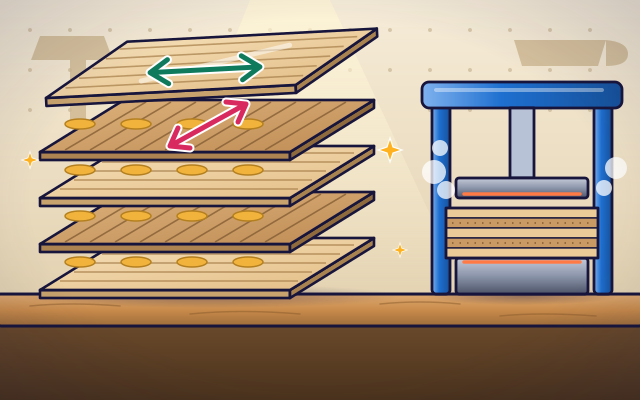
- Glue is spread on the sheets, and they are stacked. Each sheet is turned so its grain crosses the sheet below. The top and bottom sheets always point the same way.
- The stack slides into a hot press. Heat and a mighty squeeze set the glue in a few minutes. Now the layers cannot slide, and they act as one solid board.
- Test the board in both directions. Whichever way it bends, some layers have their grain running the strong way. It also stays flat, because each layer stops its neighbors from swelling.
Look inside a plywood board
This five-layer board has been pulled apart so you can see every sheet. Tap each one.
- Face sheet. The top sheet is the face. It is the best-looking sheet, and its grain runs along the length of the board.
- Cross sheets. These sheets are turned a quarter turn, so their grain crosses the sheets above and below. They give the board its strength across the width.
- Middle sheet. The middle sheet is the core. The stack is built the same above it and below it, like a mirror.
- Glue lines. A thin layer of glue between every pair of sheets locks them together, so they cannot slide when the board bends.
- Back sheet. The bottom sheet is the back. Its grain runs the same way as the face, so the board is balanced and stays flat.
- Striped edge. On the edge of a plywood board you can count the layers as stripes. Light and dark stripes take turns, because you see the grain from the side, then from the end.
Which way should the grain go?
Tap a sheet to turn its grain. The press glues the stack, and two weights test the board in both directions. Find a stack that is strong both ways and flat.
Experiment: What happens if every sheet has its grain pointing the same way?
- Turn sheets until all three point the same way. Watch both tests.
- Now make the middle sheet cross the other two.
- Try a stack where the top and bottom do not match. Does the board stay flat?
What we found: With every grain pointing the same way, the board is strong along the grain but snaps easily the other way, just like a plain plank. Crossing the middle sheet makes it hold both ways. If the top and bottom sheets do not match, the board is lopsided and curls.
Turn on JavaScript to try it yourself.
Five sheets, one strong board
Turn the five sheets so the board is strong both ways and stays flat. Then press it and test it.
Why plywood beats a plain board
Wood is made of long, thin fibers that all run the same way, up the trunk of the tree. That direction is called the grain. Along the grain, wood is very strong. Across it, the fibers can be pulled apart, which is why a plank splits along its grain.
To make plywood, a log is first softened in hot water. Then it spins against a long blade that peels off a thin sheet of wood, the way paper comes off a roll. The thin sheets are called veneer. They are cut to size and dried.
Next comes the clever part. Glue is spread on the sheets and they are stacked so that each sheet's grain crosses the grain of the sheet below. A hot press squeezes the stack until the glue sets. Now, whichever way you push or pull, some of the layers have their grain running the strong way.
Plywood has another trick. Damp wood swells across its grain but hardly at all along it. In plywood each layer holds its neighbors still, so the board stays flat and does not crack. That only works if the top and bottom sheets match, which is why plywood has an odd number of layers. The woven mat comparison is close, but the sheets in plywood are stacked and glued, not woven over and under.
Key words
- Grain
- The direction the fibers run in a piece of wood.
- Veneer
- A thin sheet of wood peeled or sliced from a log.
- Ply
- One layer of a plywood board.
- Cross-lamination
- Gluing layers so the grain of each one crosses the next.
- Balanced panel
- A board whose layers are the same above and below the middle, so it stays flat.
Check your thinking
-
How is each sheet laid on the one below it?
Show the answer
Turned so its grain crosses the grain below. Crossing the grain means each layer covers the weak direction of the next.
-
Why does a plain plank split so easily one way?
Show the answer
Its fibers all run one way and can be pulled apart sideways. Wood is strong along its fibers, but the fibers separate easily from each other.
-
Why are the sheets pressed hard while the glue sets?
Show the answer
So the layers lock together and cannot slide. Loose sheets slide over each other like a deck of cards. Glued sheets act as one board.
-
Why does plywood have an odd number of layers, such as 3, 5 or 7?
Show the answer
So the top and bottom sheets match and the board stays flat. With an odd number, the stack is the same above and below the middle, so it does not curl.
-
How is a log turned into thin sheets?
Show the answer
It spins against a blade that peels off one long sheet. The spinning log is peeled like a roll of paper.
You're a Making everyday things expert!
You watched, looked inside, tried it, solved the challenge and went deeper. Pick another question below, or switch the age at the top to see this topic another way.
More about making everyday things
 #311
Making everyday things
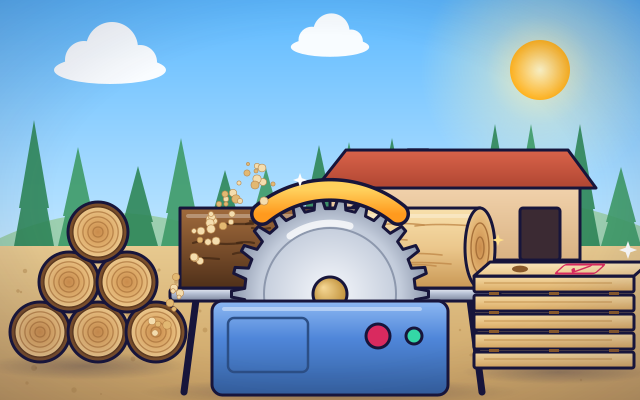
How is lumber prepared for building?
Follow logs through sawing, drying, grading, and planing into construction boards.
#311
Making everyday things
How is lumber prepared for building?
Follow logs through sawing, drying, grading, and planing into construction boards.
 #312
Making everyday things
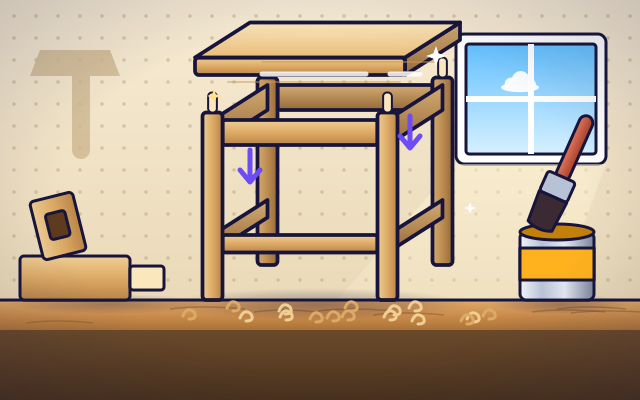
How is wooden furniture made?
Turn a design into measured pieces, assemble joints, and choose a finish.
#312
Making everyday things
How is wooden furniture made?
Turn a design into measured pieces, assemble joints, and choose a finish.
 #313
Making everyday things
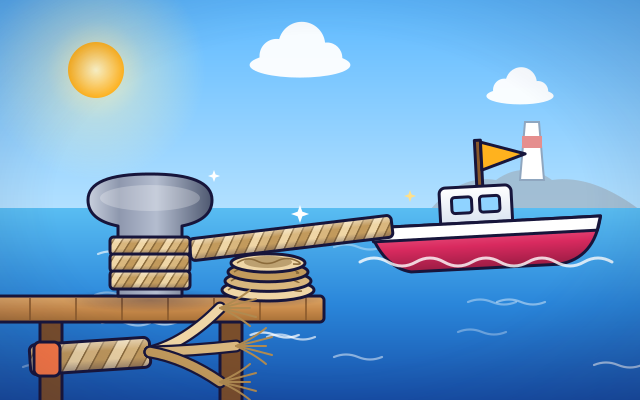
How is rope made?
Twist fibers into yarns and strands and compare different arrangements.
#313
Making everyday things
How is rope made?
Twist fibers into yarns and strands and compare different arrangements.
 #314
Making everyday things
How are carpets made?
Watch yarn enter a backing and compare looped and cut-pile surfaces.
#314
Making everyday things
How are carpets made?
Watch yarn enter a backing and compare looped and cut-pile surfaces.
Keep exploring
Games to play next
- Geometry Architect 3DCount, build and fold solids like a real architect.
- Machine RepairFix levers, pulleys, gears and ramps so every contraption works.
- Sorting FactoryTurn a work order into if/else rules and watch the conveyor sort every item.
Guide for grown-ups
- How to start homeschooling: a step-by-step guide for familiesA guide for parents · 7 min read
Science games by grade
Science worksheets by grade
- Preschool Science Worksheets
- Pre-K Science Worksheets
- Kindergarten Science Worksheets
- 1st Grade Science Worksheets
- 2nd Grade Science Worksheets
- 3rd Grade Science Worksheets
- 4th Grade Science Worksheets
- 5th Grade Science Worksheets
- 6th Grade Science Worksheets
- 7th Grade Science Worksheets
- 8th Grade Science Worksheets