How does a mechanical pressure gauge work?
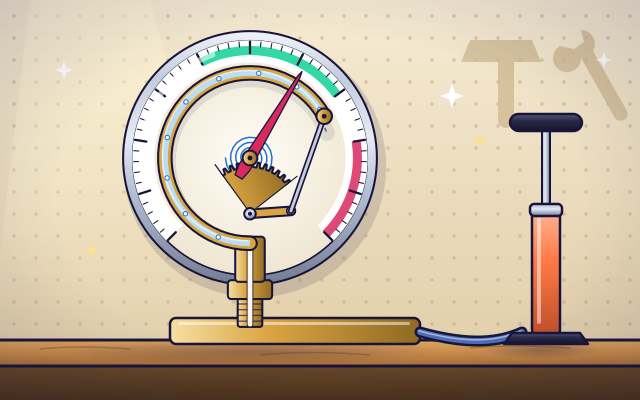
Inside the dial, a curled metal tube straightens a little when pressure pushes in, and tiny gears turn that small move into a big sweep of the pointer.
The big idea: Pressure inside a curled, springy tube makes it straighten a little. The harder the push, the more it straightens, and gears make that tiny movement big enough to read.
It's like a party blower: blow into the curled paper tube and it uncurls. A gauge's curled metal tube uncurls only a tiny bit, and gears make that tiny move big.
The interactive parts didn't load. The explanations below still work; try reloading the page.
What moves the pointer?
- Every push of the pump sends more air into the tire, and the pointer on the gauge climbs. But a gauge has no battery and no screen. What is moving that pointer?
- Lift off the dial face and you find a curled metal tube, closed at one end, joined to a few tiny gears. Air from the pump can get inside the tube.
- When air pushes inside the tube, the tube tries to straighten, just like a party blower uncurling. It is stiff metal, so its tip moves only a few millimeters.
- The tip pulls a link joined to a toothed piece called a sector gear. It turns a tiny gear on the pointer. A small turn of the big gear makes a big turn of the little one.
- Let the air out and the springy tube curls back to its old shape, so the pointer returns to zero. A fine hairspring keeps the pointer from wobbling.
- More pressure means more uncurling and a bigger swing. The marks on the dial turn the pointer's position into a number, so you can stop pumping when the tire is just right.
Look inside a pressure gauge
Tap each part to see what it does when the pressure changes.
- Inlet. The inlet screws onto the pump, pipe or tank. A small hole lets the air or water push up into the curled tube.
- Curled tube. This curled metal tube is the part that feels the pressure. More pressure inside makes it straighten a little more. It is called a Bourdon tube.
- Sealed tip. The far end of the tube is sealed, so the air cannot escape. This end is free to move, and it is the part that moves the most.
- Link. The link is a small rod. When the tube's tip moves, the link pulls on the big gear.
- Sector gear. The sector gear is a slice of a big gear. The link rocks it just a little, and its teeth push the tiny gear round.
- Pinion. The pinion is a tiny gear on the pointer's shaft. Because it is so much smaller than the sector gear, it turns much farther.
- Hairspring. The hairspring is a very fine coiled spring. It gently pushes the gears together so the pointer does not wobble or stick.
- Pointer. The pointer is fixed to the pinion, so it turns with it. A tiny movement of the tube becomes a long sweep across the dial.
- Dial. The dial is the face with marks and numbers. It turns the pointer's position into a reading. Colored zones can show what is safe.
Pressure and the curled tube
Change the pressure and compare the tube with its dotted resting shape. Then let the air out.
Experiment: What happens to the curled tube when the pressure inside goes up?
- Look at the dotted line. It shows where the tube rests with no extra pressure.
- Slide the pressure up, or tap the pump, and watch the tip of the tube.
- Let the air out and watch the tube and the pointer go back.
What we found: The tube uncurls a little when the pressure rises, and curls back when the pressure falls. The move is tiny, so gears magnify it into a big sweep of the pointer.
Turn on JavaScript to try it yourself.
The right tube for the job
Each job needs a gauge that uses most of its dial without going past the end. Choose the tube, then test it.
How a tube can measure a push
Pressure is how hard something pushes on a surface. The air in a tire pushes outward on the rubber. To measure that push, a gauge lets a little of the air into a curled metal tube that is closed at the far end.
The tube is not round like a drinking straw. It is squashed almost flat. When air pushes inside, the flat tube tries to become rounder, and that makes the whole curl open out a little. It is the same thing that happens when you blow into a party blower, only much smaller, because metal is far stiffer than paper.
The tip of the tube moves only a few millimeters, which is too little to read. So the tip pulls a small rod, the rod rocks a slice of a big gear, and the big gear turns a tiny gear with the pointer on it. A small turn of a big gear makes a large turn of a small gear, so the pointer sweeps most of the way around the dial.
The metal is springy. When the pressure drops, the tube curls back to exactly where it started, and the pointer returns to zero. Our party blower comparison breaks down here: a paper blower gets floppy and wears out, but a metal tube can bend and spring back millions of times.
Key words
- Pressure
- How hard something pushes on each bit of a surface.
- Bourdon tube
- A flattened, curved metal tube, sealed at one end, that straightens slightly when the pressure inside rises.
- Sector gear
- A slice of a large gear that rocks back and forth instead of turning all the way round.
- Pinion
- A small gear that is driven by a larger one.
- Elastic
- Able to bend or stretch and then spring back to the same shape.
- Gauge pressure
- Pressure measured above the pressure of the surrounding air.
Check your thinking
-
What does the curled tube do when the pressure inside goes up?
Show the answer
It straightens a little. Pressure inside makes the curled tube try to straighten, like a party blower.
-
Why does the pointer go back to zero when the air is let out?
Show the answer
The springy tube curls back to its old shape. The metal tube is elastic. With no extra push inside, it returns to its resting curve.
-
The tube's tip moves only a little. How does the pointer move so far?
Show the answer
A big gear turns a tiny gear, which turns much farther. A small turn of a large gear makes a large turn of a small gear.
-
You need to measure a very big pressure. Which tube should the gauge have?
Show the answer
A stiff tube. A bendy tube would uncurl too far and push the pointer past the end. A stiff tube moves just enough.
-
A tire gauge reads 2 bar. About what is the absolute pressure inside the tire?
Show the answer
About 3 bar. The gauge shows pressure above the atmosphere, which is about 1 bar, so the total is about 3 bar.
You're a Measuring & instruments expert!
You watched, looked inside, tried it, solved the challenge and went deeper. Pick another question below, or switch the age at the top to see this topic another way.
More about measuring & instruments
 #391
Measuring & instruments
How do microscopes reveal tiny details?
Position a sample and adjust focus and magnification to reveal structures.
#391
Measuring & instruments
How do microscopes reveal tiny details?
Position a sample and adjust focus and magnification to reveal structures.
 #392
Measuring & instruments
How do thermal cameras show heat patterns?
Compare familiar objects in visible-light and simulated infrared images.
#392
Measuring & instruments
How do thermal cameras show heat patterns?
Compare familiar objects in visible-light and simulated infrared images.
 #393
Measuring & instruments
How do X-ray machines look inside objects?
Send simulated X-rays through different materials and compare their resulting images.
#393
Measuring & instruments
How do X-ray machines look inside objects?
Send simulated X-rays through different materials and compare their resulting images.
 #394
Measuring & instruments
How do ultrasound scanners create pictures?
Send sound pulses into a model and build an image from returning echoes.
#394
Measuring & instruments
How do ultrasound scanners create pictures?
Send sound pulses into a model and build an image from returning echoes.
Keep exploring
Games to play next
- Data DetectiveRead the clues hidden in graphs — and build your own.
- Clock TowerKeep the town on time: set the tower clock's hands just right.
- Mapmaker QuestFollow directions to make a map, then read its legend, compass rose and scale.
Guide for grown-ups
- How to start homeschooling: a step-by-step guide for familiesA guide for parents · 7 min read
Science games by grade
Science worksheets by grade
- Preschool Science Worksheets
- Pre-K Science Worksheets
- Kindergarten Science Worksheets
- 1st Grade Science Worksheets
- 2nd Grade Science Worksheets
- 3rd Grade Science Worksheets
- 4th Grade Science Worksheets
- 5th Grade Science Worksheets
- 6th Grade Science Worksheets
- 7th Grade Science Worksheets
- 8th Grade Science Worksheets