How do propellers push vehicles forward?
A propeller's tilted blades push air or water backward as they spin. Spin them the other way and the push flips.
The big idea: Propeller blades are tilted. As they spin, they push air or water backward, and that air or water pushes the propeller forward. Spinning the other way sends the flow, and the push, the other way.
It's like an electric fan on a skateboard: the tilted, spinning blades blow air one way, and the board would roll the other way.
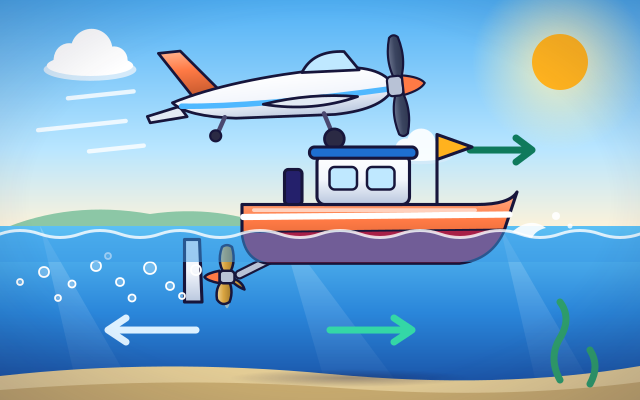
The interactive parts didn't load. The explanations below still work; try reloading the page.
How spinning blades push
- A small plane has a propeller on its nose, and a boat has one under the water at the back. Both are just spinning blades. How can spinning in a circle push something straight ahead?
- Look at one blade from its end. It is not flat to the spin: it is tilted, like a ramp. That tilt is the blade angle, and it does all the work.
- As the tilted blade sweeps round, it shoves the air backward, like a hand sweeping water in a pool. The air pushes back on the blade, so the cart rolls forward.
- Spin the propeller the other way and the tilted blades push the air forward instead. Now the cart rolls backward. That is how boats brake and back up.
- Water is about eight hundred times heavier than air. So a boat's propeller can be small and turn slowly, while a plane's propeller must be big and spin very fast.
- So the rule is simple. The blades spin, the tilted blades push air or water backward, and the plane or boat is pushed forward. More spin means more push.
Look closely at a propeller
Tap each part of the propeller and the motor that turns it.
- Blade. Each blade is shaped like a narrow wing. As it sweeps round, it pushes air or water backward.
- Blade twist. A blade is twisted along its length. Near the middle it is steep, and near the tip it is flatter.
- Blade tip. The tip is the far end of the blade. It travels the biggest circle, so it is the fastest part of the propeller.
- Hub and spinner. The hub is the strong middle that holds the blades and fixes them to the shaft. A smooth cap, the spinner, helps the air slide past.
- Shaft. The shaft is the rod that carries the turning from the motor to the propeller.
- Motor. The motor or engine turns the shaft. The harder it works, the faster the propeller spins and the bigger the push.
Which way does the flow go?
Spin the propeller both ways and change the blade angle. Watch which way the air or water flows, and which way the push points.
Experiment: What happens to the flow if you spin the propeller the other way?
- Slide Spin to the right. Which way do the flow dots move? Which way does the cart go?
- Slide Spin to the left and look again.
- Set the blade angle to flat. What happens to the push?
What we found: Spin one way and the tilted blades push the flow backward, so the push on the cart or boat is forward. Spin the other way and both flip. With flat blades the propeller just slices round and round and pushes nothing.
Turn on JavaScript to try it yourself.
Park at the dock
Drive the boat to the dock and stop inside the striped zone. Boats have no brakes: use reverse spin to stop!
Why tilted blades push
A propeller looks simple: a few blades fixed to a hub. The clever part is the tilt. Each blade is set at an angle, like a ramp. When the propeller spins, the slanted blade sweeps through the air or water and shoves it backward.
Whenever something pushes one way, it gets pushed the other way. You feel this when you push off the wall of a swimming pool. The blades push the fluid backward, so the fluid pushes the blades, and the whole plane or boat, forward.
Flip the spin and the other side of each blade does the pushing. The flow goes forward and the push points backward. Boats use this to slow down, because a boat has no brakes. Flat blades with no tilt would push nothing at all. Blades tilted too steeply just churn the fluid round.
Air is very light, so a plane needs a big propeller turning very fast to move enough of it. Water is about 800 times heavier, so a boat propeller can be small and slow. The fan comparison is close to the truth, with one difference: a fan is held still so the air moves, but a propeller is free, so it moves too.
Key words
- Thrust
- The push along the shaft that a propeller makes by throwing air or water backward.
- Blade angle (pitch)
- How much a blade is tilted.
- Hub
- The middle of a propeller, which holds the blades and joins them to the shaft.
- Torque
- A turning force, like the twist a motor gives to a shaft.
- Stall
- When a blade is tilted so steeply that the flow breaks away from it and the push drops.
- Cavitation
- Bubbles of vapor that form in water around a propeller spinning too fast.
Check your thinking
-
A plane's propeller pushes the plane forward. Which way does it push the air?
Show the answer
Backward. The blades push air backward, and the air pushes the plane forward.
-
A boat is moving forward and its propeller is switched to spin the other way. What happens?
Show the answer
The water is pushed forward, so the boat slows down and then backs up. Reversing the spin reverses the flow, so the push on the boat points backward. That is how boats brake.
-
A propeller has perfectly flat blades with no tilt. What happens when it spins?
Show the answer
It slices round and round but pushes almost nothing. Without tilt, the blade has no slanted face to shove the air or water backward.
-
Why can a boat's propeller be much smaller than a plane's?
Show the answer
Water is much heavier than air, so a small propeller still moves a lot of it. A propeller pushes by moving mass. Water is about 800 times heavier than air, so less of it needs to be moved.
-
Why are propeller blades twisted along their length?
Show the answer
The tip moves faster than the root, so each part needs a different angle to work well. The tip travels a bigger circle in the same time. Twist keeps every section meeting the fluid at a useful angle.
-
Which part of the propeller moves fastest?
Show the answer
The blade tips. The tips travel the biggest circle each turn, so they move fastest.
You're a Flight & transportation expert!
You watched, looked inside, tried it, solved the challenge and went deeper. Pick another question below, or switch the age at the top to see this topic another way.
More about flight & transportation
 #129
Flight & transportation
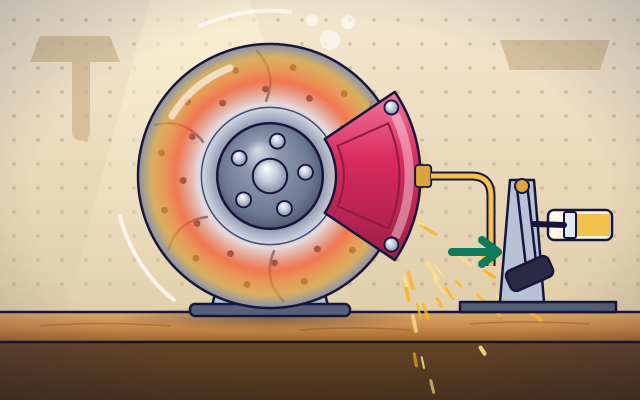
How do disc brakes stop a vehicle?
Press pads against a spinning disc and compare stopping under different simulated conditions.
#129
Flight & transportation
How do disc brakes stop a vehicle?
Press pads against a spinning disc and compare stopping under different simulated conditions.
 #130
Flight & transportation
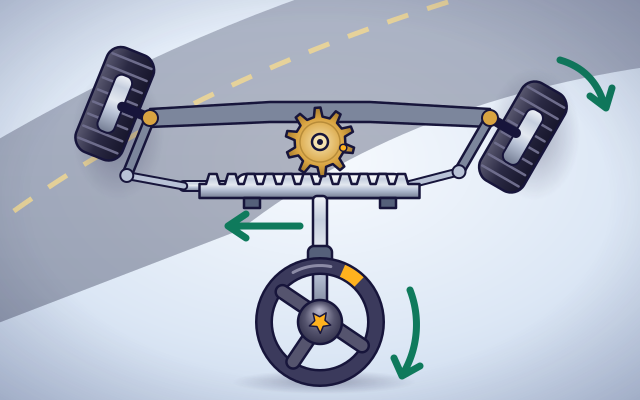
How does a car's steering system work?
Trace steering-wheel movement through a rack, linkages, and the front wheels.
#130
Flight & transportation
How does a car's steering system work?
Trace steering-wheel movement through a rack, linkages, and the front wheels.
 #131
Flight & transportation
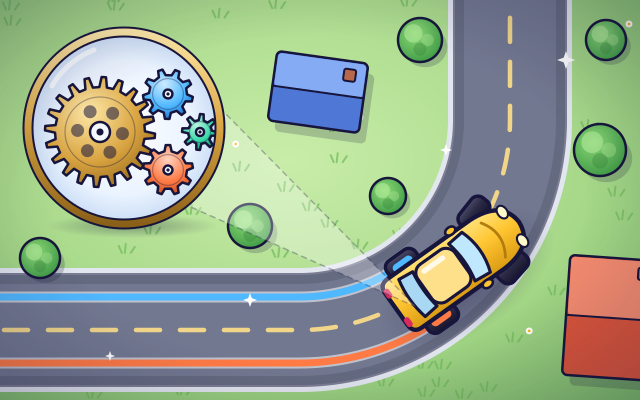
How does a differential help a car turn?
Drive around corners and compare the speeds of the inner and outer wheels.
#131
Flight & transportation
How does a differential help a car turn?
Drive around corners and compare the speeds of the inner and outer wheels.
 #132
Flight & transportation
How do tires grip the road?
Compare tread, road conditions, and tire pressure in a driving and braking simulation.
#132
Flight & transportation
How do tires grip the road?
Compare tread, road conditions, and tire pressure in a driving and braking simulation.
Keep exploring
Games to play next
- Plane Flight SimulatorTake off from the runway and thread numbered sky hoops in order. Every clean flight is a new personal best.
- Downriver Kayak SlalomFind the rhythm of the current, one paddle stroke at a time.
- Machine RepairFix levers, pulleys, gears and ramps so every contraption works.
Guide for grown-ups
- How to start homeschooling: a step-by-step guide for familiesA guide for parents · 7 min read
Science games by grade
Science worksheets by grade
- Preschool Science Worksheets
- Pre-K Science Worksheets
- Kindergarten Science Worksheets
- 1st Grade Science Worksheets
- 2nd Grade Science Worksheets
- 3rd Grade Science Worksheets
- 4th Grade Science Worksheets
- 5th Grade Science Worksheets
- 6th Grade Science Worksheets
- 7th Grade Science Worksheets
- 8th Grade Science Worksheets