How do seeds travel to new places?
Plants can't move, so their seeds do the traveling: on the wind, on water, on animals and by bursting out of pods.
The big idea: Seeds that land right under their parent have to share light, water and space. So plants give their seeds shapes that help them travel: fluff and wings for wind, air-filled husks for water, hooks or tasty fruit for animals, and pods that pop.
It's like
The interactive parts didn't load. The explanations below still work; try reloading the page.
Four ways seeds travel
- If every seed fell straight down, the seedlings would crowd together in the parent's shade and fight over light, water and space. Seeds need to travel.
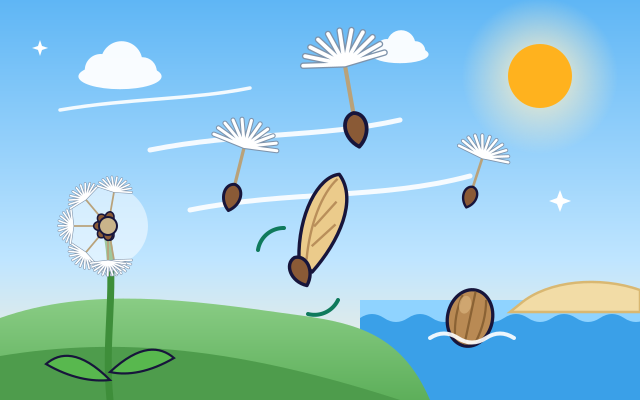
- Some seeds ride the wind. A dandelion seed hangs under a fluffy parachute. A maple seed has a wing that makes it spin, so it falls slowly and the wind carries it farther.
- Some seeds travel by water. A coconut has a thick husk full of air, so it floats. Ocean currents can carry it to a faraway beach, where it sprouts.
- Some seeds hitch a ride. Burrs have tiny hooks that grab fur and drop off later. Other seeds hide inside tasty fruit: animals eat it and leave the seeds somewhere new in their droppings.
- Some plants throw their own seeds. As a pod dries, it pulls tight like a spring. Suddenly it splits and twists, flinging the seeds away.
- When a seed lands somewhere with water, warmth and room, it wakes up. A root grows down, a shoot grows up, and a new plant begins, far from its parent.
Seeds and their travel tricks
Tap each seed to see how its shape helps it travel. Then look inside a seed!
- Fluffy parachute. A dandelion seed hangs below a tuft of fine hairs. The fluff catches the air like a parachute, so the seed falls slowly and drifts far.
- Spinning wing. A maple seed has one papery wing. As it falls, it spins like a helicopter blade, which slows it down and gives the wind more time to carry it.
- Floating husk. A coconut is a giant seed in a thick, stringy husk full of air. It floats like a boat and has a waterproof shell.
- Hooks. A burr is covered with tiny hooks. They catch in fur, feathers or your socks, and the seed rides along until it gets brushed off.
- Tasty fruit. Berries are a snack with seeds hidden inside. A bird eats the fruit, flies off, and later the seeds come out in its droppings, ready to grow.
- Popping pod. As this pod dries, its two halves pull tight. When it splits, they curl up in a flash and flick the seeds away.
- Seed coat. Every seed has a tough outer coat. It protects the baby plant inside from drying out, bumps and bugs during the journey.
- Baby plant and food. Inside the seed is a tiny baby plant, called an embryo, with a store of food. The food feeds it until its first leaves can make their own.
Seed design lab
Design a seed, then test it in wind, in water and on an animal's fur. Which design works for which journey?
Experiment: Which seed design travels farthest on the wind?
- Choose the wind test.
- Try each seed design and watch where it lands.
- Now try the same designs in water and on fur.
What we found: The fluffy parachute wins on the wind, with the spinning wing second. They fall slowly, so the wind has more time to carry them. But fluff is no use in water or on fur: each design fits one kind of journey.
Turn on JavaScript to try it yourself.
Right seed, right journey
Complete four journeys. Read each mission, choose the best seed design, and send it. Fewer wrong tries earn more stars.
How seeds find new homes
A plant is stuck in one place, but its seeds are not. If all the seeds fell right beside the parent, the young plants would have to share the same patch of light, water and soil. Most would not survive. So plants have many clever ways to send their seeds away.
Wind seeds are light and have something to slow their fall. Dandelion seeds have fluffy parachutes. Maple seeds have a wing that spins like a helicopter blade. The slower a seed falls, the longer the wind can carry it.
Water seeds float. A coconut has a thick husk full of air and a waterproof shell, so it can drift across the sea. Animal seeds either stick on, with hooks that grab fur, or get eaten inside tasty fruit and dropped later.
Some plants do the job themselves. Their pods dry out, pull tight, and then burst open, flinging the seeds. No single way is best: each seed's shape fits the journey it is made for. Most seeds never find a good spot, which is why plants make so many.
Key words
- Seed dispersal
- The ways seeds move away from their parent plant.
- Germination
- When a seed wakes up and starts to grow.
- Pappus
- The fluffy parachute of hairs on a dandelion seed.
- Samara
- A winged seed, such as a maple's, that spins as it falls.
- Fall speed
- How quickly something drops through the air.
- Buoyant
- Able to float.
Check your thinking
-
Why is it good for seeds to travel away from the parent plant?
Show the answer
They get their own light, water and space. Seedlings crowded under the parent must share light, water and soil.
-
Why does a dandelion seed travel so far on the wind?
Show the answer
Its fluff makes it fall very slowly. Falling slowly gives the wind more time to carry it.
-
Why does a coconut float?
Show the answer
Its thick husk is full of air. Air trapped in the husk makes the coconut light for its size.
-
How does a burr travel?
Show the answer
Its hooks grab onto animal fur. The hooks catch in fur or clothes and drop off somewhere else.
-
A bird eats a berry. What happens to the seeds?
Show the answer
They come out later in its droppings, somewhere new. The tough seed coat protects the seeds inside the bird, and they are dropped far away.
You're a Plants & ecosystems expert!
You watched, looked inside, tried it, solved the challenge and went deeper. Pick another question below, or switch the age at the top to see this topic another way.
More about plants & ecosystems
 #226
Plants & ecosystems
How does flower pollination work?
Move pollen between flower parts and compare insect and wind pollination.
#226
Plants & ecosystems
How does flower pollination work?
Move pollen between flower parts and compare insect and wind pollination.
 #227
Plants & ecosystems
How does water travel from roots to leaves?
Follow colored water through a transparent plant and explore evaporation from leaves.
#227
Plants & ecosystems
How does water travel from roots to leaves?
Follow colored water through a transparent plant and explore evaporation from leaves.
 #228
Plants & ecosystems
Why do leaves change color in autumn?
Reveal different pigments as the amount of chlorophyll changes through a seasonal timeline.
#228
Plants & ecosystems
Why do leaves change color in autumn?
Reveal different pigments as the amount of chlorophyll changes through a seasonal timeline.
 #229
Plants & ecosystems
How do leaves control water loss?
Open and close virtual stomata while balancing gas exchange and water loss.
#229
Plants & ecosystems
How do leaves control water loss?
Open and close virtual stomata while balancing gas exchange and water loss.
Keep exploring
Games to play next
- Label LabPut the right labels on beautiful science diagrams, from bean plants to heart chambers.
- Classification ExplorerSort living things by what you can see, then follow and build yes-or-no keys.
- Garden AutomationProgram a garden robot with sensor rules — then watch a whole day play out.
Guide for grown-ups
- How to start homeschooling: a step-by-step guide for familiesA guide for parents · 7 min read
Science games by grade
Science worksheets by grade
- Preschool Science Worksheets
- Pre-K Science Worksheets
- Kindergarten Science Worksheets
- 1st Grade Science Worksheets
- 2nd Grade Science Worksheets
- 3rd Grade Science Worksheets
- 4th Grade Science Worksheets
- 5th Grade Science Worksheets
- 6th Grade Science Worksheets
- 7th Grade Science Worksheets
- 8th Grade Science Worksheets