Why do leaves change color in autumn?
Leaves hide yellow and orange under their green all summer. When the green fades in autumn, the hidden colors show.
The big idea: A leaf has several colors in it. Green chlorophyll covers the others. In autumn the tree stops making chlorophyll, so the yellow and orange appear.
It's like a yellow shirt under a green jacket: in autumn the tree takes the green jacket off, and the yellow that was always underneath shows.
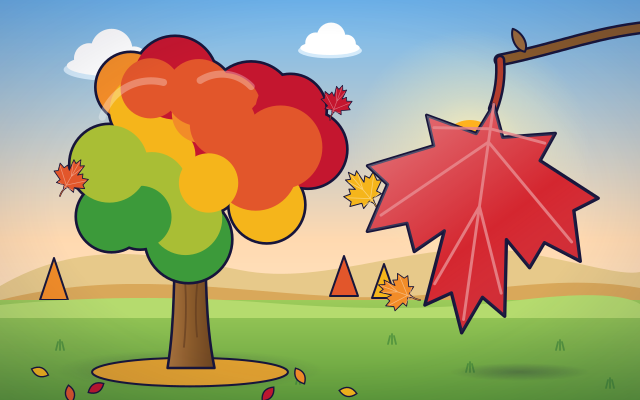
The interactive parts didn't load. The explanations below still work; try reloading the page.
The hidden colors of a leaf
- All summer the leaves are busy. Their green stuff, called chlorophyll, catches sunlight so the tree can make its food.
- Look inside a leaf. There is yellow and orange in there too. But there is so much green that it covers them up.
- In autumn the days grow shorter and the nights cooler. That is the tree's signal to get ready for winter.
- The tree stops making green and takes its useful parts back into the branches. Without the green cover, yellow and orange shine through.
- Some trees, like maples, add a new color. Sugar gets trapped in the leaf, and on sunny days with cool nights it is turned into red.
- A corky layer grows across the leaf's stalk and seals it off. The leaf lets go and floats down. A bud for next spring is already waiting.
Look inside an autumn leaf
Tap each part. Find the three kinds of color and the place where the leaf lets go.
- Chlorophyll (green). Chlorophyll is the green color in leaves. It catches sunlight so the tree can make sugar from air and water.
- Carotenoids (yellow and orange). Carotenoids are yellow and orange colors. They are in the leaf all year, but you only see them when the green is gone.
- Anthocyanins (red). Anthocyanins are red and purple colors. Some trees make them in autumn from sugar that is trapped in the leaf.
- Veins. Veins are the leaf's pipes. In autumn they carry useful materials out of the leaf and back into the tree to be stored.
- Seal at the stalk. At the bottom of the leaf stalk, a corky layer grows. It closes the pipes, and the leaf breaks off cleanly without hurting the tree.
- Next year's bud. Next spring's leaves are already made! They are folded up tight inside this bud, wrapped in scales to keep out the cold.
Reveal the hidden colors
Drag the marker along the timeline from July to November. Watch the three color bars. Then try another tree and other weather.
Experiment: In autumn the green fades and a leaf turns yellow. Where does the yellow come from?
- Start in July. Look at the yellow bar while the leaf is still green.
- Drag the marker to October and watch the green bar drop.
- Did the yellow bar grow, or was it there all along?
What we found: The yellow bar was full all summer. Yellow and orange were always in the leaf, but the green covered them. When the tree stops making green, the hidden colors show. Red is different: maples make it new in autumn, and birches do not make it at all.
Turn on JavaScript to try it yourself.
Photograph a red maple
Take a photo of a bright red leaf. Choose the right tree, the right weather and the right time, then press the camera button.
Why leaves change color in autumn
A green leaf is a tiny food factory. Its green color comes from chlorophyll, which catches sunlight. With that energy the leaf turns air and water into sugar for the whole tree.
Chlorophyll is not the only color in a leaf. There are also yellow and orange colors called carotenoids. They are there all spring and summer, but there is so much green that you cannot see them. It is like wearing a yellow shirt under a green jacket.
In autumn the days get shorter and the nights get colder. Winter is coming, and thin leaves would freeze. So the tree stops making chlorophyll and pulls the useful parts back into its branches to save them. The green fades, and the yellow and orange that were hiding appear.
Some trees, such as maples, also make a new color in autumn: red. Sugar gets trapped in the leaf and is turned into red color, especially when the days are sunny and the nights are cool. At last a corky layer seals the leaf stalk, the leaf falls, and the tree rests until spring. The jacket idea only goes so far: red is not uncovered, it is added.
Key words
- Pigment
- A substance that gives something its color.
- Chlorophyll
- The green pigment that plants use to catch sunlight.
- Carotenoids
- Yellow and orange pigments that are in leaves all year.
- Anthocyanins
- Red and purple pigments that some leaves make in autumn.
- Deciduous
- A tree that drops all its leaves for part of the year.
- Abscission layer
- The layer at the bottom of a leaf stalk where the leaf breaks off.
Check your thinking
-
Where does the yellow in an autumn leaf come from?
Show the answer
It was in the leaf all summer, hidden by the green. The yellow is always there. In autumn the green fades, so the yellow shows.
-
What tells a tree that it is time to change its leaves?
Show the answer
Shorter days and cooler nights. Trees sense that the nights are getting longer and colder. That is their sign that winter is coming.
-
A birch and a maple stand side by side. The birch turns yellow and the maple turns red. Why?
Show the answer
The maple makes a new red color in autumn, and the birch does not. Both show their hidden yellow. Only the maple also turns trapped sugar into red.
-
Why does the tree take the green apart before the leaf falls?
Show the answer
To save the useful materials for next year. The green holds valuable materials. The tree stores them in its branches and uses them to grow new leaves in spring.
-
How does a leaf come off the tree?
Show the answer
A corky layer seals the stalk and the leaf breaks off. The seal closes the leaf's pipes and makes a weak line, so the leaf drops off cleanly.
You're a Plants & ecosystems expert!
You watched, looked inside, tried it, solved the challenge and went deeper. Pick another question below, or switch the age at the top to see this topic another way.
More about plants & ecosystems
 #229
Plants & ecosystems
How do leaves control water loss?
Open and close virtual stomata while balancing gas exchange and water loss.
#229
Plants & ecosystems
How do leaves control water loss?
Open and close virtual stomata while balancing gas exchange and water loss.
 #230
Plants & ecosystems
How do carnivorous plants catch insects?
Compare snap, pitcher, and sticky traps and trace the nutrients obtained.
#230
Plants & ecosystems
How do carnivorous plants catch insects?
Compare snap, pitcher, and sticky traps and trace the nutrients obtained.
 #231
Plants & ecosystems
How do climbing plants hold on?
Guide tendrils, twining stems, and clinging roots around different supports.
#231
Plants & ecosystems
How do climbing plants hold on?
Guide tendrils, twining stems, and clinging roots around different supports.
 #232
Plants & ecosystems
How do plants grow toward light?
Move a light source and use a time slider to observe directional growth.
#232
Plants & ecosystems
How do plants grow toward light?
Move a light source and use a time slider to observe directional growth.
Keep exploring
Games to play next
- Habitat Builder 3DFind the right home for frogs, camels, polar bears and more.
- Classification ExplorerSort living things by what you can see, then follow and build yes-or-no keys.
- Label LabPut the right labels on beautiful science diagrams, from bean plants to heart chambers.
Draw it or make it
- How to draw a tree with branchesDrawing lesson
- Torn-Paper Tree CollagePaper craft
Guide for grown-ups
- How to start homeschooling: a step-by-step guide for familiesA guide for parents · 7 min read
Science games by grade
Science worksheets by grade
- Preschool Science Worksheets
- Pre-K Science Worksheets
- Kindergarten Science Worksheets
- 1st Grade Science Worksheets
- 2nd Grade Science Worksheets
- 3rd Grade Science Worksheets
- 4th Grade Science Worksheets
- 5th Grade Science Worksheets
- 6th Grade Science Worksheets
- 7th Grade Science Worksheets
- 8th Grade Science Worksheets