How do leaves control water loss?
Leaves are covered in tiny pores that open and close. Open pores let in the air a plant needs, but they also let water escape.
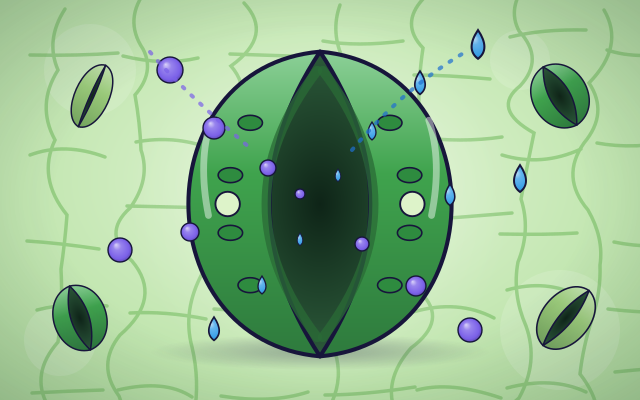
The big idea: Each pore has two guard cells. When they fill with water they bend apart and the pore opens. The plant opens them to feed and closes them to save water.
It's like opening a window on a cold day: fresh air comes in, but warmth escapes, so you open it just as much as you need.
The interactive parts didn't load. The explanations below still work; try reloading the page.
How a leaf breathes
- Under a strong magnifier, the underside of a leaf is dotted with tiny pores. A single leaf can have many thousands of them.
- Each pore sits between two bean-shaped cells called guard cells. Together they work like a pair of lips that can open and close.
- In the light, water flows into the guard cells. They swell up and bend apart, like two long balloons, and the pore between them opens.
- Through the open pore, the gas carbon dioxide drifts in. The leaf uses it to make sugar. At the same time, oxygen and water vapor drift out.
- On a hot, dry day the plant loses water too fast. The guard cells let water out, go limp and close the pore. That saves water, but stops the food making.
- So all day, the plant balances: open to eat, closed to save water. At night there is no light for making food, so most plants close their pores.
A slice through a leaf
This is a thin slice of a leaf seen from the side. Tap each layer to see what it does.
- Waxy coat. The cuticle is a thin, waxy coat over the whole leaf. It is waterproof, so water cannot dry out through the skin.
- Skin of the leaf. The epidermis is the leaf's skin, a single layer of clear cells on the top and bottom. Light passes straight through it.
- Food-making cells. Just under the top skin are tall cells packed with green chloroplasts. This is where most of the leaf's sugar is made.
- Air spaces. The lower part of the leaf is spongy, with air spaces between the cells. Gases can drift through them to and from every cell.
- Guard cells. Two guard cells surround each pore. Swollen with water, they bend apart and open it. When they go limp, it closes.
- Pore. The pore is the opening itself. Carbon dioxide comes in through it, and oxygen and water vapor go out.
- Vein. Veins bring water up from the roots and carry sugar away. The water that escapes through the pores is replaced from here.
Open wide or save water?
Drag the guard cells apart or use the slider. Watch the food bar and the water bar. Then change the weather.
Experiment: It is a hot, dry day. What happens if the pores stay wide open?
- Open the pore all the way in hot, dry weather. Watch the water bar and the little plant.
- Close the pore completely. What happens to the food bar?
- Find an opening in between. Then try cool, damp weather.
What we found: Wide open pores let in lots of carbon dioxide, so the plant makes plenty of food. But on a hot, dry day water pours out and the plant wilts. Closed pores save the water, but then no food is made. The plant has to find the best opening in between, and it changes with the weather.
Turn on JavaScript to try it yourself.
One day as a leaf
You control the pores for one whole day. Make enough sugar by evening, but do not let the water run out.
How leaves control their water
A plant makes its own food from sunlight, water and a gas in the air called carbon dioxide. To get that gas, a leaf needs openings. But a leaf is also full of water, and water escapes through any opening. That is the plant's problem.
The answer is the stoma, a pore that can open and close. Most leaves have thousands of them, mainly on the underside. The rest of the leaf is sealed with a waxy, waterproof coat.
Each pore lies between two guard cells shaped like beans. When they fill with water they swell. Their walls are thicker on the inside edge, so they cannot swell evenly. They bend apart instead, and the pore opens. When the guard cells lose water they go limp, straighten, and the pore closes.
In the morning light the pores open, carbon dioxide comes in and the leaf makes sugar. If the day turns hot and dry, the plant loses water faster than its roots can supply it, so the pores narrow or close. At night there is no light to make food, so most plants keep them shut. A window is a fair picture of a stoma, with one difference: nobody opens it. The guard cells do it themselves.
Key words
- Stoma
- A tiny pore in a leaf that can open and close. Two or more are called stomata.
- Guard cells
- The two cells around a pore that open and close it.
- Carbon dioxide
- A gas in the air that plants need to make food.
- Transpiration
- The loss of water vapor from a plant, mostly through its stomata.
- Turgor
- The firmness of a plant cell that is full of water.
- Water-use efficiency
- How much food a plant makes for each bit of water it loses.
Check your thinking
-
Why does a leaf need to open its pores?
Show the answer
To let in carbon dioxide for making food. The leaf needs carbon dioxide from the air to make sugar, and the pores are the only way in.
-
What do the pores of most plants do on a very hot, dry afternoon?
Show the answer
They close up to save water. When water is escaping faster than the roots can replace it, the guard cells go limp and the pores close.
-
What makes a pore open?
Show the answer
The guard cells fill with water and bend apart. Swollen guard cells are firm and curved, which pulls the pore open. Limp ones close it.
-
Why do most plants close their pores at night?
Show the answer
Without light they cannot make food, so open pores would only waste water. In the dark the leaf cannot use carbon dioxide, so there is nothing to gain from open pores.
-
Where on a leaf are most of the pores, and why?
Show the answer
Underneath, in the shade, where less water is lost. The underside is cooler and out of the direct sun, so open pores lose less water there.
You're a Plants & ecosystems expert!
You watched, looked inside, tried it, solved the challenge and went deeper. Pick another question below, or switch the age at the top to see this topic another way.
More about plants & ecosystems
 #230
Plants & ecosystems
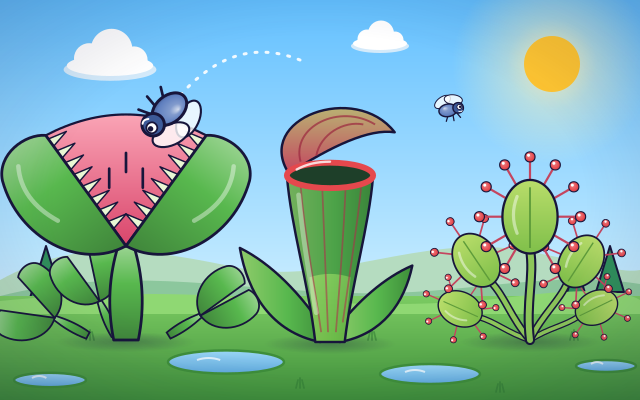
How do carnivorous plants catch insects?
Compare snap, pitcher, and sticky traps and trace the nutrients obtained.
#230
Plants & ecosystems
How do carnivorous plants catch insects?
Compare snap, pitcher, and sticky traps and trace the nutrients obtained.
 #231
Plants & ecosystems
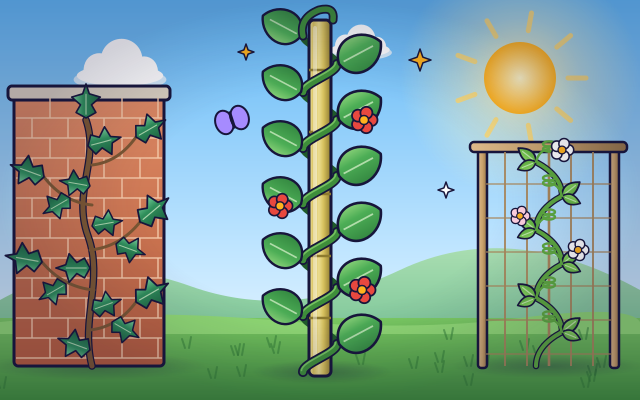
How do climbing plants hold on?
Guide tendrils, twining stems, and clinging roots around different supports.
#231
Plants & ecosystems
How do climbing plants hold on?
Guide tendrils, twining stems, and clinging roots around different supports.
 #232
Plants & ecosystems
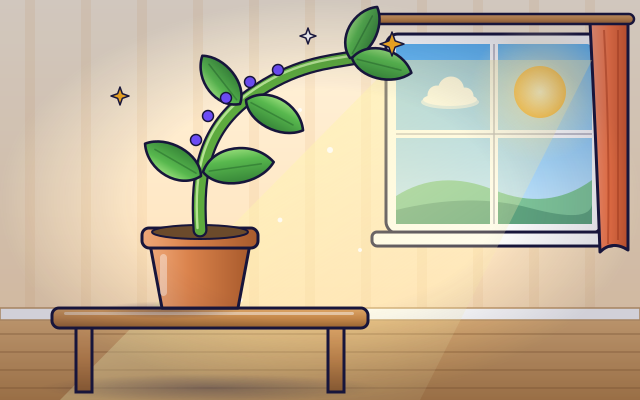
How do plants grow toward light?
Move a light source and use a time slider to observe directional growth.
#232
Plants & ecosystems
How do plants grow toward light?
Move a light source and use a time slider to observe directional growth.
 #233
Plants & ecosystems
How do mangroves survive in salty, muddy places?
Explore specialized roots and adaptations for salt, unstable ground, and limited soil oxygen.
#233
Plants & ecosystems
How do mangroves survive in salty, muddy places?
Explore specialized roots and adaptations for salt, unstable ground, and limited soil oxygen.
Keep exploring
Games to play next
- Label LabPut the right labels on beautiful science diagrams, from bean plants to heart chambers.
- River MysterySomething changed the river. Sample sites with a limited budget, follow the evidence and find where the change begins.
- Garden AutomationProgram a garden robot with sensor rules — then watch a whole day play out.
Guide for grown-ups
- How to start homeschooling: a step-by-step guide for familiesA guide for parents · 7 min read
Science games by grade
Science worksheets by grade
- Preschool Science Worksheets
- Pre-K Science Worksheets
- Kindergarten Science Worksheets
- 1st Grade Science Worksheets
- 2nd Grade Science Worksheets
- 3rd Grade Science Worksheets
- 4th Grade Science Worksheets
- 5th Grade Science Worksheets
- 6th Grade Science Worksheets
- 7th Grade Science Worksheets
- 8th Grade Science Worksheets