How do springs store and release energy?
A spring keeps the energy you put in when you squash or stretch it, then gives it back as movement.
The big idea: A spring always tries to return to its own shape. Squash or stretch it and it stores your push as energy. Let go and that energy becomes movement.
It's like a trampoline: the deeper you sink into it, the harder it pushes back, and the higher you bounce.
The interactive parts didn't load. The explanations below still work; try reloading the page.
The push inside a spring
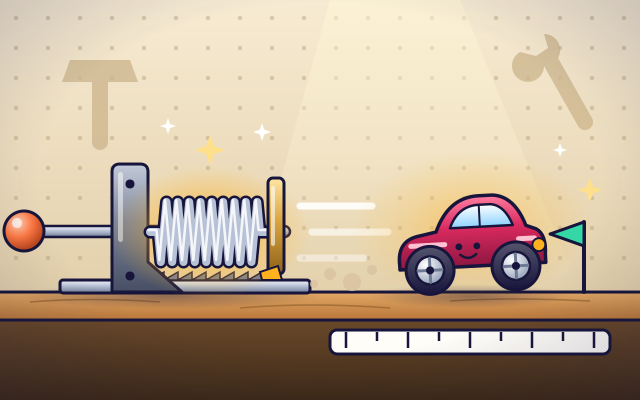
- This toy launcher has a spring inside. Pull the knob back, let go, and the car zooms away. But nobody pushed it. So where did the push come from?
- A spring is springy wire wound into loops. It has one shape it always returns to. Squash it shorter or stretch it longer, and it springs straight back.
- When you squash a spring, it pushes back on you. A small squash gives a small push. A big squash gives a big push, because the spring is farther from its own shape.
- A catch holds the spring squashed. The work your hand did has not gone away. It is stored inside the spring as energy, waiting to be used.
- Let go, and the spring snaps back to its own shape. It shoves the car as it goes, so the stored energy turns into movement energy in the car.
- Now compare two launches. A small squash stores a little energy, so the car rolls a short way. A big squash stores much more energy, so the car rolls much farther.
Look inside a spring launcher
Tap each part of the launcher. Watch it move when you find it!
- Coils. The spring is one long wire wound into loops called coils. The gaps between the coils close up when you squash it and open wider when you stretch it.
- Springy steel wire. The wire is made of a special hard steel. You can bend it a little and it springs right back, again and again, without staying bent.
- Fixed end. One end of the spring is held still by a strong bracket. The spring needs something solid to push against, or it could not push the car.
- Push plate. The push plate sits on the free end of the spring. When the spring snaps back, the plate passes the push on to the car.
- Rod and knob. A rod runs through the middle of the spring to a knob. Pulling the knob squashes the spring, and the rod keeps the spring straight.
- Catch. Little teeth and a catch hold the spring squashed. The energy stays stored in the spring until the catch lets go.
- Toy car. The car is what the spring pushes. It takes the spring's stored energy and turns it into movement, rolling until rubbing slows it down.
Squash, stretch and launch
Drag the car back a little, let go, and see how far it rolls. Then pull it back a lot. You can squash the spring or stretch it.
Experiment: If you squash the spring twice as far, how much farther will the car roll?
- Set the squash to 4 cm and let go. See where the flag lands.
- Now set the squash to 8 cm and let go.
- Compare the two flags and the two distances.
What we found: Twice the squash sends the car about four times as far! A bigger squash means the spring pushes harder, and it also pushes for longer. Both add energy, so the stored energy grows very quickly.
Turn on JavaScript to try it yourself.
Stop in the green zone
Launch the car so its nose stops inside the green zone. Not too short, not too far!
How a spring keeps your push
A spring is made of a special steel wire that does not like to be bent out of shape. Squash it and it pushes outward. Stretch it and it pulls inward. Either way, it is trying to get back to its own length, called its rest length.
The farther you move a spring from its rest length, the harder it pushes or pulls. That is why the first little squash is easy and the last bit is hard work. Your muscles are doing work, and the spring keeps that work as stored energy.
When you let go, the spring gives the energy back as movement. It can throw a toy car, pop up a toaster, bounce a pogo stick or push a pen tip back inside. A bigger squash stores much more energy, because the spring pushes harder and pushes over a longer distance.
Springs are not perfect. If you stretch one far too much, the wire stays bent and the spring is spoiled. And our comparison with a trampoline is not exact: on a trampoline you also push with your legs, which adds extra energy on every bounce.
Key words
- Rest length
- The length of a spring when nothing is squashing or stretching it.
- Elastic
- Able to go back to its own shape after being squashed or stretched.
- Stored energy
- Energy that is waiting inside something, ready to be used.
- Stiffness
- How hard a spring is to squash or stretch.
- Hooke's law
- The force from a spring is proportional to its change in length: F = kx.
Check your thinking
-
What does a spring always try to do?
Show the answer
Go back to its own shape. Squashed or stretched, a spring pushes or pulls back toward its rest length.
-
You want the car to roll farther. What should you do?
Show the answer
Squash the spring more before letting go. More squash stores more energy in the spring, so the car gets more movement energy.
-
The catch is holding the spring squashed. Where is the energy from your push?
Show the answer
Stored inside the squashed spring. Energy does not vanish. It waits in the spring until the catch lets go.
-
A spring compressed by 3 cm stores 0.1 joules. About how much does it store when compressed by 6 cm?
Show the answer
0.4 joules. E = ½kx², so doubling x gives 2² = 4 times the energy.
-
What happens if you stretch a spring far, far too much?
Show the answer
It stays bent and stops working properly. Every spring has a limit. Past it, the wire bends for good and cannot spring back.
-
Two springs are compressed by the same distance. One is twice as stiff. How do their stored energies compare?
Show the answer
The stiffer one stores twice as much. E = ½kx². Energy is proportional to k, so twice the stiffness gives twice the energy at the same x.
You're a Forces & mechanisms expert!
You watched, looked inside, tried it, solved the challenge and went deeper. Pick another question below, or switch the age at the top to see this topic another way.
More about forces & mechanisms
 #112
Forces & mechanisms
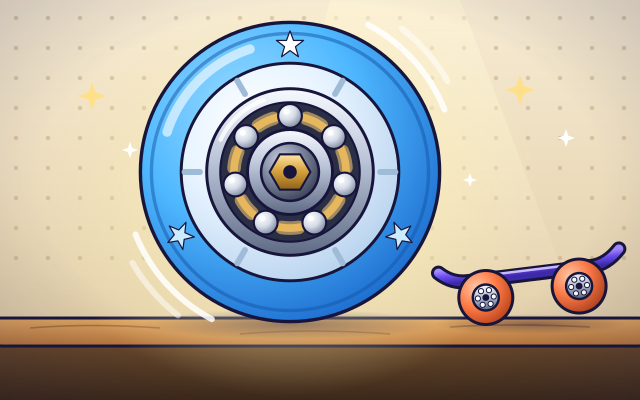
How do ball bearings help wheels turn smoothly?
Compare sliding surfaces with rolling bearings while moving the same load.
#112
Forces & mechanisms
How do ball bearings help wheels turn smoothly?
Compare sliding surfaces with rolling bearings while moving the same load.
 #113
Forces & mechanisms
How do flywheels keep machines running smoothly?
Add a flywheel to a jerky mechanism and observe changes in rotational speed.
#113
Forces & mechanisms
How do flywheels keep machines running smoothly?
Add a flywheel to a jerky mechanism and observe changes in rotational speed.
 #114
Forces & mechanisms
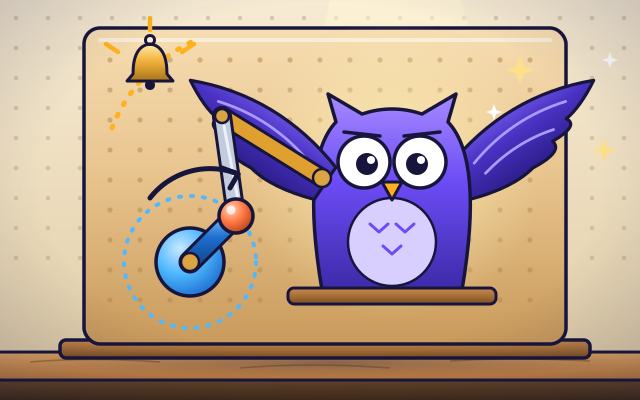
How do mechanical linkages transfer movement?
Connect pivoting bars and change their lengths to create different movements.
#114
Forces & mechanisms
How do mechanical linkages transfer movement?
Connect pivoting bars and change their lengths to create different movements.
 #115
Forces & mechanisms
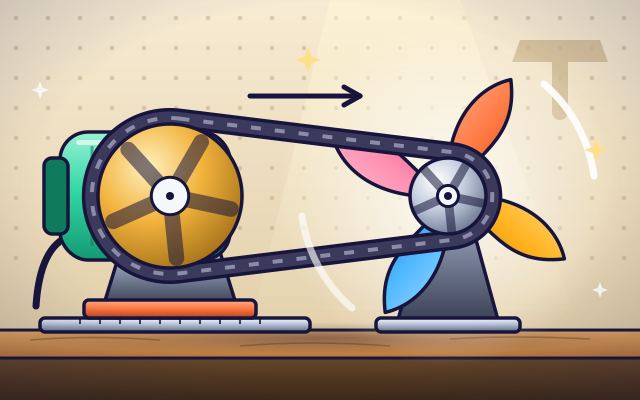
How do belts transfer power between wheels?
Link rotating wheels with belts and investigate speed changes, tension, and slipping.
#115
Forces & mechanisms
How do belts transfer power between wheels?
Link rotating wheels with belts and investigate speed changes, tension, and slipping.
Keep exploring
Games to play next
- Machine RepairFix levers, pulleys, gears and ramps so every contraption works.
- Marble MountainLay straights, curves, drops and splitters to roll marbles down the mountain.
- Bridge LabBuild a bridge from beams, brace it with triangles, and stay on budget.
Guide for grown-ups
- How to start homeschooling: a step-by-step guide for familiesA guide for parents · 7 min read
Science games by grade
Science worksheets by grade
- Preschool Science Worksheets
- Pre-K Science Worksheets
- Kindergarten Science Worksheets
- 1st Grade Science Worksheets
- 2nd Grade Science Worksheets
- 3rd Grade Science Worksheets
- 4th Grade Science Worksheets
- 5th Grade Science Worksheets
- 6th Grade Science Worksheets
- 7th Grade Science Worksheets
- 8th Grade Science Worksheets