How is tofu made?
Soybeans are soaked, ground and cooked into soy milk. Then the milk is curdled and the curds are pressed into a block.
The big idea: Tofu is made a lot like cheese. Soybeans become soy milk, a little mineral salt makes the milk's protein clump into curds, and pressing squeezes water out so the curds join into a firm block.
It's like squeezing a wet sponge: the harder you press, the more water runs out and the firmer it gets. Tofu curds are pressed the same way.
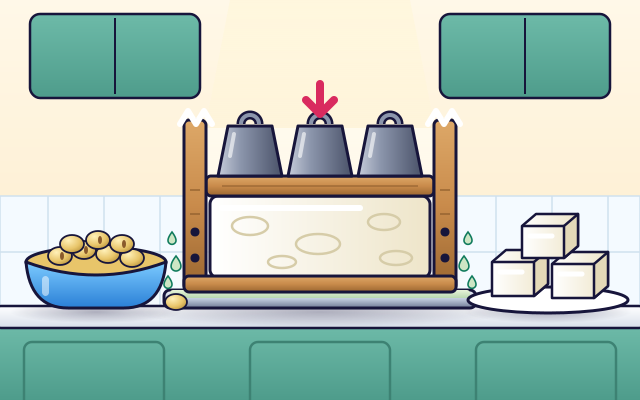
The interactive parts didn't load. The explanations below still work; try reloading the page.
From soybean to tofu
- Tofu is made from soybeans. They grow in fuzzy pods on a leafy plant. When the pods dry out, the beans inside are small, hard and yellow.
- First the hard beans are soaked in water overnight. They soak up water and swell to about twice their size, which makes them soft enough to grind.
- Next the soft beans are ground up with fresh water. The grinder smashes them into a thick, creamy mush called slurry.
- The slurry is boiled, which makes it safe and takes away the raw bean taste. Then it is poured through a cloth. Smooth soy milk runs through and the pulp stays behind.
- A little mineral salt, called a coagulant, is stirred into the hot soy milk. The protein clumps into soft white curds, leaving a clear yellowish liquid called whey.
- The curds are scooped into a cloth-lined box with holes. A weight presses down, water drains out, and the curds join into one block. More pressing makes firmer tofu.
The six steps of tofu making
Step through the tofu workshop. Each step changes the beans a little more.
- 1. Soak the beans. Dry soybeans are covered with water and left overnight. They swell to about double their size and turn soft.
- 2. Grind with water. The soaked beans are ground with fresh water into a thick, creamy slurry.
- 3. Cook the slurry. The slurry is boiled for several minutes. Cooking makes soy safe to eat and removes the raw, beany taste.
- 4. Strain out the pulp. The cooked slurry is poured through a cloth. Soy milk runs through, and the bean pulp, called okara, stays behind.
- 5. Curdle the soy milk. A coagulant is stirred gently into the hot soy milk. The protein clumps into white curds that float in clear, yellowish whey.
- 6. Press the curds. The curds are scooped into a cloth-lined box with holes and pressed under a weight. Water drains away and the curds join into a block.
Curdle and press
Add the coagulant to the hot soy milk and watch curds form. Then put weights on the press, one at a time. What happens to the block?
Experiment: What happens to the block of curds when you add more weight to the press?
- Tap the coagulant cup and watch the soy milk curdle.
- Tap one weight to put it on the press. Watch the holes at the bottom.
- Add the other weights. Tap the block to see how much it wobbles.
What we found: Each weight squeezes more water out through the holes. The block gets thinner, firmer and less wobbly. That is the difference between soft tofu and extra firm tofu.
Turn on JavaScript to try it yourself.
Tofu to order
Three cooks want different tofu: soft, extra firm and firm. Press each block to its dotted line, then serve it.
Why soy milk turns into tofu
A dry soybean is a tightly packed seed. It holds a lot of protein, some oil and tough fiber. To make tofu, you have to get the protein out of the bean and into water. That is what the first steps are for. Soaking softens the bean. Grinding smashes it open. Cooking makes it safe and tasty. Straining takes out the fiber. What is left is soy milk: water full of tiny bits of protein and oil.
In soy milk the bits of protein push each other away, a little like magnets held the wrong way round. So they stay spread out and the milk stays runny. A coagulant changes that. It is a mineral salt, and when it is stirred in, the proteins stop pushing apart. They stick together in soft white clumps called curds. The clear, yellowish liquid left over is called whey.
Fresh curds are full of water, like a soaked sponge. They are scooped into a box lined with cloth, and a weight is set on top. Water drains out through the holes and the curds squash together into one block. A little pressing gives soft tofu. A lot of pressing gives firm tofu that you can slice and fry.
People have made tofu this way for about two thousand years, first in China. The sponge comparison helps with pressing, but it is not perfect: a squeezed sponge springs back and soaks up water again, while pressed curds join together and stay firm.
Key words
- Soy milk
- The smooth liquid made by grinding soaked soybeans with water, cooking and straining.
- Okara
- The bean pulp, mostly fiber, left in the cloth when soy milk is strained.
- Coagulant
- Something that makes a liquid clump into curds. For tofu it is a mineral salt.
- Curds
- The soft white clumps of protein that form when soy milk or milk curdles.
- Whey
- The thin liquid left over when curds form.
- Protein
- A body-building part of food. Soybeans have a lot of it.
Check your thinking
-
Which food is tofu made from?
Show the answer
Soybeans. Soybeans are turned into soy milk, and soy milk is turned into tofu.
-
You want extra firm tofu instead of soft tofu. What should you change?
Show the answer
Press the curds harder or for longer. More pressing squeezes out more water, and tofu with less water is firmer.
-
Why are the dry beans soaked before they are ground?
Show the answer
Soaking makes them soft, so they grind into fine bits. Dry soybeans are very hard. After a night in water they are soft and swollen, and they grind up smoothly.
-
What does the coagulant do to hot soy milk?
Show the answer
It makes the protein clump into curds. The mineral salt makes the bits of protein stick together into white curds, leaving thin whey.
-
A maker presses two batches made from the same curds. Batch A is pressed lightly, batch B heavily. How do the blocks compare?
Show the answer
B is smaller and firmer, with the same amount of protein. Pressing removes water, not protein. The same solids end up in a smaller block with a lower water content, which is firmer.
-
When soy milk is strained through a cloth, what stays behind in the cloth?
Show the answer
The bean pulp, called okara. The cloth lets the liquid soy milk through and holds back the bits of bean fiber.
You're a Food & farming expert!
You watched, looked inside, tried it, solved the challenge and went deeper. Pick another question below, or switch the age at the top to see this topic another way.
More about food & farming
 #279
Food & farming
How is fruit juice made?
Run fruit through sorting, washing, crushing, pressing, and packaging.
#279
Food & farming
How is fruit juice made?
Run fruit through sorting, washing, crushing, pressing, and packaging.
 #280
Food & farming
How is olive oil made?
Follow olives through cleaning, crushing, mixing, and separation into oil and other material.
#280
Food & farming
How is olive oil made?
Follow olives through cleaning, crushing, mixing, and separation into oil and other material.
 #281
Food & farming
How is sugar made from plants?
Extract juice from cane or beets and explore purification, concentration, and crystallization.
#281
Food & farming
How is sugar made from plants?
Extract juice from cane or beets and explore purification, concentration, and crystallization.
 #282
Food & farming
How is maple syrup made?
Collect virtual sap and follow filtering and evaporation as it becomes concentrated.
#282
Food & farming
How is maple syrup made?
Collect virtual sap and follow filtering and evaporation as it becomes concentrated.
Keep exploring
Games to play next
- Ratio KitchenScale recipes, fill ratio tables and find the better buy.
- Garden AutomationProgram a garden robot with sensor rules — then watch a whole day play out.
- Label LabPut the right labels on beautiful science diagrams, from bean plants to heart chambers.
Guide for grown-ups
- How to start homeschooling: a step-by-step guide for familiesA guide for parents · 7 min read
Science games by grade
Science worksheets by grade
- Preschool Science Worksheets
- Pre-K Science Worksheets
- Kindergarten Science Worksheets
- 1st Grade Science Worksheets
- 2nd Grade Science Worksheets
- 3rd Grade Science Worksheets
- 4th Grade Science Worksheets
- 5th Grade Science Worksheets
- 6th Grade Science Worksheets
- 7th Grade Science Worksheets
- 8th Grade Science Worksheets