How do traffic lights manage busy roads?
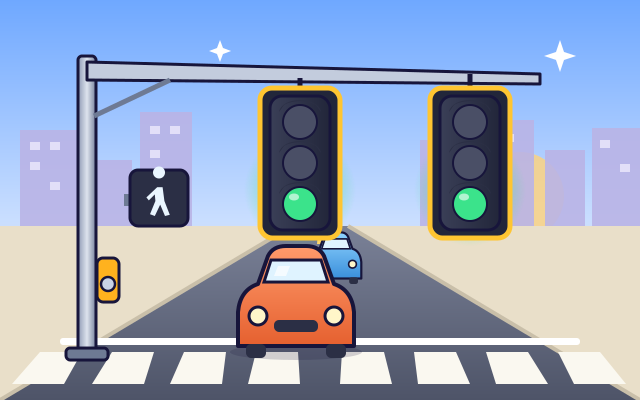
Traffic lights share a busy crossing in turns, sense waiting cars and make time for people to walk across.
The big idea: Two roads can't use the same crossing at the same moment. Traffic lights share it in turns: each road gets a green, and people get a safe time to walk.
It's like
The interactive parts didn't load. The explanations below still work; try reloading the page.
How a crossroads takes turns
- Where two busy roads cross, cars from different directions all want the same space in the middle. Without a plan, nobody knows who should go first.
- Every traffic light speaks the same simple language. Green means go if the way is clear, yellow means the light is about to turn red, and red means stop.
- The lights give one road a green while the other road waits at red. Then they switch. The waiting cars form a line, called a queue, until their turn comes.
- How does the light know a car is waiting? A loop of wire under the road senses the metal car and tells the controller box, which can change the lights sooner.
- People need a turn too. Pressing the button asks for a walk signal. The cars get red, the walking person lights up, and then a flashing hand warns that time is almost up.
- On long streets the lights can work as a team. Each one turns green just as the cars arrive from the last one, so they roll through many lights without stopping. This is a green wave.
The parts of a traffic signal
Tap each part of the street corner. Watch what each one does when you find it!
- Signal head. The signal head holds the red, yellow and green lights. Red is always on top, so even people who can't tell red from green know which light is on.
- LED lamps. Each colored light is made of many small LEDs. They are very bright, use little electricity and last for years.
- Controller cabinet. The metal box at the corner holds the controller, a small computer that runs the timing plan and switches the lights. It also checks for mistakes.
- Loop detector. A loop of wire is buried in a thin cut in the road. When a car stops over it, the loop senses the metal and tells the controller that someone is waiting.
- Video or radar detector. Some intersections use a camera or radar on the pole to notice waiting cars instead of a loop. It works like an extra pair of eyes for the controller.
- Push button. Pressing the button tells the controller that a person wants to cross. Many buttons beep or vibrate to help people who can't see well.
- Walk signal. The walking person means start crossing. A flashing hand means don't start, but finish crossing if you already began. Some signals count down the seconds left.
- Stop line and crosswalk. The thick white stop line shows drivers where to wait. The striped crosswalk is the safe path for people crossing the road.
Share the green
Give each road a green time. The busy road has lots of cars. Watch the lines of waiting cars grow and shrink.
Experiment: What happens if you give the busy road a much longer green light?
- Start with the busy road's green short (10 seconds).
- Now make the busy road's green long (60 seconds).
- Watch both lines of cars and read the line meters.
What we found: Green time is shared. If the busy road's green is too short, more cars arrive than can leave and its line keeps growing. Give it lots of green and its line clears, but now the quiet road waits through a long red and its line grows. The best timing gives each road enough green for its cars.
Turn on JavaScript to try it yourself.
Rush hour!
Program the lights for rush hour. Keep every line from reaching the edge of town, and give walkers enough time to cross safely.
How engineers time traffic lights
A crossroads is a place where two roads share the same space. Cars going across and cars going up and down would bump into each other if they all went at once. Traffic lights solve this by taking turns: one road gets a green light while the other road waits at red.
While a road waits at red, the cars that arrive form a line called a queue. When the light turns green, the queue drives away, about one car every two seconds in each lane. If a road's green is too short, more cars arrive than can leave, and the queue keeps growing.
That's why engineers count cars. A busy road gets more green time and a quiet road gets less. Sensors such as loops of wire under the road tell the controller when cars are waiting, so it doesn't waste green time on an empty road.
Safety comes first. The yellow light gives drivers time to stop, and a short all-red moment lets the last car clear the middle before the other road goes. Walkers press a button to get their own turn, with enough time to reach the other side.
Key words
- Phase
- One turn of the lights, such as green for the busy road.
- Cycle
- One full round of turns, until the lights start over.
- Queue
- The line of cars waiting at a red light.
- Loop detector
- A loop of wire in the road that senses a car on top of it.
- All-red
- A short moment when every car light is red, so the middle can empty.
- Green wave
- Signals along a street timed so a group of cars meets green after green.
Check your thinking
-
What does a yellow light tell drivers?
Show the answer
The light is about to turn red. Yellow warns drivers that red is coming, so they can stop safely if they can.
-
How does a traffic light know a car is waiting on a quiet road?
Show the answer
A loop of wire in the road senses the car. The loop senses the car's metal body and tells the controller.
-
If the busy road's green is much too short, what happens?
Show the answer
Its line of cars keeps growing. More cars arrive during each red than can leave during each green.
-
Why is there a moment when all the car lights are red?
Show the answer
So the last car can clear the middle before the other road goes. The all-red moment keeps cars from different roads out of the middle at the same time.
-
A green wave lets cars...
Show the answer
Roll through many lights without stopping. Each light turns green just as the cars arrive from the last one.
You're a Buildings & city systems expert!
You watched, looked inside, tried it, solved the challenge and went deeper. Pick another question below, or switch the age at the top to see this topic another way.
More about buildings & city systems
 #65
Buildings & city systems
How does a recycling center sort materials?
Send materials along a conveyor and explore magnets, screens, and sorting equipment. Follow selected paper, metal, and plastic items into processing.
#65
Buildings & city systems
How does a recycling center sort materials?
Send materials along a conveyor and explore magnets, screens, and sorting equipment. Follow selected paper, metal, and plastic items into processing.
 #66
Buildings & city systems
How do construction cranes lift heavy things?
Explore the boom, cables, pulleys, and counterweights. Move virtual loads while investigating how their position affects the crane's balance.
#66
Buildings & city systems
How do construction cranes lift heavy things?
Explore the boom, cables, pulleys, and counterweights. Move virtual loads while investigating how their position affects the crane's balance.
 #67
Buildings & city systems
How are tunnels built underground?
Look inside a tunnel-boring machine and follow excavation, soil removal, and tunnel lining. Guide construction around underground obstacles in a model city.
#67
Buildings & city systems
How are tunnels built underground?
Look inside a tunnel-boring machine and follow excavation, soil removal, and tunnel lining. Guide construction around underground obstacles in a model city.
 #68
Buildings & city systems
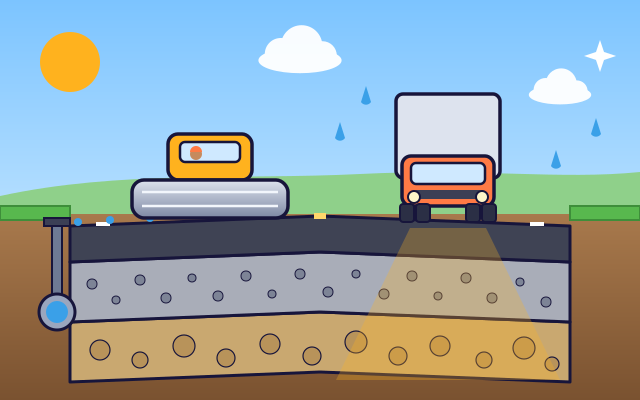
How are roads built?
Build a layered model road, compact the surface, and add drainage. Explore how traffic, water, and temperature contribute to wear and potholes.
#68
Buildings & city systems
How are roads built?
Build a layered model road, compact the surface, and add drainage. Explore how traffic, water, and temperature contribute to wear and potholes.
Keep exploring
Games to play next
- City Driving AdventureExplore the city behind the wheel, park safely and collect roadside deliveries.
- Route PlannerFind the shortest way around town, dodge closed roads, and measure trips with a scale bar.
- Plane Flight SimulatorTake off from the runway and thread numbered sky hoops in order. Every clean flight is a new personal best.
Guide for grown-ups
- How to start homeschooling: a step-by-step guide for familiesA guide for parents · 7 min read
Science games by grade
Science worksheets by grade
- Preschool Science Worksheets
- Pre-K Science Worksheets
- Kindergarten Science Worksheets
- 1st Grade Science Worksheets
- 2nd Grade Science Worksheets
- 3rd Grade Science Worksheets
- 4th Grade Science Worksheets
- 5th Grade Science Worksheets
- 6th Grade Science Worksheets
- 7th Grade Science Worksheets
- 8th Grade Science Worksheets