How do parachutes slow a fall?
A parachute catches a huge amount of air. The air pushes back and slows the fall to a gentle float.
The big idea: Anything that falls has to push air out of the way, and the air pushes back. A wide parachute catches so much air that the push becomes as big as the weight, and the fall turns slow and steady.
It's like dropping a flat sheet of paper and a crumpled one. They weigh the same, but the flat sheet catches more air, so it drifts down slowly.

The interactive parts didn't load. The explanations below still work; try reloading the page.
How a parachute slows a fall
- A drone drops a test box with no parachute. Gravity pulls it down faster and faster, and it hits the ground with a thump. How could we slow it down?
- As the box falls it has to shove air out of its way, and the air pushes back. This push is called air resistance. A small box only catches a little air, so the push is weak.
- The parachute opens. Its wide canopy catches a huge amount of air, so the push from the air suddenly becomes much bigger and the box slows down.
- As the box slows, the push from the air gets smaller, until it exactly matches the weight. Then the box stops slowing and floats down at a steady speed.
- Trapped air has to escape somewhere. Without a hole it spills out from under one edge, then another, and the parachute swings. A small vent in the top lets air out smoothly.
- The box touches down gently. A bigger parachute means a slower fall, and a heavier box needs a bigger parachute to land just as softly.
The parts of a parachute
Tap each part of this cargo parachute to see what it does.
- Canopy. The canopy is the big fabric dome. It is made of light, strong nylon and catches the air to slow the fall.
- Trapped air. Air piles up under the canopy as it falls. This squashed-up air pushes up on the fabric and holds the canopy open.
- Vent. The vent is a small hole at the very top. It lets some trapped air escape smoothly, so the parachute does not swing from side to side.
- Suspension lines. Many thin, strong lines run from the edge of the canopy down to the load. They share the pull evenly so the canopy keeps its shape.
- Risers. The lines are gathered into a few wide straps called risers. The risers connect to the harness around the load.
- Cargo. The load hangs underneath. A heavier load pulls down harder, so it needs a bigger canopy to come down at the same gentle speed.
- Pilot chute. This tiny parachute opens first. It catches the air and pulls the big canopy out of its bag, so the big one opens neatly.
Parachute drop test
Choose a canopy size and a cargo mass, then press Drop. Your last drop falls beside the new one so you can compare them.
Experiment: You drop the same box twice, the second time with a much bigger parachute. What happens?
- Drop the box with a small parachute. Watch how it lands.
- Make the parachute much bigger and drop it again. The first drop falls beside it.
- Now make the cargo heavier. What happens to the landing?
What we found: A bigger parachute catches more air, so the air's push matches the weight at a lower speed. The box falls slowly and lands softly. A heavier box falls faster under the same parachute, so it needs a bigger one.
Turn on JavaScript to try it yourself.
Hit the target in the wind
The wind blows the parachute sideways as it falls. Choose a canopy and move the drone so the box lands softly on the target.
Catching the air
Air may look like nothing, but it is real stuff. When something falls, it has to push the air out of its way, and the air pushes back. This push is called air resistance, or drag. You can feel it on your hand when you hold it out of a moving car's window with a grown-up.
Two things make air resistance bigger: moving faster, and having a bigger surface to catch the air. A falling box is small, so the air barely slows it. A parachute spreads a huge sheet of fabric above the box. Now there is a great deal of air to push out of the way, and the air pushes back hard.
At first the box speeds up. But the faster it goes, the harder the air pushes. Soon the push of the air is exactly as big as the pull of gravity. From then on the box does not speed up or slow down. It drifts down at one steady speed, slow enough for a soft landing.
A flat sheet of paper and a crumpled one show the same idea, but real parachutes need more care. They have a vent so they do not swing, many lines to share the pull, and a size chosen for the load. A heavier load needs a bigger parachute.
Key words
- Air resistance (drag)
- The push of the air against anything moving through it.
- Terminal velocity
- The steady speed a falling thing reaches when the air's push equals its weight.
- Canopy
- The fabric dome of a parachute.
- Vent
- A hole in the top of the canopy that lets air out smoothly and stops the parachute from swinging.
- Drift
- How far the wind carries something sideways while it falls.
Check your thinking
-
What slows a parachute as it falls?
Show the answer
The air pushing up on the big canopy. The canopy has to push a lot of air out of the way, and that air pushes back.
-
You swap a small parachute for a much bigger one. What happens to the fall?
Show the answer
It gets slower. A bigger canopy catches more air, so the air's push matches the weight at a lower speed.
-
A heavier box uses the same parachute. How does it fall?
Show the answer
Faster, because it needs a bigger push from the air to match its weight. The air only pushes harder when the box moves faster, so a heavier box must fall faster before the forces match.
-
Why does the same parachute fall much faster on Mars than on Earth?
Show the answer
The air on Mars is far thinner, so there is much less drag at any speed. Drag is proportional to air density. Mars's air is about a hundred times thinner, so a much higher speed is needed before drag equals weight, even though gravity there is weaker.
-
What is the small hole in the top of a round parachute for?
Show the answer
It lets air out smoothly so the parachute does not swing. Without a vent, air spills out from under the edges and rocks the parachute from side to side.
You're a Flight & transportation expert!
You watched, looked inside, tried it, solved the challenge and went deeper. Pick another question below, or switch the age at the top to see this topic another way.
More about flight & transportation
 #124
Flight & transportation
How do hot-air balloons rise and descend?
Heat or cool the balloon's air and observe changes in lift and height.
#124
Flight & transportation
How do hot-air balloons rise and descend?
Heat or cool the balloon's air and observe changes in lift and height.
 #125
Flight & transportation
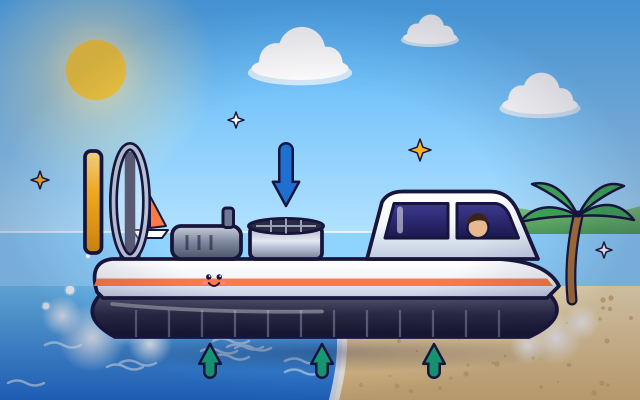
How do hovercraft travel over land and water?
Follow air into the cushion beneath a hovercraft and steer across different surfaces.
#125
Flight & transportation
How do hovercraft travel over land and water?
Follow air into the cushion beneath a hovercraft and steer across different surfaces.
 #126
Flight & transportation
How do sailboats use the wind?
Adjust sail angle and rudder position to navigate with winds from different directions.
#126
Flight & transportation
How do sailboats use the wind?
Adjust sail angle and rudder position to navigate with winds from different directions.
 #127
Flight & transportation
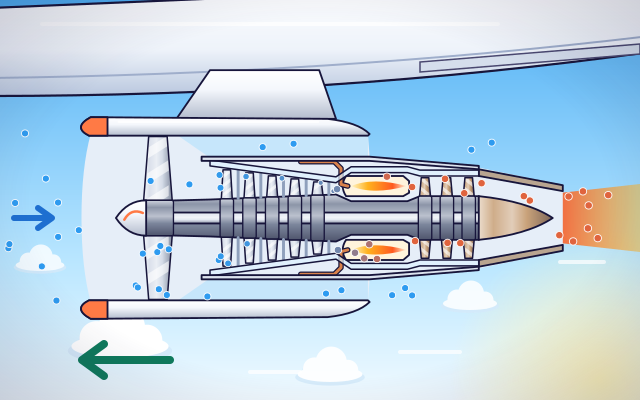
How do jet engines produce thrust?
Follow air through compression, heating, and expansion inside a transparent engine.
#127
Flight & transportation
How do jet engines produce thrust?
Follow air through compression, heating, and expansion inside a transparent engine.
Keep exploring
Games to play next
- Plane Flight SimulatorTake off from the runway and thread numbered sky hoops in order. Every clean flight is a new personal best.
- Machine RepairFix levers, pulleys, gears and ramps so every contraption works.
- Timetable TerminalRead the departure board, count the minutes and catch your connection on time.
Guide for grown-ups
- How to start homeschooling: a step-by-step guide for familiesA guide for parents · 7 min read
Science games by grade
Science worksheets by grade
- Preschool Science Worksheets
- Pre-K Science Worksheets
- Kindergarten Science Worksheets
- 1st Grade Science Worksheets
- 2nd Grade Science Worksheets
- 3rd Grade Science Worksheets
- 4th Grade Science Worksheets
- 5th Grade Science Worksheets
- 6th Grade Science Worksheets
- 7th Grade Science Worksheets
- 8th Grade Science Worksheets