How do centrifuges separate samples?
A centrifuge spins tubes so fast that the heavier parts of a mixture are pushed to the outside and settle into layers.
The big idea: Things that spin try to fly outward. In a spinning tube, the heaviest bits push their way to the outer end first, so a mixture separates into layers.
It's like a playground roundabout: the faster it turns, the harder you feel pushed toward the outside edge. In a tube, the heavy bits get there first.
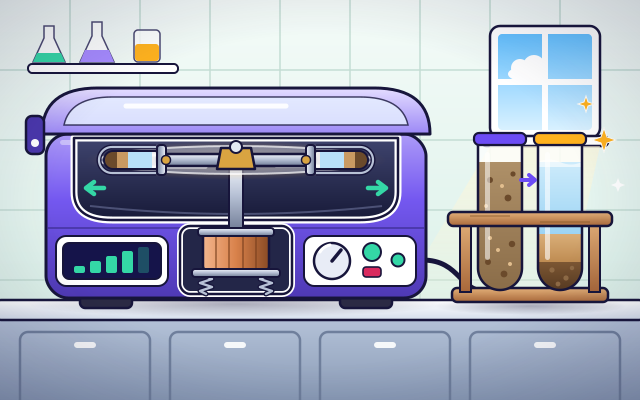
The interactive parts didn't load. The explanations below still work; try reloading the page.
Spinning a mixture apart
- This tube holds muddy pond water. Sand, fine clay and water are all mixed together. How can we pull them apart?
- If the tube just stands still, gravity pulls the heavy sand down quite quickly. But the tiny clay bits sink so slowly that it takes hours.
- So we put the tube in a centrifuge and close the lid. A motor spins it thousands of times a minute, and the tube holders swing out sideways.
- Spinning pushes everything toward the outer end of the tube. The big, heavy sand grains win the race. The fine clay follows, and clear water is left near the middle.
- One tube on its own makes the rotor heavier on one side, so it wobbles. A matching tube straight across balances it, and it spins smoothly.
- After a few minutes the rotor stops. The mixture has become neat layers: sand at the bottom, clay above it and clear water on top.
Look inside a centrifuge
Tap each part of the centrifuge. Every one moves when you find it!
- Lid. The strong lid covers the spinning rotor. It keeps fingers out and keeps everything inside if a tube leaks.
- Lid lock. The lock holds the lid shut. The motor will not start until it is locked, and the lid will not open until the rotor has stopped.
- Rotor. The rotor is the spinning part in the middle. It carries the tubes around in a circle, thousands of times each minute.
- Swing buckets. Each tube sits in a bucket on a hinge. When the rotor spins, the buckets swing out sideways, so the bottom of each tube points outward.
- Sample tubes. The tubes hold the mixture. They are loaded in matching pairs, straight across from each other, so the rotor stays balanced.
- Motor. An electric motor under the rotor turns a shaft. The shaft spins the rotor up to speed and then slows it down again.
- Springy mounts. The motor sits on springy mounts. They soak up small wobbles so the machine does not shake or walk across the bench.
- Control panel. On the panel you set the speed and the time. The screen shows how fast the rotor is turning.
Load it, balance it, spin it
Tap the holes to balance the rotor, choose a speed and press Spin. Watch the close-up tube. What does spinning faster do?
Experiment: The run always lasts 5 minutes. What happens to the sample if you spin it faster?
- Tap the hole straight across from the sample to add a matching tube.
- Set the speed to Slow, press Spin and look at the close-up tube when it stops.
- Press Shake it up again, set the speed to Fast and spin once more.
What we found: A slow spin only settles the big sand grains. A fast spin pushes much harder, so even the tiny bits reach the outer end and the sample ends in neat layers.
Turn on JavaScript to try it yourself.
Balance every load
Load 2 tubes, then 3, then 4. Each time, place them so the rotor is balanced and spin it.
Why spinning sorts a mixture
Have you ever been on a playground roundabout that was spinning fast? You feel pushed toward the outside edge. Really, your body is trying to keep going in a straight line, and the roundabout keeps pulling you around the bend. Everything inside a spinning tube feels the same thing.
In a mixture, the heavy bits push outward harder than the liquid around them, so they sink toward the outer end of the tube. Light things, like oil or cream, are squeezed the other way, toward the middle. Big, dense bits such as sand move fast. Tiny bits such as clay move slowly, because the water drags on them.
Gravity would do the same job if you waited long enough, but a centrifuge can push hundreds or thousands of times harder than gravity. A job that takes hours in a jar takes minutes in a rotor. Spinning twice as fast pushes four times as hard.
Centrifuges are everywhere. Hospital labs spin blood to separate the red cells from the pale yellow liquid called plasma. Dairies spin milk to take off the cream. A washing machine's spin cycle and a salad spinner use the same idea to fling water out. The tubes must always be balanced, or the machine shakes itself and stops.
Key words
- Centrifuge
- A machine that spins tubes very fast to separate a mixture.
- Mixture
- Two or more things mixed together that can be separated again, like sand in water.
- Density
- How heavy something is for its size. A stone is denser than a cork.
- Rotor
- The spinning part of a centrifuge that carries the tubes.
- Relative centrifugal force (RCF)
- How many times stronger than gravity the outward push is.
- Pellet
- The packed layer of solid bits that collects at the outer end of a tube.
Check your thinking
-
When a tube of muddy water spins, where do the heaviest bits end up?
Show the answer
At the outer end of the tube. Spinning pushes everything outward. The heavy bits push hardest, so they reach the outer end first.
-
You have one sample tube to spin. What should you do first?
Show the answer
Put a tube of the same weight straight across from it. A matching tube on the opposite side balances the rotor, so it does not wobble.
-
Why does a centrifuge separate muddy water faster than just waiting?
Show the answer
It pushes the bits much harder than gravity does. Spinning gives an outward push that can be hundreds of times stronger than gravity, so the bits settle in minutes.
-
Salad dressing is spun in a centrifuge. Oil is lighter than vinegar. Where does the oil go?
Show the answer
To the end nearest the middle. The heavier vinegar pushes outward and squeezes the lighter oil toward the middle.
-
Three tubes of equal mass must be spun in a rotor with six holes. How can they be balanced?
Show the answer
Space them evenly, with one empty hole between each. Three equal masses 120 degrees apart cancel each other, so the center of mass stays on the axis.
-
Why will a centrifuge not let you open the lid while it is spinning?
Show the answer
The rotor is moving very fast, so the lock keeps hands safely out. A spinning rotor has lots of energy. The lock stays shut until it has stopped completely.
You're a Measuring & instruments expert!
You watched, looked inside, tried it, solved the challenge and went deeper. Pick another question below, or switch the age at the top to see this topic another way.
More about measuring & instruments
 #397
Measuring & instruments
How do digital scales measure weight?
Place objects on a scale and follow sensor changes into a displayed measurement.
#397
Measuring & instruments
How do digital scales measure weight?
Place objects on a scale and follow sensor changes into a displayed measurement.
 #400
Measuring & instruments
How does radar locate distant objects?
Send radio pulses and use returning signals to estimate object positions.
#400
Measuring & instruments
How does radar locate distant objects?
Send radio pulses and use returning signals to estimate object positions.
 #476
Measuring & instruments
How do atomic clocks keep accurate time?
Use an atomic transition frequency to regulate a model clock and compare drift.
#476
Measuring & instruments
How do atomic clocks keep accurate time?
Use an atomic transition frequency to regulate a model clock and compare drift.
 #479
Measuring & instruments
How does a magnetic compass find north?
Rotate a compass in a model magnetic field and compare its direction with a map.
#479
Measuring & instruments
How does a magnetic compass find north?
Rotate a compass in a model magnetic field and compare its direction with a map.
Keep exploring
Games to play next
- Clock TowerKeep the town on time: set the tower clock's hands just right.
- Mapmaker QuestFollow directions to make a map, then read its legend, compass rose and scale.
- Data DetectiveRead the clues hidden in graphs — and build your own.
Guide for grown-ups
- How to start homeschooling: a step-by-step guide for familiesA guide for parents · 7 min read
Science games by grade
Science worksheets by grade
- Preschool Science Worksheets
- Pre-K Science Worksheets
- Kindergarten Science Worksheets
- 1st Grade Science Worksheets
- 2nd Grade Science Worksheets
- 3rd Grade Science Worksheets
- 4th Grade Science Worksheets
- 5th Grade Science Worksheets
- 6th Grade Science Worksheets
- 7th Grade Science Worksheets
- 8th Grade Science Worksheets