How do digital scales measure weight?
Inside a digital scale, a metal beam bends a tiny bit under the load. A sensor feels the bend and a chip turns it into a number.
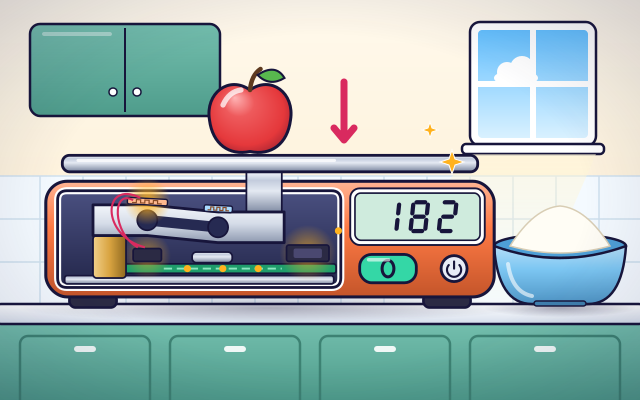
The big idea: The weight bends a metal beam. A thin zig-zag wire glued to the beam stretches, electricity finds it harder to pass, and a chip turns that change into grams.
It's like a diving board: a heavier diver bends it further down. A scale measures how far its little board bends.
The interactive parts didn't load. The explanations below still work; try reloading the page.
From a push to a number
- An apple goes on the kitchen scale, and in a blink the screen shows its weight in grams. How does a flat little box know that?
- Inside, the plate rests on one end of a metal beam. The other end is fixed. The apple's weight pushes down and bends the beam a tiny bit.
- Glued to the beam is a strain gauge: a very thin metal wire in a zig-zag. When the beam bends, the wire is stretched longer and thinner.
- A battery sends electricity through the wire. The stretched wire is harder to get through, so the electric signal changes a tiny bit. An amplifier makes that change bigger.
- A tiny computer chip measures the signal many times a second. It knows how much signal one gram makes, so it works out the grams and shows them.
- Put a bowl on, and the scale shows the bowl's weight. Press Tare and it goes back to zero. Now it shows only what you add.
Look inside a kitchen scale
Tap each part of the scale. Watch what it does when something is weighed.
- Platform. The flat plate you put things on. It is fixed to the free end of the beam, so every push on the plate reaches the beam.
- Load cell. A small metal beam, fixed at one end. Weight on the plate bends it a tiny bit, and it springs straight again when the weight is lifted off.
- Strain gauge. A very thin zig-zag of metal glued to the beam. When the beam bends, the zig-zag stretches, and electricity finds it harder to pass.
- Amplifier. The signal from the gauge is very tiny. The amplifier makes it many times bigger so the chip can measure it.
- Chip. A tiny computer that measures the signal, works out how many grams it means and tells the screen what to show.
- Display. The screen shows the weight. Each digit is made of seven little bars that switch on and off.
- Tare button. Press it and the scale calls whatever is on the plate zero. Then it shows only what you add next.
- Battery. A small battery pushes electricity through the gauge and powers the chip and the screen.
Follow the push to the number
Tap things to put them on the scale. Watch the beam, the signal and the number. Try the Tare button too.
Experiment: One apple is on the scale. You add a second apple just like it. What happens?
- Tap one apple onto the scale. Look at the beam and the number.
- Tap the second apple on as well.
- Take everything off, put the bowl on, press Tare and add an apple.
What we found: Twice the weight bends the beam twice as far, stretches the gauge twice as much and doubles the signal, so the number doubles too. The scale really measures the bend.
Turn on JavaScript to try it yourself.
Weigh out the flour
Weigh out the amount of flour on the recipe card into the bowl, then press Check.
How a scale turns a push into a number
When you put an apple on a kitchen scale, gravity pulls the apple down and the apple pushes on the plate. Under the plate is a short metal beam, called a load cell. One end is fixed to the base and the plate sits on the other end, so the push bends the beam, a bit like a tiny diving board.
The bend is far too small to see, less than the thickness of a hair for a light object. So the scale uses a clever sensor called a strain gauge: a very thin metal wire, folded into a zig-zag and glued to the beam. When the beam bends, the wire is stretched a little longer and thinner. Electricity finds a long, thin wire harder to get through.
A battery pushes electricity through the gauge all the time. When the wire stretches, the electric signal changes by a tiny amount. An amplifier makes the change bigger, and a small computer chip measures it. The factory taught the chip how much signal one gram makes, so it can work out the grams and light up the right bars on the screen.
The tare button is a handy trick. Put an empty bowl on the scale and press it, and the chip remembers the bowl's signal and calls it zero. Everything you add after that is counted on its own. Bathroom scales, luggage scales and the scales at a shop checkout all work in this same way.
Key words
- Load cell
- The metal beam inside a scale that bends a tiny bit under the weight.
- Strain gauge
- A thin zig-zag wire that changes how well it carries electricity when it is stretched.
- Tare
- To set the scale to zero with a container on it, so only what you add is weighed.
- Calibration
- Teaching the scale how much signal a known weight makes.
- Resolution
- The smallest step the scale can show, such as 1 gram.
Check your thinking
-
What does the weight do to the metal beam inside a digital scale?
Show the answer
It bends the beam a tiny bit. The plate sits on the end of the beam, so weight on the plate bends the beam.
-
You swap an egg on the scale for a much heavier bag of sugar. What happens to the strain gauge?
Show the answer
It stretches more, so the signal is bigger. More weight bends the beam further, which stretches the gauge more and makes a bigger signal.
-
A bowl is on the scale and you press Tare. What does the display show, and why?
Show the answer
Zero, because the chip now subtracts the bowl. Tare tells the chip to call the present signal zero, so only what you add next is counted.
-
Why does a scale need an amplifier?
Show the answer
The signal from the gauge is far too tiny to measure as it is. The stretch changes the electric signal only a tiny bit. The amplifier makes it big enough for the chip.
-
An astronaut takes a kitchen scale, calibrated on Earth, to the Moon. What does it show for a 600 gram bag?
Show the answer
About 100 grams, because the scale senses force and the Moon's gravity is about one sixth. The mass is unchanged, but the bag's weight, the force on the load cell, is about one sixth as large.
You're a Measuring & instruments expert!
You watched, looked inside, tried it, solved the challenge and went deeper. Pick another question below, or switch the age at the top to see this topic another way.
More about measuring & instruments
 #400
Measuring & instruments
How does radar locate distant objects?
Send radio pulses and use returning signals to estimate object positions.
#400
Measuring & instruments
How does radar locate distant objects?
Send radio pulses and use returning signals to estimate object positions.
 #476
Measuring & instruments
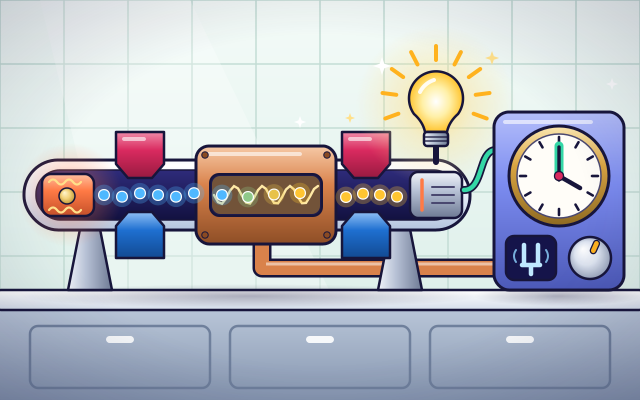
How do atomic clocks keep accurate time?
Use an atomic transition frequency to regulate a model clock and compare drift.
#476
Measuring & instruments
How do atomic clocks keep accurate time?
Use an atomic transition frequency to regulate a model clock and compare drift.
 #479
Measuring & instruments
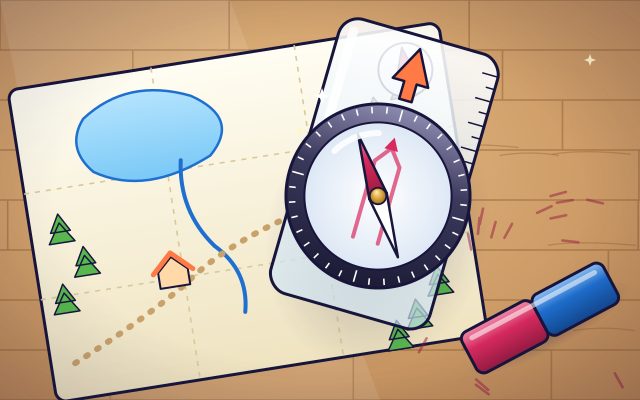
How does a magnetic compass find north?
Rotate a compass in a model magnetic field and compare its direction with a map.
#479
Measuring & instruments
How does a magnetic compass find north?
Rotate a compass in a model magnetic field and compare its direction with a map.
 #480
Measuring & instruments
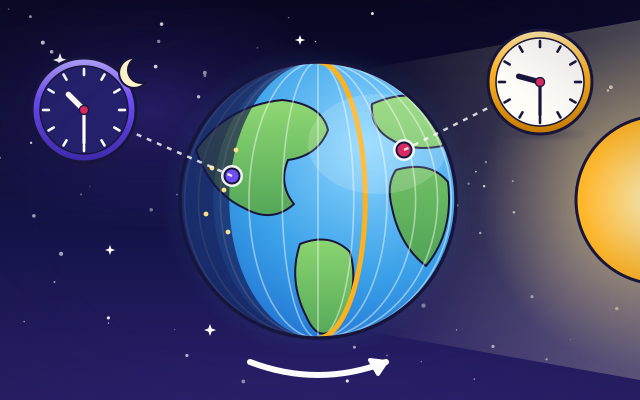
How do time zones work?
Compare local clock readings around a globe and explore coordinated standard times.
#480
Measuring & instruments
How do time zones work?
Compare local clock readings around a globe and explore coordinated standard times.
Keep exploring
Games to play next
- Algebra BalanceKeep the scale level and the equation true, step by step.
- Data DetectiveRead the clues hidden in graphs — and build your own.
- Clock TowerKeep the town on time: set the tower clock's hands just right.
Guide for grown-ups
- How to start homeschooling: a step-by-step guide for familiesA guide for parents · 7 min read
Science games by grade
Science worksheets by grade
- Preschool Science Worksheets
- Pre-K Science Worksheets
- Kindergarten Science Worksheets
- 1st Grade Science Worksheets
- 2nd Grade Science Worksheets
- 3rd Grade Science Worksheets
- 4th Grade Science Worksheets
- 5th Grade Science Worksheets
- 6th Grade Science Worksheets
- 7th Grade Science Worksheets
- 8th Grade Science Worksheets