How does radar locate distant objects?
Radar sends out pulses of radio waves and listens for the echoes. The time an echo takes tells how far away something is, even in fog or at night.
The big idea: Radio waves travel out, bounce off an object and return. A long wait means the object is far away. The way the antenna is pointing tells you the direction.
It's like shouting hello across a valley and counting until the echo returns. The longer you count, the farther away the cliff is.

The interactive parts didn't load. The explanations below still work; try reloading the page.
Seeing with echoes
- Thick cloud hides a plane from the airport. Eyes and cameras cannot see through it. But a spinning antenna on the ground knows just where the plane is.
- The dish sends out a very short burst of radio waves, called a pulse. The waves race away through the cloud faster than anything else can travel.
- When the waves reach the plane, they bounce off its metal skin. A tiny part of them travels straight back to the dish. That is the echo.
- The radar times each echo. A near plane answers quickly and a far plane answers later. Because the waves always travel at the same speed, the time tells the distance.
- The dish turns slowly, sending pulses in every direction. Whichever way it is pointing when an echo returns is the direction of the plane.
- A computer draws each echo as a glowing dot, called a blip, on a round screen with the radar in the middle. Farther from the middle means farther away.
Look inside a radar station
Tap each part of the radar station to see its job.
- Transmitter. The transmitter makes a very short, very strong burst of radio waves, again and again.
- Feed horn. A small horn in front of the dish. The waves pour out of it onto the dish, and returning echoes are collected into it.
- Dish. The curved dish works like the shiny bowl in a flashlight. It gathers the waves into a narrow beam, and it catches the faint echo.
- Turning mount. A motor turns the dish steadily, so the beam sweeps all the way around. A sensor reports which way the dish is pointing.
- Receiver. The echo is unbelievably faint when it gets back. The receiver picks it up and makes it much stronger.
- Timer and computer. A very fast clock times each echo. The computer turns the time into a distance and remembers the direction.
- Radar screen. The screen is a map with the radar in the middle. Each echo becomes a blip in the right direction, at the right distance.
Send pulses, catch echoes
Tap the sea, or drag the beam, to aim. Send pulses and watch for echoes. Which boat's echo takes longest to return?
Experiment: Two boats are hidden in the fog. The echo from one comes back sooner than the echo from the other. Which boat is farther away?
- Tap the sea in different places until an echo comes back.
- Find a second boat. Compare the two echo times.
- Switch on Spin the antenna and watch the screen fill in.
What we found: The waves always travel at the same speed, so a slower echo means a longer trip. The boat with the slow echo is the one that is farther away.
Turn on JavaScript to try it yourself.
Rescue in the fog
Three boats are hidden. Use the radar screen to find the one nearest the island, and tap its place on the foggy sea to send help.
How echoes make a map
If you shout across a valley, your voice travels to the far side, bounces off the cliff and comes back as an echo. The farther away the cliff is, the longer you wait. Radar does the same thing, but instead of sound it uses radio waves, the same kind of invisible waves that carry radio and television.
A radar's dish sends out a very short burst of radio waves, called a pulse, in a narrow beam. Then it goes quiet and listens. If the pulse meets something solid, such as a plane, a ship or even heavy rain, a little of it bounces back. A very accurate clock measures how long the echo took.
Radio waves travel at the speed of light, which is so fast that a pulse can go around the whole Earth seven times in one second. Because the speed never changes, the time tells the distance exactly. And because the dish is turning, the radar knows which way it was pointing when the echo came back. Distance and direction together give the place.
A computer draws all the echoes on a round screen as glowing dots called blips, with the radar in the middle. Radar lets airports guide planes through cloud, ships avoid each other at night, and weather forecasters watch rain coming. It works in fog and darkness, because radio waves do not need light.
Key words
- Radio waves
- Invisible waves that travel as fast as light and can pass through cloud and fog.
- Pulse
- A very short burst of radio waves sent out by a radar.
- Echo
- The small part of a pulse that bounces off an object and returns.
- Range
- How far away something is.
- Bearing
- The direction to something, like a point on a compass.
- Blip
- The glowing dot a radar screen draws for an echo.
Check your thinking
-
What does a radar send out and then listen for?
Show the answer
Pulses of radio waves and their echoes. Radar sends short pulses of radio waves and listens for the part that bounces back.
-
One echo returns quickly and another returns later. What does that tell the radar?
Show the answer
The later echo came from something farther away. The waves always travel at the same speed, so a longer wait means a longer trip.
-
Why does the radar's dish keep turning?
Show the answer
To send pulses in every direction and learn which way each echo comes from. The beam is narrow, so the dish must sweep around. The way it is pointing when an echo returns is the direction of the object.
-
Why can radar find a plane inside thick cloud when a camera cannot?
Show the answer
Radio waves pass through cloud, but light does not. Cloud blocks light, but radio waves go through it almost as if it were not there.
-
A target moves to twice its original range. How does the strength of its echo change?
Show the answer
It falls to one sixteenth. The pulse spreads on the way out and the echo spreads on the way back, so echo power falls with the fourth power of range: 2 × 2 × 2 × 2 = 16.
You're a Measuring & instruments expert!
You watched, looked inside, tried it, solved the challenge and went deeper. Pick another question below, or switch the age at the top to see this topic another way.
More about measuring & instruments
 #476
Measuring & instruments
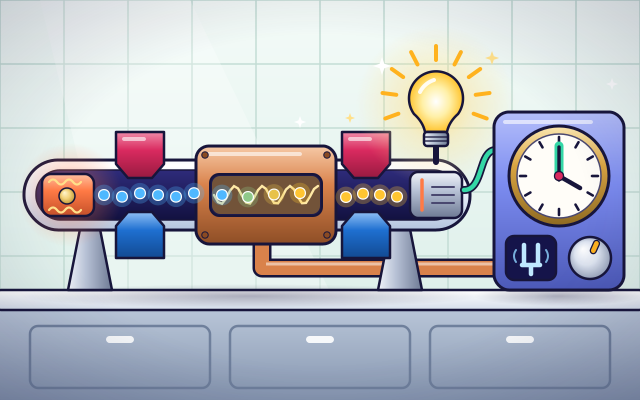
How do atomic clocks keep accurate time?
Use an atomic transition frequency to regulate a model clock and compare drift.
#476
Measuring & instruments
How do atomic clocks keep accurate time?
Use an atomic transition frequency to regulate a model clock and compare drift.
 #479
Measuring & instruments
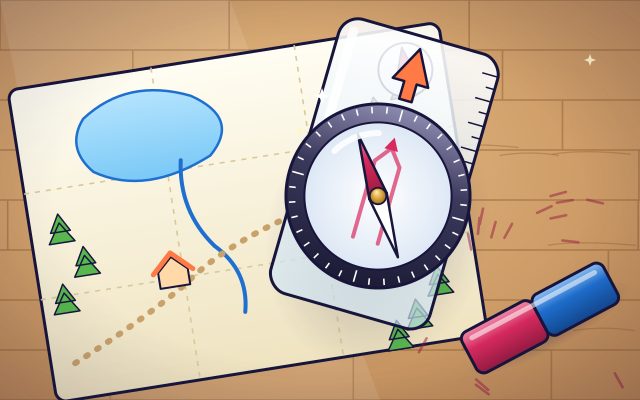
How does a magnetic compass find north?
Rotate a compass in a model magnetic field and compare its direction with a map.
#479
Measuring & instruments
How does a magnetic compass find north?
Rotate a compass in a model magnetic field and compare its direction with a map.
 #480
Measuring & instruments
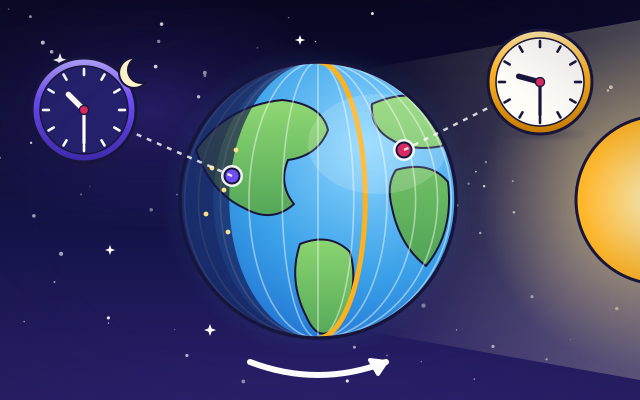
How do time zones work?
Compare local clock readings around a globe and explore coordinated standard times.
#480
Measuring & instruments
How do time zones work?
Compare local clock readings around a globe and explore coordinated standard times.
 #101
Measuring & instruments
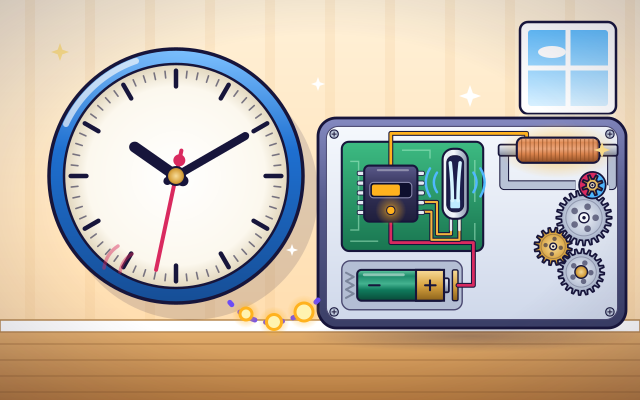
How do quartz clocks and digital watches keep time?
Watch quartz vibrations become counted electrical pulses that advance clock hands or a digital display.
#101
Measuring & instruments
How do quartz clocks and digital watches keep time?
Watch quartz vibrations become counted electrical pulses that advance clock hands or a digital display.
Keep exploring
Games to play next
- Clock TowerKeep the town on time: set the tower clock's hands just right.
- Mapmaker QuestFollow directions to make a map, then read its legend, compass rose and scale.
- Data DetectiveRead the clues hidden in graphs — and build your own.
Guide for grown-ups
- How to start homeschooling: a step-by-step guide for familiesA guide for parents · 7 min read
Science games by grade
Science worksheets by grade
- Preschool Science Worksheets
- Pre-K Science Worksheets
- Kindergarten Science Worksheets
- 1st Grade Science Worksheets
- 2nd Grade Science Worksheets
- 3rd Grade Science Worksheets
- 4th Grade Science Worksheets
- 5th Grade Science Worksheets
- 6th Grade Science Worksheets
- 7th Grade Science Worksheets
- 8th Grade Science Worksheets